Executive Summary / Opening Intelligence
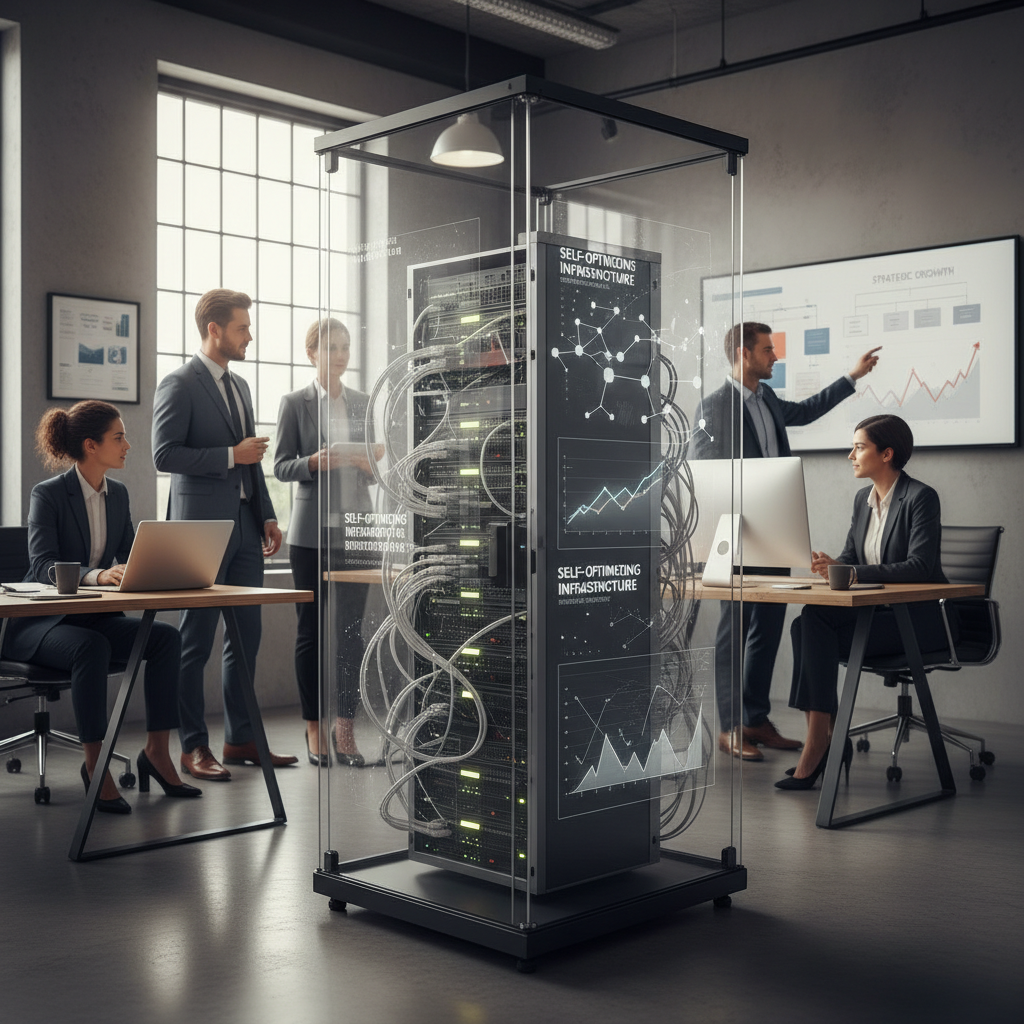
The Event: The operational paradigm for technology startups is undergoing a fundamental transformation. Rather than relying solely on human teams for infrastructure management, artificial intelligence is increasingly being deployed as an "algorithmic architect." This new approach automates the design, deployment, monitoring, and self-healing of IT infrastructure, moving beyond simple automation to genuine self-optimization. The shift signifies a maturation of AIOps principles, making them accessible and crucial for nascent enterprises.
Why Now: This moment is pivotal because the economic pressures on startups are intensifying. Cloud costs, coupled with the escalating salaries and scarcity of skilled DevOps and Site Reliability Engineers (SREs), are threatening many startups' viability. Concurrently, AI technologies – particularly in machine learning for pattern recognition and predictive analytics – have reached a sufficient level of sophistication to reliably address complex operational challenges. For a startup, leveraging this technology is no longer a futuristic vision but a strategic imperative to achieve capital efficiency and robust scalability without prohibitive operational expenditure. The industry is transitioning from reactive incident response to proactive, AI-driven infrastructure management, fundamentally reshaping how young companies can compete and grow.
The Stakes: The implications are substantial. For individual startups, the stakes include millions of dollars in potential cloud cost savings, avoidance of costly downtime that can decimate user trust and revenue, and the ability to scale globally with lean teams. Industry-wide, the successful application of AI in this domain could redefine competitive landscapes, allowing innovators with superior algorithmic architects to outmaneuver well-funded incumbents burdened by legacy operational models. Conversely, failure to adopt these strategies risks higher burn rates, slower innovation cycles, and eventual market displacement.
Key Players: The primary actors driving this shift include hyperscale cloud providers such as AWS (with services like DevOps Guru and CodeGuru), Google Cloud (offering extensive operations tooling), and Microsoft Azure (featuring Azure Monitor with AI insights). AIOps and observability platform leaders like Datadog, Dynatrace, and New Relic are continuously expanding their AI capabilities. A new cohort of specialized startups, exemplified by FinOps tools from companies like Harness and Zesty, are also key, focusing specifically on AI-driven cloud cost optimization. Underlying this proprietary ecosystem are robust open-source foundations such as Kubernetes, Prometheus, Grafana, and OpenTelemetry, which democratize access to the building blocks for AI-driven infrastructure.
Bottom Line: For decision-makers, the message is clear: integrating AI into your infrastructure strategy is no longer optional. It's a critical differentiating factor that enables unprecedented operational efficiency, resilience, and accelerated product delivery. Startups that embrace this paradigm will not only survive but thrive by transforming their operational overhead into an automated, strategic advantage, enabling them to focus scarce resources on core product innovation rather than repetitive infrastructure woes.
Multi-Dimensional Strategic Analysis
Historical Context & Inflection Point
The journey of infrastructure management, particularly for technology startups, has been a rapid and continuous evolution, driven by the escalating demands of software and user bases. In the nascent days of the internet, infrastructure was largely monolithic, manually provisioned, and managed by a few dedicated system administrators. Downtime was frequent, scaling was slow, and reliability was often an afterthought.
Timeline with specific dates:
- Early 2000s: The rise of virtualization began to abstract hardware, but provisioning remained largely manual or script-based. Companies like VMware paved the way for more efficient resource utilization.
- Mid-2000s (circa 2006): AWS launched EC2, inaugurating the era of Infrastructure-as-a-Service (IaaS). This allowed on-demand provisioning of compute, storage, and networking, shifting CAPEX to OPEX and significantly lowering startup barriers for entry.
- Early 2010s (circa 2011): The emergence of Infrastructure as Code (IaC) tools like Chef and Puppet, followed by Ansible (2012) and Terraform (2014), revolutionized configuration management. It allowed infrastructure to be defined, versioned, and deployed programmatically, bringing engineering rigor to operations. This was a critical step towards automated, repeatable deployments.
- Mid-2010s (circa 2014): Docker's popularization of containers and Google's open-sourcing of Kubernetes (2014) ushered in the containerization era. This provided unparalleled portability, efficiency, and resource isolation for applications, becoming the de facto standard for deploying microservices. Orchestration simplified large-scale deployments but also introduced new layers of complexity.
- Late 2010s (circa 2017 onwards): Observability platforms (Prometheus, Grafana, OpenTelemetry) moved beyond basic monitoring to provide deeper insights into system health and performance. This data-rich environment became the fertile ground for AI's entry into IT operations.
- Early 2020s: The AIOps revolution gained significant traction. AI/ML algorithms began to move from descriptive analytics (what happened) to diagnostic (why it happened), predictive (what will happen), and prescriptive (what to do about it) analytics.
Failed predictions & lessons: Early predictions often focused on "lights-out" data centers where human intervention would be entirely eliminated. While full autonomy remains elusive and undesirable in many critical scenarios, the lesson learned is that AI's strength lies in augmenting human capabilities, handling routine tasks, identifying subtle patterns, and accelerating decision-making, rather than completely replacing human expertise. The importance of observability and clean, comprehensive data for any AI application was also profoundly underestimated initially. Without high-quality data, AIOps systems quickly devolve into "garbage in, garbage out" scenarios, eroding trust.
Why THIS moment matters: This particular moment is an inflection point for startups because the convergence of several factors makes AI-driven infrastructure not just viable, but essential. Firstly, the sheer scale and complexity of cloud-native architectures, especially those leveraging microservices and serverless functions, have outstripped human capacity for manual oversight. Secondly, the economic climate demands unprecedented capital efficiency; every dollar spent on operational overhead is a dollar not invested in product development or market expansion. Thirdly, the maturity of AI frameworks and the availability of vast operational datasets mean that AI models are now capable of delivering tangible, measurable improvements in uptime, cost, and developer velocity. This enables startups to achieve operational resilience and scalability that previously required large SRE teams, thus democratizing access to enterprise-grade operational excellence. For a startup, this technology represents a profound strategic tool for competitive advantage and sustainable growth.
Deep Technical & Business Landscape
The application of AI to infrastructure, often encapsulated by the term AIOps, transcends simple scripting or rule-based automation. It leverages sophisticated machine learning models to analyze vast streams of operational data, identify patterns, predict failures, and enact self-healing or optimization actions. This capability is rapidly becoming a cornerstone for any startup aiming to achieve robust, scalable, and cost-efficient operations.
Technical Deep-Dive: At its core, AIOps relies on ingesting, processing, and analyzing diverse data sources from the infrastructure landscape. This includes logs, metrics (CPU, memory, network I/O, application-specific metrics), traces (end-to-end request flows), event data, and configuration changes. Observability tools like OpenTelemetry provide standardized ways to collect this data, while platforms like Prometheus and Grafana offer robust storage and visualization. The AI layer then applies various machine learning techniques:
- Predictive Scaling: Time-series forecasting models (e.g., ARIMA, Prophet, or more advanced deep learning LSTMs) predict future load based on historical patterns, seasonality, and exogenous factors (e.g., marketing campaigns). This enables systems to proactively adjust resource allocations (e.g., increasing Kubernetes pod replicas, scaling up EC2 instances, or adjusting serverless function concurrency) before performance degradation occurs, optimizing both cost and availability.
- Anomaly Detection: Unsupervised learning algorithms (e.g., Isolation Forest, One-Class SVMs, or neural networks like Autoencoders) are crucial here. They establish a baseline of "normal" system behavior across multiple correlated metrics. Any significant deviation from this baseline, even subtle ones that a human might miss, triggers an alert. Examples include sudden drops in successful API calls, unusual spikes in database latency, or unexpected changes in network traffic patterns. These anomalies often precede major outages, providing an early warning system.
- Automated Root Cause Analysis (RCA): This is arguably the most complex and invaluable aspect. By correlating data across different layers (application, infrastructure, network) and types (logs, metrics, traces), AI can pinpoint the likely cause of an incident. Techniques include graph databases to model dependencies, natural language processing (NLP) on log data to extract error patterns, and causal inference models. For instance, if an application's latency spikes, the AI might correlate it with recent database connection pool exhaustion events from logs, a sudden increase in garbage collection activity from JVM metrics, and a new code deployment detected in CI/CD logs, quickly identifying a faulty release as the root cause. This drastically reduces Mean Time To Resolution (MTTR).
- Self-Healing & Automated Remediation: This capability integrates the AI's diagnostic power with automated action. Once an anomaly is detected and a likely root cause identified, the AI system can trigger pre-defined or even dynamically generated remediation actions. This might involve restarting a problematic service, rolling back a recent deployment, adjusting a configuration parameter within a Kubernetes manifest, or isolating a faulty microservice. Integration with CI/CD pipelines and cloud provider APIs (like AWS Lambda, Azure Functions, or GCP Cloud Functions for event-driven actions) is critical for these automated responses. Trust in these systems is paramount, often built through progressively increasing automation levels, starting with suggested actions before autonomous execution.
Business Strategy: For startups, the business strategy revolves around achieving "operational leverage" through AI. This means accomplishing more with less, turning infrastructure from a cost center into a strategic enabler.
Player Breakdown with Specifics:
- Hyperscale Cloud Providers (AWS, GCP, Azure): They offer native AIOps-lite solutions (e.g., AWS DevOps Guru, CloudWatch anomaly detection, Azure Monitor Insights). Their core business strategy is to lock customers into their ecosystem by providing comprehensive, integrated services. Startups leveraging these often benefit from deep integration with other cloud services and reduced vendor sprawl. The challenge is multi-cloud portability and potential vendor lock-in.
- AIOps & Observability Platforms (Datadog, Dynatrace, New Relic): These are full-stack offerings that aggregate data across diverse environments (on-prem, multi-cloud, hybrid). Their business strategy is to be the single pane of glass for operational intelligence. They provide advanced AI-driven features, extensive integrations, and often sophisticated user interfaces. For funded startups, they offer a powerful out-of-the-box solution, but their cost can be significant. Datadog, for example, excels in its breadth of integrations and intuitive dashboards, critical for a startup learning its infrastructure. Dynatrace's OneAgent provides deep code-level insights and automated topology mapping, enhancing RCA.
- Emerging Specialists & Open Source: This category is crucial for lean startups.
- FinOps Tools (Harness, Zesty): These startups focus explicitly on using AI to optimize cloud spending. Harness, for instance, offers AI-powered cloud cost management that can automatically right-size resources and identify waste. Zesty specializes in autonomous cloud cost optimization through intelligent compute resizing and committed use discount management. Their business strategy is to cut massive cloud bills, offering direct ROI that can be immediately quantified.
- Open Source Foundations (Kubernetes, Prometheus, Grafana, OpenTelemetry): These form the backbone for startups opting to "build their own" AIOps. The strategy here is cost reduction and maximum flexibility. While requiring significant in-house expertise for integration and maintenance, these tools provide unparalleled control and prevent vendor lock-in. A startup with a strong engineering culture might build custom AI models on top of Prometheus metrics and Elasticsearch logs, feeding into a custom automation engine. Mentoring within the engineering team becomes vital here, fostering deep operational knowledge.
Product Positioning, Pricing: AIOps offerings are generally positioned as solutions for complexity, cost reduction, and enhanced reliability. Pricing models vary:
- Cloud providers often use consumption-based models (e.g., data ingested, API calls).
- SaaS AIOps platforms typically charge per host, per container, or per data ingested, with tiered functionality.
- FinOps tools often use a percentage of savings generated, aligning their success directly with the customer's cost reduction.
Partnerships, Competitive Advantages: Strategic partnerships include integrations with major cloud providers, CI/CD tools (e.g., Jenkins, GitLab CI), and incident management platforms (e.g., PagerDuty). For a startup, the competitive advantage derived from AI-driven infrastructure is multi-faceted:
- Reduced Operational Overhead: Significantly lower need for large, expensive SRE teams, allowing engineering talent to focus on product innovation.
- Faster Time-to-Market: Automated infrastructure provisioning and self-healing reduce deployment friction and accelerate iteration cycles.
- Enhanced Resilience: Proactive issue detection and automated remediation lead to higher uptime and a better user experience.
- Cost Optimization: AI-driven resource right-sizing and waste identification directly impact the bottom line, preserving critical runway.
- Scalability: The ability to scale infrastructure automatically in response to demand, enabling rapid growth without manual intervention. This technological edge directly translates to business agility, a paramount concern for any startup.
Economic & Investment Intelligence
The economic implications of AI-driven infrastructure for startups are profound, influencing investment decisions, valuations, and the broader market landscape. This technology represents a crucial lever for operational efficiency, directly impacting a startup's burn rate and runway – critical metrics for investors.
Funding Rounds, Valuations, Lead Investors: The AIOps and cloud cost optimization space has seen significant investment activity. Companies like Datadog have achieved multi-billion dollar valuations and successful IPOs, reflecting investor confidence in the long-term value of unified observability and AI-driven insights. In recent years, companies specializing in FinOps, such as Zesty.ai and Harness, have secured substantial funding rounds (e.g., Zesty raising over $20M in Series B, Harness regularly securing hundreds of millions in various rounds from investors like Battery Ventures, IVP, GV, and Capital One Ventures) precisely because they promise tangible, quantifiable cost savings for cloud-heavy enterprises and startups. Investors are actively seeking startups that can demonstrate a clear, defensible technological advantage in managing the complexities of modern cloud infrastructure, recognizing that operational excellence through AI directly reduces risk and enhances profitability. Lead investors in this space often include top-tier venture capital firms with a deep understanding of enterprise SaaS and infrastructure software, such as Andreessen Horowitz, Sequoia Capital, Lightspeed Venture Partners, and various corporate venture arms of tech giants looking for strategic integrations.
VC Strategy, Public Market Implications:
- VC Strategy: Venture capitalists are increasingly looking for startups that embed AI into their core operations from day one, rather than as an afterthought. This signals a forward-thinking approach to capital efficiency and scalability. VCs are keen on solutions that enable "lean SRE" models, where small teams can manage vast, complex infrastructures. Investments are flowing into companies offering vertical-specific AIOps solutions, solutions that integrate seamlessly with existing cloud ecosystems, and those providing clear ROI metrics around cost savings or improved reliability. Startups seeking funding are expected to articulate how their technology strategy, especially concerning infrastructure, contributes to economic defensibility and accelerated growth.
- Public Market Implications: For public companies, AI-driven infrastructure translates to better financial performance. Reduced operational expenditure, higher availability (leading to consistent revenue), and faster feature delivery all contribute to stronger investor sentiment and higher stock valuations. Companies successfully implementing AIOps demonstrate superior operational maturity, which is attractive to institutional investors. The market is rewarding companies that showcase efficient scaling and responsible spending, particularly in a tighter economic climate, making AI for operational optimization a key part of the public market narrative.
M&A Activity, Industry Disruption: M&A activity in the AIOps and observability space is robust. Larger players like Cisco acquiring a company like AppDynamics (2017) or Splunk acquiring companies like SignalFx (2019) and Omnition (2019) demonstrate a strategic imperative to integrate AIOps capabilities into comprehensive enterprise offerings. Hyperscalers also look to acquire specialized tooling to enhance their native services. This trend indicates that the market views AI-driven infrastructure as a fundamental, non-optional component of future enterprise IT. The industry disruption is significant: traditional IT services firms that relied on hourly billing for manual operations are facing existential threats. Startups leveraging AI can displace incumbents by offering superior reliability and lower costs. Furthermore, the barrier to entry for new startups with complex infrastructure needs is lowered. A small team, armed with cutting-edge AI-driven tools, can manage a globally distributed, high-traffic application more effectively than a much larger, traditionally staffed operations department. This empowers disruptive innovation by freeing up engineering talent from mundane operational tasks, allowing them to focus on unique product features – a core strategy for achieving market leadership.
Geopolitical & Regulatory Deep-Dive
The deployment and governance of AI-driven infrastructure, particularly within the sensitive operational layers of a startup, are increasingly subject to geopolitical and regulatory influences. While AIOps might seem purely technical, its widespread adoption intersects with data sovereignty, national security, and privacy concerns, demanding careful consideration from startups operating globally.
US Policy, EU Regulations, China Strategy:
- US Policy: In the United States, the policy landscape emphasizes innovation (e.g., through initiatives promoting AI research and development) while also addressing national security concerns. The National Institute of Standards and Technology (NIST) has developed an AI Risk Management Framework, which, while voluntary, provides guidelines for trustworthy AI, including aspects relevant to AIOps like explainability, reliability, and security. Given that AIOps systems often have privileged access to critical infrastructure, their security and resilience against cyber threats are paramount. US policy generally encourages market-driven solutions but maintains oversight on critical infrastructure protection.
- EU Regulations: The European Union is at the forefront of AI regulation with its proposed AI Act. This landmark legislation categorizes AI systems by risk level and imposes stringent requirements for high-risk AI, which could encompass AIOps platforms controlling essential services or infrastructure. Requirements include data governance, technical robustness and accuracy, human oversight, and explainability. For startups building or deploying AI-driven infrastructure solutions, particularly if they process EU citizen data or operate critical services within the EU, compliance will be a complex but mandatory undertaking. The General Data Protection Regulation (GDPR) also plays a critical role, as AIOps systems ingest vast amounts of operational data, some of which may contain personal data. Ensuring data minimization, anonymization, and secure processing is essential.
- China Strategy: China's approach to AI is characterized by strong state-led investment and a focus on accelerating technological leadership. Its policies (e.g., the New Generation Artificial Intelligence Development Plan) aim to make China a global AI leader by 2030. For AI-driven infrastructure, this means state-backed entities actively developing and deploying AIOps solutions, often with a focus on efficiency and control. Data localization requirements and national security laws (like the Cybersecurity Law and Data Security Law) are stringent. Any startup operating in or serving the Chinese market with AI-driven infrastructure must navigate a complex web of compliance mandates, including potential data transfer restrictions and requirements for algorithms to be transparent to regulators.
US-China Competition, Strategic Implications: The technological competition between the US and China extends directly into AI and infrastructure. Both nations view AI capabilities, including those applied to critical infrastructure, as strategic national assets. This competition can manifest in:
- Supply Chain Resilience: Concerns about the origins of hardware and software components used in AIOps systems, potentially leading to restrictions on certain vendors or technologies. Startups must be aware of their supply chain dependencies and potential geopolitical risks.
- Data Sovereignty: The increasing demand for data to be stored and processed within national borders. A startup using a global AIOps provider might need to ensure regional data centers for compliance.
- Export Controls: Restrictions on the export of advanced AI technologies, which could impact startups developing cutting-edge AIOps solutions for international markets or using specific AI models.
- Talent Geopolitics: Competition for AI talent, which could lead to shifts in immigration policies or increased incentives for domestic talent development, impacting a startup's ability to hire skilled experts for building and maintaining these complex systems.
Regulatory Timeline: While a complete global regulatory framework for AI is still evolving, the trend is towards increased oversight.
- Immediate (0-12 months): Increased scrutiny of data privacy in AIOps systems under existing regulations like GDPR and CCPA. Early guidelines from NIST and similar bodies globally will start shaping best practices. Startups should prioritize data anonymization and robust access controls.
- Mid-term (1-3 years): Implementation and enforcement of comprehensive AI regulations like the EU AI Act. This will necessitate significant investment in compliance measures, including auditing, risk assessments, and robust documentation for high-risk AIOps applications. Startups should begin internal audits of their AI systems to identify potential compliance gaps.
- Long-term (3-5 years): Harmonization, or at least interoperability, of various national and regional AI regulations. This could lead to internationally recognized standards for AI trustworthiness and security in critical infrastructure. Companies with a global footprint will benefit from modular, adaptable AIOps solutions that can be configured to meet diverse regional requirements.
For startups, navigating this landscape requires a proactive and informed strategy. Ignoring geopolitical and regulatory shifts is not an option; integrating these considerations into the design and deployment of AI-driven infrastructure is essential for long-term viability and global scalability. This foresight becomes a crucial aspect of overall business mentoring, guiding founders not just on technical execution but also on responsible technological stewardship.
Future Forecasting & Strategic Implications
The trajectory of AI in infrastructure is not just incremental improvement; it promises a redefinition of operational norms, competitive landscapes, and even the fundamental structure of technology companies. For startups, understanding this future is crucial for crafting enduring strategy.
Near-Term Horizon (6-12 months): Immediate Catalysts
The next 6-12 months will see specific catalysts accelerate the adoption and sophistication of AI-driven infrastructure, providing immediate strategic opportunities for agile startups.
Events to watch, early signals:
- Enhanced Generative AI Integration: The rapid evolution of large language models (LLMs) will lead to more intuitive and powerful AIOps interfaces. Beyond simply detecting anomalies, AI will be able to generate natural language explanations for complex incidents, suggest verbose remediation steps, or even write small code snippets for automated fixes. For instance, an alert might not just say "High CPU on DB server," but "AI detected a 150% spike in CPU utilization on
db-replica-03primarily due to along-running queryoriginating fromservice-X, which was deployed at 14:00 UTC. Consider rolling backservice-Xor optimizingquery-UUID-123. See logs for details." This leap in explanatory power dramatically reduces the cognitive load on engineers, accelerating MTTR. - Cloud Provider AI Feature Wars: AWS, GCP, and Azure will continue to aggressively release new, more integrated AI features within their monitoring and management suites (e.g., more sophisticated predictive analytics, automated FinOps recommendations). Startups should meticulously track these releases, as native cloud solutions often offer cost efficiencies and seamless integration that third-party tools may struggle to match. Early adopters of these features will gain immediate operational advantages.
- Specialized FinOps AI Tools Proliferation: The economic downturn will further emphasize cloud cost optimization. Startups like Zesty, Harness, and others will gain significant traction, offering AI-driven solutions that granularly analyze cloud spend and automatically adjust resources, purchase savings plans, or identify unused resources. Adoption of these tools will become a key performance indicator for CFOs and CTOs.
- Talent Scarcity Drives Automated Skill Transfer: As the talent gap for SREs and DevOps engineers widens, AI will increasingly be used to codify institutional knowledge. This involves using machine learning to learn from incident response playbooks, troubleshooting logs, and expert interactions to build more robust automated remediation sequences.
- Enhanced Generative AI Integration: The rapid evolution of large language models (LLMs) will lead to more intuitive and powerful AIOps interfaces. Beyond simply detecting anomalies, AI will be able to generate natural language explanations for complex incidents, suggest verbose remediation steps, or even write small code snippets for automated fixes. For instance, an alert might not just say "High CPU on DB server," but "AI detected a 150% spike in CPU utilization on
First-mover advantages, strategic plays:
- Aggressive Cloud Cost Optimization: Startups that implement AI-powered FinOps solutions immediately will unlock significant capital, extending runway and providing a competitive edge in investment rounds. This frees up budget for core product development.
- Proactive Resilience Engineering: Deploying AI for predictive scaling and robust anomaly detection earliest means fewer outages. Uptime translates directly to customer trust and retention, particularly in competitive markets where switching costs are low.
- "Small Dev, Big Ops" Model: Leveraging AI for infrastructure allows a smaller, highly skilled engineering team to manage complex operations that would traditionally require a much larger SRE team. This fosters a culture of innovation by minimizing operational toil and maximizing time spent on feature development.
- Data-Driven Development Feedback Loops: AI insights from operational data can be fed back into the development process, improving code quality, identifying performance bottlenecks in pre-production, and promoting a "shift-left" approach to operational excellence. This tight feedback loop is a key characteristic of successful startup evolution.
Mid-Term Horizon (2-3 years): Industry Restructuring
Over the next 2-3 years, the pervasive adoption of AI in infrastructure will not just optimize existing systems but fundamentally restructure industries, displacing traditional players and creating new giants.
Displaced industries, new giants:
- Traditional MSPs and IT Outsourcing: Managed Service Providers (MSPs) that rely on manual monitoring, alert triaging, and reactive incident response will face severe pressure. AI-driven platforms can perform these tasks with greater speed and accuracy at a fraction of the cost, displacing MSPs that fail to adopt advanced automation. New giants will emerge as "AI-native MSPs" or "Operational AI-as-a-Service" providers, offering outcomes (e.g., 99.999% uptime, X% cloud cost reduction) rather than just human hours.
- Legacy Monitoring Solutions: Standalone monitoring tools lacking integrated AI capabilities will become obsolete. The market will consolidate around comprehensive AIOps platforms that offer full-stack observability with sophisticated machine learning at their core.
- Specialized Consultancy Firms: While high-level strategic consultancy will remain, firms specializing in basic cloud migrations or manual optimization will be challenged. The AI will automate much of the analysis that used to be a consultant's purview.
- The Rise of the "Algorithmic Operations Engineer": The role of the SRE will evolve. Instead of being primary responders, they will become architects and maintainers of the AI systems that manage infrastructure, focusing on training models, verifying outputs, and intervening in novel failure modes the AI hasn't learned yet.
Value chain shifts, workforce transformation:
- Shift Left in Operations: Observability and operational considerations will be pushed even further left into the development lifecycle. Developers will gain immediate AI-powered feedback on the operational impact of their code changes before deployment, fostering a culture of "ops-aware development."
- Augmented Decision Making: Human engineers will spend less time gathering data and diagnosing problems, and more time making high-level strategic decisions, designing resilient systems, and handling unique, complex incidents that require creative human problem-solving skills.
- Skills Premium for AI/ML and Data Engineering: The workforce will pivot towards roles requiring expertise in machine learning, data science, data engineering (for AIOps data pipelines), and AI model governance. Traditional system administration skills will need to be augmented with these new capabilities. Investment in mentoring and upskilling programs will be critical to navigate this transformation.
- "Ops by Default": Infrastructure operations will become an inherent, largely automated component of software development, rather than a separate, siloed discipline.
Competitive positioning, revenue inflection:
- Differentiation on Operational Excellence: Startups will compete not just on features, but on the perceived reliability, performance, and cost-effectiveness of their products, which is directly tied to their AI-driven infrastructure. Companies with superior AIOps will command higher customer loyalty and market share.
- Faster Product Cycles: The ability to deploy new features and services with significantly reduced operational friction will enable faster innovation and responsiveness to market demands, driving revenue inflection by capturing emerging opportunities more rapidly.
- Global Scaling with Regionalized Efficiency: AI will enable startups to scale their infrastructure globally with greater efficiency, localizing resources and optimizing costs based on regional demand patterns, expanding market reach with minimal additional operational burden.
- Financial Agility: The ability to precisely manage cloud spend through AI means startups can pivot strategies, launch new initiatives, or weather economic downturns with greater financial agility, ensuring a longer runway for growth and accelerating their path to profitability. This strategic application of technology will become a cornerstone of sustainable startup growth.
Long-Term Vision (5 years): Civilizational Impact
Looking five years out, the broad application of AI-driven infrastructure will permeate beyond business operations, inducing profound civilizational shifts in economic structures, geopolitical dynamics, and fundamental human capabilities.
Societal transformation, economic structure:
- Ubiquitous "Invisible" Infrastructure: The concept of infrastructure management as a distinct human function will largely disappear from public consciousness, akin to how electricity generation is mostly invisible to end-users. Critical digital services will simply "work" with extremely high reliability, managed by self-optimizing AI networks.
- Reallocation of Human Capital: Millions of operational, monitoring, and response roles in IT will be automated. This frees up vast human capital, forcing a societal shift towards creative, strategic, and human-centric roles (e.g., AI trainers, ethicists, designers, complex problem solvers). Governments and educational institutions will need to adapt rapidly, focusing on lifelong learning and adaptive skills. The concept of mentoring will extend deeply into retraining and career transition programs.
- Enhanced Economic Efficiency: The dramatic reduction in operational costs for digital services will lower barriers to entry for new businesses globally, fueling a new wave of innovation and potentially stimulating unprecedented economic growth. AI-managed logistics, energy grids, and resource allocation systems will drastically improve efficiency across entire economies.
- Hyper-Resilient Critical Infrastructure: AI will manage national power grids, communication networks, transportation systems, and financial market infrastructure with unprecedented resilience, minimizing large-scale failures and reducing systemic risks.
Geopolitical order, human capability:
- AI as a Strategic National Asset: Nations with superior AI capabilities in infrastructure management will possess a significant strategic advantage, directly impacting economic competitiveness and national security. The ability to defend, optimize, and resiliently operate national digital infrastructure will be a cornerstone of geopolitical power. This could exacerbate the US-China tech rivalry, making AI capabilities in this domain a key measure of technological leadership.
- Cyber Warfare Redefined: AI-driven defenses will necessitate AI-driven offenses. The "invisible war" in cyberspace will be fought between sophisticated AI systems, with human oversight focused on high-level strategy and adaptation to novel threats. Nations that can deploy self-healing, AI-managed cyber defenses will be far more resilient.
- Human-AI Symbiosis: Human intelligence will increasingly be augmented by AI, not just in IT operations, but across all domains. This allows individuals to tackle problems of greater complexity, enhancing overall human capability and collective intelligence. Engineers, scientists, and even policymakers will rely on AI to parse vast datasets and suggest optimal strategies for managing complex systems.
- Ethical AI Governance Imperative: The widespread deployment of autonomous AI in critical infrastructure will necessitate robust ethical AI frameworks, governance models, and audit mechanisms to ensure fairness, accountability, and transparency. The "black box" problem becomes a civilizational challenge, requiring international cooperation to ensure these powerful systems operate for the good of all, rather than inadvertently causing harm or misuse.
Executive Conclusion & Strategic Takeaways
Bottom Line Assessment: The strategic integration of AI into infrastructure management represents a fundamental, non-negotiable paradigm shift for startups. Our assessment, with high confidence, is that early and deliberate adoption of AI as an "algorithmic architect" will differentiate market leaders from those struggling with operational overhead. This isn't just about incremental efficiency; it's about enabling a step-function change in scalability, resilience, and capital utilization. Startups that master this will unlock disproportionate competitive advantages, extending their runway and accelerating their path to sustained growth and profitability.
Key Insights Summary:
- Operational Leverage is Paramount: AI offers startups unprecedented operational leverage, allowing lean teams to manage complex, global infrastructure with efficiency previously reserved for much larger enterprises. This directly impacts burn rate and investor attractiveness.
- Cost Optimization is a Strategic Imperative: AI-driven FinOps tools are becoming essential. Proactively implementing these can free up significant capital, allowing reallocation to core product development and market expansion.
- Resilience as a Differentiator: Automated anomaly detection, predictive scaling, and self-healing systems provide a superior level of uptime and performance, building customer trust and providing a crucial competitive edge.
- The Evolving Role of Engineering Talent: The future SRE and DevOps engineer will be an architect of AI systems, rather than a manual operator. Startups must invest in skill transformation and mentoring to adapt their workforce.
- Navigating Regulatory and Geopolitical Complexities: AI-driven infrastructure, especially for global operations, is not immune to regulatory pressures and geopolitical dynamics. Proactive compliance and strategic foresight are crucial for long-term viability.
- AI-Native Development is the Future: Embedding AI into infrastructure strategy from day one facilitates faster iteration, more reliable deployments, and a seamless feedback loop between operations and development.
- Open Source Remains a Core Enabler: For cost-conscious startups, leveraging robust open-source foundations (Kubernetes, Prometheus, OpenTelemetry) combined with custom AI logic offers unparalleled flexibility and cost control.
The Big Question: In a future where digital infrastructure operates with near-perfect autonomy and efficiency, and human operators primarily manage the AI orchestrators, what new problems will emerge to challenge the next generation of entrepreneurial minds, and how will humanity’s fundamental relationship with technology evolve as more critical functions become self-governing?