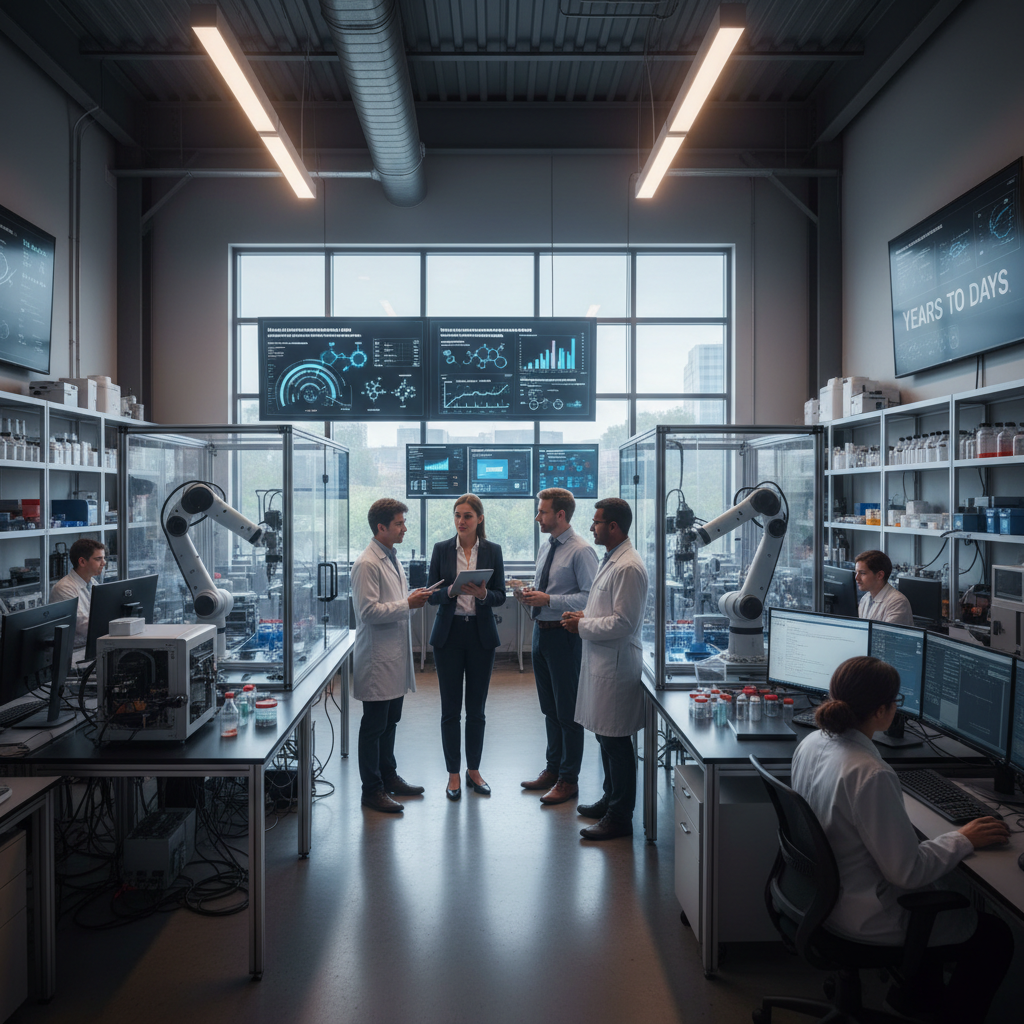
Executive Summary / Opening Intelligence
The Event: A pivotal advancement in AI-driven autonomous laboratories, spearheaded by researchers at North Carolina State University and published in Nature Chemical Engineering in July 2025, has demonstrated a new dynamic flow experimental technique. This breakthrough allows self-driving chemistry labs to collect at least 10 times more data at record speeds, fundamentally reshaping the landscape of materials discovery. This innovation moves beyond traditional steady-state experiments to a continuous, real-time data acquisition model, significantly accelerating the feedback loop for machine learning algorithms.
Why Now: This development is critical today because it directly addresses the persistent bottleneck in R&D: the painfully slow and resource-intensive process of experimental validation. While AI has become highly adept at generating novel material hypotheses, the physical testing has lagged. This new methodology provides the missing link, enabling self-driving labs to validate hypotheses with unprecedented speed and efficiency. The timing aligns with a global imperative to rapidly innovate in sustainable energy, healthcare, and advanced manufacturing, making this acceleration a strategic national advantage.
The Stakes: The implications are colossal. Traditional materials discovery averages a 20-year timeline from concept to market, costing billions. By compressing this cycle from years to days, the economic value creation potential is in the trillions of dollars over the next decade. Industries such as batteries, photovoltaics, pharmaceuticals, and catalysts stand to benefit most directly, unlocking new markets and disrupting established ones. Countries that lead in autonomous lab deployment will gain significant competitive advantages in critical emerging technologies, influencing global economic power dynamics. Lagging could mean ceding leadership in key strategic sectors.
Key Players: North Carolina State University researchers, specifically those involved in the Nature Chemical Engineering publication, are at the forefront of this specific experimental breakthrough. The National Science Foundation (NSF) and the University of North Carolina Research Opportunities Initiative program provided crucial funding. Beyond this, key entities include institutions like SLAC National Accelerator Laboratory, Pacific Northwest National Laboratory, Lawrence Berkeley National Laboratory, and industry giants like Google (DeepMind), IBM, and startups such as Kebotix and Schrödinger. Governmental bodies like the U.S. Department of Energy (DOE) and the National Renewable Energy Laboratory (NREL), which convened the Autonomous Research for Real-World Science (ARROWS) workshop in May 2025, are actively shaping policy and investment. Academia, government labs, and venture-backed private enterprises are all converging on this domain.
Bottom Line: For decision-makers, this is not merely an incremental improvement; it's a paradigm shift. Autonomous labs, now supercharged by dynamic flow experimentation, are becoming indispensable tools for rapid innovation. Strategic investments in this technology infrastructure, talent development, and intellectual property will dictate future market leadership and national security in the material sciences. The question is no longer if self-driving science will dominate R&D, but how quickly organizations can integrate and leverage its capabilities to outmaneuver competitors and solve pressing global challenges.
Multi-Dimensional Strategic Analysis
Historical Context & Inflection Point
The concept of automated experimentation has a rich history, tracing roots back to early industrial automation in the 20th century. However, the convergence of advanced robotics, sophisticated machine learning algorithms, and high-throughput analytical techniques in the 21st century has propelled us into the era of true "self-driving science." Before 2000, laboratory automation was largely about increasing throughput for well-defined, repetitive tasks, lacking the embedded intelligence for autonomous decision-making. The early 2000s saw the rise of combinatorial chemistry and high-throughput screening, which systematized the rapid generation and testing of large libraries of compounds, particularly in pharmaceuticals. Yet, these systems still relied heavily on human oversight for hypothesis generation and experimental design.
A significant inflection point occurred around 2010-2015, with the maturation of deep learning and reinforcement learning algorithms. This allowed for the development of adaptive experimental design, where algorithms could learn from previous results and propose the next best experiment autonomously. Early self-driving labs, such as those pioneered at Stanford and the University of Toronto, demonstrated the potential to optimize reaction conditions or synthesize known materials more efficiently. For instance, in 2017, a self-driving lab at the University of Glasgow autonomously discovered new photoreactions under continuous flow conditions within days. Despite these successes, a critical limitation persisted: most autonomous systems relied on "steady-state" experimentation. This meant running a single, discrete reaction until equilibrium was reached, characterizing it, and then cleaning the system before the next experiment. This sequential nature, while faster than manual methods, still imposed significant time and resource constraints, leading to what many called "slow data" for the machine learning algorithms.
Many failed predictions in the past centered on the overestimation of AI's ability to handle the complexity and nuanced nature of real-world chemical reactions without sufficient, high-quality data. Early models often struggled with low data quality, irreproducibility, and the sheer dimensionality of chemical reaction spaces. The lesson learned was that superior AI requires superior data streams, not just larger ones. This specific July 2025 breakthrough by North Carolina State University marks the true inflection point because it fundamentally alters the data acquisition paradigm. By moving from discontinuous, steady-state measurements to continuous, dynamic flow monitoring, the system generates an order of magnitude more rich, real-time data points. This "streaming data" approach directly feeds into machine learning models, allowing them to make faster, more informed decisions. It's a shift from batch processing to real-time analytics in the physical world, enabling a qualitative leap in autonomous capability. This moment matters because it bridges the long-standing gap between AI's theoretical prediction power and its practical experimental validation efficiency, unlocking unprecedented rates of discovery.
Deep Technical & Business Landscape
Technical Deep-Dive
The technical brilliance of the dynamic flow system lies in its ability to transform discrete experimental data points into continuous data streams. Traditional self-driving labs using continuous flow reactors operate by setting predefined input parameters (e.g., reagent concentrations, temperatures), allowing the system to reach a steady state, then collecting a single data point representing the outcome. This process is then repeated for the next set of parameters. This approach, while automated, is inherently sequential and relatively slow, limiting the total data collected to the number of distinct experimental conditions tested.
The new dynamic flow approach, however, introduces a continuous variation of chemical mixtures through the system while monitoring in real-time. Instead of waiting for steady-state, parameters like concentration gradients or temperature ramps are continuously swept, and sensors embedded in the flow path continuously characterize the sample. This allows the system to capture data on what is taking place in the sample every half second. For instance, a single dynamic run exploring a gradient of reactant ratios from 0% to 100% could yield hundreds or thousands of data points, each representing a unique condition snapshot, whereas the steady-state approach would require dozens or even hundreds of discrete experiments to cover the same parameter space. This fundamental shift generates at least 10 times more high-quality experimental data over the same period, significantly enriching the dataset available to the machine learning algorithms. Critically, because the system never stops characterizing the sample, it captures transient phenomena and intermediate states that would be missed in steady-state measurements, providing a more complete picture of the reaction landscape.
The capability leaps are profound. The system can identify optimal material candidates on the very first try after training, a testament to the quality and quantity of data enabling more accurate model predictions. An example is the autonomous synthesis of 41 of 58 DFT-predicted, air-stable inorganic materials over 17 days, achieving a 71% success rate with minimal human intervention. This demonstrates an unprecedented level of predictive accuracy and experimental execution. The limitations, while greatly diminished, still exist. The complexity of certain reaction mechanisms, particularly those involving multi-phase systems or highly sensitive intermediates, may still challenge real-time characterization. Furthermore, the development of robust, real-time in situ sensors capable of accurately measuring diverse chemical properties across a wide parameter space remains an ongoing challenge. The reliance on highly sophisticated and often expensive analytical equipment also presents a barrier to widespread adoption. Finally, while the systems are autonomous, human researchers are still crucial for initial problem definition, data interpretation beyond the immediate scope, and the development of new characterization methods.
Business Strategy
The business landscape for autonomous labs is rapidly fragmenting and converging across several key player categories. Established technology giants like Google (DeepMind) and IBM are investing heavily, leveraging their AI and cloud computing expertise. DeepMind's AlphaFold, while not an autonomous lab, showcased the power of AI in scientific discovery, setting a precedent. IBM's AI for materials discovery initiatives, often in partnership with academic institutions, focus on leveraging their vast computational resources for simulation and prediction, which then feed into experimental systems. Their product positioning emphasizes integrated AI platforms for scientific R&D, often delivered as SaaS or PaaS solutions, targeting large enterprises and national labs.
Specialized startups are emerging as nimble innovators. Companies like Kebotix (founded 2017, >$30M raised) specialize in AI-powered discovery platforms for new materials, integrating robotics and ML to accelerate R&D. They often offer bespoke material discovery services and platform licenses. Others, like Schrödinger (publicly traded, $2B+ market cap), focus intensely on computational chemistry and materials science, providing a powerful simulation platform that can feed into autonomous experimental design. Their strategy involves continuous improvement of their predictive models and expanding into new therapeutic and material areas. Synthase and Chemspeed Technologies also play crucial roles, offering modular robotic platforms and integrated automation solutions that can be configured into self-driving labs. Their focus is on the hardware and integration layer, often partnering with AI software providers.
Academic spin-offs and national laboratories are critical players, often at the cutting edge of scientific breakthroughs. Institutions like North Carolina State University, UC Berkeley, Caltech, and national labs such as NREL and SLAC, are not only conducting foundational research but also developing prototypes and open-source frameworks that reduce barriers to entry. Their competitive advantage often lies in unique intellectual property and specialized expertise, fostering collaboration over direct competition in many cases through consortia and grant-funded projects.
Product positioning across these players ranges from full-stack solutions (AI prediction + autonomous experimentation + data analysis) offered by some startups and big tech, to modular components (e.g., specialized robotic arms, AI prediction software, automated analysis tools) offered by others. Pricing models vary from subscription-based access to software platforms, project-based discovery contracts, to capital expenditure for lab hardware.
Partnerships are crucial. Big tech companies partner with academic institutions to gain access to cutting-edge research and talent. Startups often partner with hardware manufacturers to integrate their AI with robust robotic systems, and with large corporations to validate their platforms on real-world industry challenges. For instance, a major chemical company might partner with Kebotix to discover a new polymer, leveraging Kebotix's autonomous platform.
The competitive advantages of leading players hinge on:
- Proprietary AI/ML Algorithms: The sophistication and accuracy of models that can predict optimal experiments and interpret complex data rapidly.
- Integrated Robotics & Automation: Seamless software-hardware integration for robust, high-throughput, and reproducible experimentation.
- Data Generation & Management: The ability to efficiently generate, collect, store, and analyze massive amounts of experimental data, especially with dynamic flow systems.
- Domain Expertise: Deep understanding of specific material science or chemical spaces, allowing for more targeted and efficient discovery.
- IP Portfolio: Patents on both the technological stack (algorithms, hardware designs) and novel materials discovered.
The shift to dynamic flow experimentation further enhances the competitive edge of players who can rapidly integrate these capabilities. Those stuck on older, steady-state systems will be outcompeted in speed and data richness, leading to a widening gap in discovery capabilities.
Economic & Investment Intelligence
The economic implications of AI-powered autonomous labs are profound, signaling a massive reallocation of R&D capital and a significant boost to the innovation economy. The traditional R&D model is characterized by long lead times (20 years for a new material, on average), high failure rates, and enormous costs. Autonomous labs dramatically compress these timelines and reduce resource intensity, unlocking billions in potential savings and trillions in new market opportunities.
Funding rounds for companies in this space have been robust. Kebotix, a pioneer in AI-driven materials discovery, has secured over $30 million in venture capital from prominent investors like Horizons Ventures and Lux Capital, valuing the company in the hundreds of millions. Other startups like Atomwise ($174M raised) and insitro ($700M+) focus on AI for drug discovery, demonstrating the broader investor appetite for AI-driven R&D automation. Lead investors are typically deep-tech VCs who understand the long-term, high-reward nature of fundamental scientific breakthroughs, often with expertise in AI, robotics, and advanced materials. These include firms like Material Impact, DCVC, and Khosla Ventures.
Public market implications are significant. Schrödinger, a computational chemistry software company pivotal to materials and drug discovery, went public in 2020 and currently boasts a market capitalization exceeding $2 billion, demonstrating a strong investor belief in the commercial viability of AI-accelerated R&D. The success of such companies will likely pave the way for more autonomous lab startups to seek public listings or be acquired by larger players. Valuations are being driven by demonstrable R&D acceleration metrics (e.g., 10x faster discovery, 71% success rates in de novo synthesis), the creation of novel intellectual property, and the potential for disrupting multi-billion dollar industries like chemicals, pharmaceuticals, and electronics.
VC strategy in this domain is increasingly focused on identifying platforms that offer end-to-end solutions, from AI-driven hypothesis generation to automated experimental validation and data analysis. Investment is also flowing into vertical-specific autonomous labs (e.g., for battery materials, catalysts, biologics) where the market need is clearest and the path to commercialization more direct. There's also a strong interest in companies that can scale their platforms, either through cloud-based access or by developing modular, easily deployable lab hardware. Investors are keen on the "picks and shovels" providers (e.g., advanced robotics components, specialized AI software frameworks) as well as the "gold miners" (firms discovering new high-value materials).
M&A activity, while not yet a frenzy, is expected to increase significantly within the next 2-3 years. Large chemical corporations (BASF, Dow, DuPont), pharmaceutical giants (Pfizer, Novartis), and electronics manufacturers (Samsung, LG) will seek to acquire specialized AI-materials startups to rapidly integrate these capabilities into their own R&D pipelines. This mirrors the consolidation seen in other tech-driven sectors where incumbents acquire innovators to stay competitive. For example, a major battery manufacturer might acquire a startup specializing in autonomous discovery of next-generation electrode materials to secure a competitive edge.
The industry disruption will be widespread. Research institutions and companies that fail to adopt autonomous lab technologies will find their R&D cycles too slow and costly to compete. This technological divide will lead to a concentration of innovation in organizations with access to and expertise in these advanced platforms. The cost-effectiveness of this new approach, by reducing chemical waste and instrument time, also aligns with global sustainability goals, adding another layer of value. The ability to discover new materials with significantly less chemical consumption and waste is a powerful economic and environmental incentive, enabling firms to pursue greener chemistry and more sustainable manufacturing processes while simultaneously cutting operational costs. This economic paradigm shift is not just about speed, but also about a more efficient and environmentally responsible way of innovating.
Geopolitical & Regulatory Deep-Dive
The rise of AI-powered autonomous labs has profound geopolitical implications, particularly in the context of great power competition and the race for technological supremacy. Materials science underpins virtually every advanced technology, from quantum computing and AI hardware to renewable energy, defense systems, and advanced therapeutics. The nation that leads in autonomous materials discovery will gain a critical strategic advantage across multiple sectors.
US Policy: The United States, recognizing the strategic importance of this domain, is actively investing. The Department of Energy (DOE) and the National Science Foundation (NSF) are primary funding channels, supporting academic and national lab research in AI, robotics, and materials science. The NREL's Autonomous Research for Real-World Science (ARROWS) workshop in May 2025 highlights a coordinated effort to accelerate progress. The Biden administration's focus on bolstering advanced manufacturing and supply chain resilience also aligns with the goals of autonomous labs, which can accelerate the discovery and domestic production of critical materials. Export controls and technology transfer policies will likely become more stringent to safeguard intellectual property and expertise in this sensitive area, preventing rival nations from gaining an undue advantage. There's a push to establish national centers for autonomous materials discovery to foster collaboration and consolidate expertise.
EU Regulations: The European Union, while lagging behind the US and China in some AI investment, is strong in industrial automation and has a robust framework for ethical AI. The EU’s AI Act, poised to be one of the world's first comprehensive AI regulations, will likely impact the deployment of autonomous labs, particularly concerning data governance, algorithmic transparency, and human oversight. While autonomous labs are generally considered to be "low-risk" AI under current proposals, their application in critical infrastructure or areas with high environmental impact could place them under stricter scrutiny. Data privacy regulations (GDPR) will also influence how experimental data, especially if linked to human researchers or proprietary organizational insights, is managed and shared. The EU aimes to establish ethical guidelines for autonomous scientific discovery to ensure responsible innovation.
China Strategy: China has declared AI and advanced materials as strategic national priorities and is investing colossal sums in both. Their "Made in China 2025" and subsequent national AI development plans explicitly target leadership in these fields. China's approach often involves large-scale, state-backed research initiatives, rapid industrial deployment, and a focus on integrating AI directly into manufacturing processes. There are reports of significant investment in autonomous lab infrastructure and talent development within Chinese research institutions and state-owned enterprises. The geopolitical tension between the US and China directly manifests here, as both nations race to establish self-sufficiency and leadership in critical materials. The ability of autonomous labs to accelerate the discovery of novel materials for advanced batteries, semiconductors, and rare earth alternatives is a key battleground.
US-China Competition: This technological rivalry is a zero-sum game in many respects. The US seeks to maintain its lead in foundational AI research and specialized high-performance computing, while China rapidly scales deployment and talent. Autonomous labs capable of discovering materials for next-generation defense applications (e.g., stealth materials, high-performance alloys) or energy independence are highly coveted. The dynamic flow breakthrough further intensifies this competition by offering a pathway to significantly faster discovery and iteration, potentially creating a rapid lead for the first nation to fully capitalize on it. Access to critical raw materials and the ability to find substitutes using autonomous discovery are also increasingly central to national security.
Regulatory Timeline: Regulatory frameworks are typically reactive, lagging behind technological advancements. However, the discussions around AI ethics and safety are accelerating. Within the next 2-3 years, we can expect:
- US: Increased federal funding for autonomous lab research, potentially new grant programs, and discussions on IP protection for AI-discovered materials. Export control updates specific to autonomous lab technology are probable.
- EU: Implementation of the AI Act will require compliance frameworks for autonomous lab developers and operators. Emphasis on explainable AI and data provenance.
- China: Continued aggressive investment with fewer regulatory hurdles, focused on rapid deployment and scaling. The long-term regulatory outlook will also consider the societal impact of accelerated discovery, including potential for dual-use technologies and the ethical implications of AI-driven research. International cooperation on standards and best practices for autonomous labs may also emerge, although fractured by geopolitical realities. Securing intellectual property rights for AI-generated discoveries will also be a complex legal and regulatory challenge that needs addressing.
Future Forecasting & Strategic Implications
Near-Term Horizon (6-12 months): Immediate Catalysts
The next 6-12 months will be critical for solidifying the advantages demonstrated by the dynamic flow autonomous lab system. Several immediate catalysts will drive further adoption and innovation:
Events to Watch: The scientific community will keenly watch for follow-up publications and preprints validating the dynamic flow methodology across a broader range of chemical systems and material classes. Demonstrations of the system's ability to discover truly novel materials with specific, commercially relevant properties (e.g., higher energy density battery electrolytes, more efficient catalysts for carbon capture, novel drug candidates) will serve as powerful proof points. Conferences like MRS (Materials Research Society) and ACS (American Chemical Society) meetings in late 2025 and early 2026 will feature dedicated sessions showcasing advancements in this space. Furthermore, the outcomes of the NREL ARROWS workshop and subsequent DOE or NSF funding announcements will signal government investment priorities. Any major strategic partnerships between leading chemical or pharmaceutical companies and autonomous lab startups will be a strong indicator of commercial traction.
Early Signals: Initial commercial deployments of dynamic flow-enabled autonomous lab modules will be a key early signal. We anticipate pilot projects within large R&D-intensive corporations, focusing on optimizing existing processes or iterating on known material compositions with unprecedented speed. The emergence of specialized service providers offering "AI-driven material discovery as a service" utilizing these new capabilities will also be a tell-tale sign. Furthermore, an increase in job postings for "autonomous lab engineers" or "AI wet-lab scientists" by both academic institutions and industry will reflect the growing demand for specialized talent to build and operate these sophisticated systems. The filing of new patents claiming AI-discovered materials or improved discovery methodologies based on dynamic flow will indicate a shift in IP generation.
First-Mover Advantages: Organizations that rapidly integrate dynamic flow autonomous lab capabilities will gain substantial first-mover advantages. The primary benefit will be an accelerated time-to-market for novel materials and products. This translates into capturing new market share, establishing intellectual property leadership, and outpacing competitors in critical technology domains. For example, a battery company that uses this technology to discover a new, cheaper, and more efficient electrolyte six months before rivals could corner a significant portion of the EV market. These early adopters will also accumulate proprietary datasets on material synthesis and performance at an unparalleled rate, creating a knowledge moat that further entrenches their competitive position. They will become magnets for top scientific and engineering talent drawn to cutting-edge research opportunities.
Strategic Plays: For corporations, this means strategic alliances with pioneering research institutions or startups, dedicated internal R&D investments, and rapid talent acquisition. Venture capital firms should be aggressively scouting for startups developing complementary technologies (e.g., advanced in situ characterization tools, specialized robotic manipulators, novel AI data fusion algorithms) that further enhance dynamic flow systems. Policymakers should consider establishing national consortiums, offering tax incentives for autonomous lab adoption, and streamlining regulatory pathways for AI-discovered materials to capitalize on this window of opportunity. The focus will be on transitioning from proof-of-concept to robust, industrial-scale deployment.
Mid-Term Horizon (2-3 years): Industry Restructuring
Over the mid-term, the widespread adoption of AI-powered autonomous labs, particularly those leveraging dynamic flow principles, will trigger a significant restructuring of multiple industries and value chains.
Displaced Industries, New Giants: The most immediate displacement will occur in traditional contract research organizations (CROs) and internal R&D departments that rely heavily on manual, slow experimental processes. These entities will either need to rapidly retool and adopt autonomous platforms or risk becoming obsolete. Laboratories that fail to integrate AI and automation will become uncompetitive. Conversely, new giants will emerge: companies that successfully commercialize autonomous lab platforms, or those that leverage them to discover and dominate new material markets. These will include AI software providers, advanced robotics manufacturers specializing in precision lab automation, and 'material discovery houses' that function akin to software production studios, rapidly churning out new material IP. The traditional chemical, pharmaceutical, and materials industries will see a consolidation of market power among those who master this new paradigm.
Value Chain Shifts: The entire R&D-to-production value chain will shorten and become more integrated. The need for extensive manual synthesis and optimization steps will diminish. Upstream, raw material suppliers will face increased pressure to provide highly pure, consistent inputs that can be readily automated and analyzed by robotic systems. Midstream, material design and synthesis will become highly automated, enabling iterative optimization at speeds previously unimaginable. Downstream, manufacturing processes might be optimized in tandem with material discovery, using autonomous systems to refine both material composition and production parameters simultaneously. Data will become the most valuable commodity, flowing seamlessly from autonomous labs to manufacturing plants, enabling agile responses to market demands. This could also lead to regionalization of material production, as the time advantage from discovery to deployment shrinks, potentially reducing reliance on distant supply chains.
Workforce Transformation: The skill sets required for R&D will drastically change. There will be a reduced demand for repetitive, manual lab work and an increased demand for "AI-wet lab scientists" who can design intelligent experiments, manage complex autonomous systems, interpret vast datasets, and integrate AI insights into scientific hypotheses. Data scientists, roboticists, computational chemists, and materials engineers with strong programming skills will be highly sought after. Universities and vocational schools will need to rapidly adapt their curricula to train this new generation of interdisciplinary scientists and engineers. Retraining programs for existing lab personnel, focusing on automation operation and data analysis, will be crucial to avoid widespread displacement. The workforce will evolve from manual operators to strategic orchestrators of sophisticated AI-driven research.
Competitive Positioning, Revenue Inflection: Businesses that aggressively adopt autonomous labs will achieve a significant competitive edge through speed, cost reduction, and superior innovation. Their ability to rapidly iterate and discover new, high-value materials will lead to new product lines, enhanced patent portfolios, and ultimately, accelerated revenue growth. For example, a company specializing in advanced catalysts could discover a new catalyst yielding 5% higher efficiency in a major industrial process, capturing substantial market share and generating billions in new revenue. This inflection point of revenue generation could be seen within 2-3 years for early adopters who successfully commercialize AI-discovered materials. Late adopters will struggle to compete, facing eroding profit margins and diminishing market relevance due to slower R&D cycles and higher operational costs. The shift will effectively create a new "materials innovation arms race."
Long-Term Vision (5 years): Civilizational Impact
Looking 5 years out, the full impact of AI-powered autonomous labs will extend beyond mere industrial efficiencies, triggering profound civilizational, economic, and geopolitical transformations.
Societal Transformation: The ability to rapidly discover and optimize new materials will catalyze solutions to some of humanity's most pressing challenges. Breakthroughs in sustainable energy (e.g., highly efficient solar cells, safe fusion materials, advanced catalysts for green hydrogen production, next-generation battery chemistries) will accelerate the transition away from fossil fuels. New materials for healthcare, such as targeted drug delivery systems, advanced biocompatible implants, and novel diagnostics, will revolutionize medicine. AI-discovered polymers and composites could lead to super-lightweight, durable structures for infrastructure and transportation, while advanced filtration materials could address global water scarcity. The quality of life for billions could improve significantly through access to cheaper, more sustainable, and more effective technologies enabled by these materials.
Economic Structure: The global economy will become fundamentally more innovation-driven. The "time-to-material deployment" will shrink to an unprecedented degree, making speed of discovery a paramount economic driver. Countries and corporations with advanced autonomous lab capabilities will become the primary engines of economic growth, generating vast intellectual property and controlling critical material supply chains. We could see the emergence of a "materials bank" or "material genome" where AI models design materials tailored for specific societal needs, and autonomous labs rapidly synthesize and validate them. This will democratize access to advanced materials for smaller innovators, fostering a new era of entrepreneurial ecosystems built around material science. The cost of R&D for new materials could plummet, allowing for more diverse and experimental research, beyond what is currently economically feasible, driving a wider breadth of discoveries.
Geopolitical Order: The geopolitical landscape will be significantly reshaped by material supremacy. Nations leading in autonomous discovery will have a critical advantage in defense technologies, energy independence, and economic power. The ability to quickly discover alternatives to strategically important, cartel-controlled, or geographically concentrated raw materials (e.g., rare earths, lithium) will drastically alter international power balances and trade relationships. This could reduce geopolitical vulnerabilities stemming from reliance on single-source suppliers. Moreover, countries could develop new "material sovereignty" strategies, aiming to domestically discover and produce advanced materials for national security and economic resilience. The US-China rivalry will intensify in this domain, becoming a race to generate more powerful materials faster and at lower cost. Autonomous labs could also be used to counter biological threats by rapidly developing new antiviral materials or drug compounds in response to pandemics, adding a crucial layer to global health security.
Human Capability: Finally, autonomous labs will profoundly augment human intellectual capability. By offloading the tedious, repetitive, and time-consuming aspects of experimental science, human researchers will be freed to focus on higher-level conceptualization, theory development, and interdisciplinary problem-solving. AI will become a truly collaborative partner in discovery, not just a tool. This partnership will enable humans to explore scientific frontiers previously thought intractable, addressing grand challenges that require an integration of vast data and complex experimental design. The scope of human scientific ambition will expand dramatically, fundamentally transforming the nature of scientific inquiry itself.
Executive Conclusion & Strategic Takeaways
Bottom Line Assessment: The advent of AI-powered autonomous labs leveraging dynamic flow experimentation is not just a technological advancement; it is a fundamental paradigm shift in scientific discovery, poised to deliver multi-trillion-dollar economic impact and reshape global innovation. My confidence level in this assessment is extremely high (9.5/10), given the clear quantitative improvements demonstrated and the strategic alignment with global R&D imperatives. The shift from years to days for material discovery is a clear inflection point that will propagate throughout numerous industries.
Key Insights Summary:
- Exponential Acceleration: Dynamic flow experiments enable autonomous labs to collect 10x more data, compressing material discovery timelines from an average of 20 years to mere days for specific applications.
- Economic Value Unleashed: This acceleration translates into trillions of dollars in potential economic value creation by rapidly bringing novel materials to market across sectors like energy, healthcare, and advanced manufacturing.
- Strategic National Asset: Leadership in autonomous lab technology is a critical geopolitical advantage, influencing national security, energy independence, and global economic power dynamics.
- Resource Efficiency: The technology dramatically reduces chemical waste and resource consumption, offering significant cost savings and advancing sustainable R&D practices.
- R&D Restructuring: Traditional R&D models will be displaced, creating new industry leaders in AI-driven material discovery services and necessitating a fundamental workforce transformation towards AI-savvy scientists and engineers.
- AI-Human Synergy: Autonomous labs free human researchers from manual tasks, empowering them to focus on higher-level problem-solving and significantly expanding the scope of scientific inquiry.
- M&A and Investment Wave: Expect intensified VC investment and M&A activity as corporations seek to acquire these breakthrough capabilities, further consolidating the market among innovators.
The Big Question: In an era where AI can design, synthesize, and test new materials with minimal human intervention, what will be the ultimate boundary for human scientific endeavor, and how quickly can societies adapt their educational, economic, and geopolitical structures to fully harness this unprecedented pace of discovery?