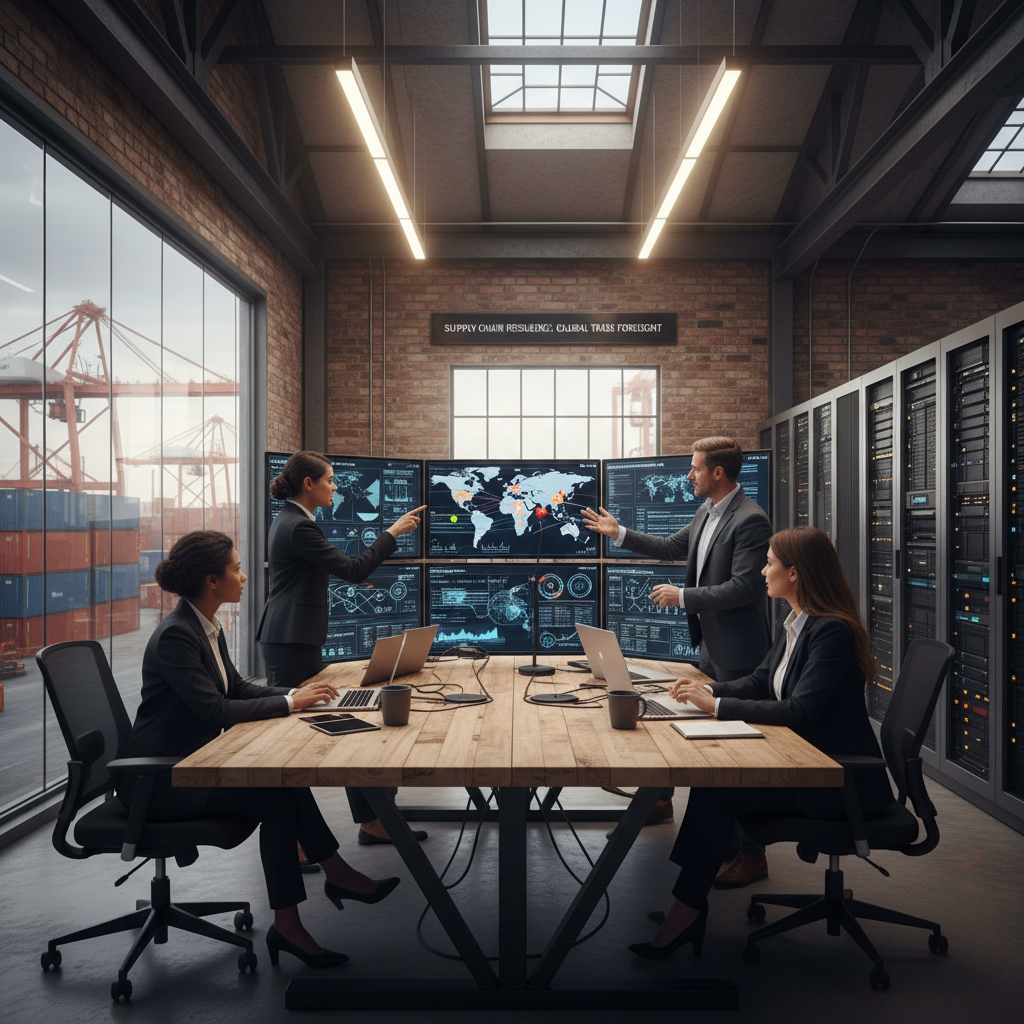
Executive Summary / Opening Intelligence
The Event: Global supply chains are undergoing a fundamental transformation, driven by an urgent need for foresight over mere visibility. A new generation of technology startups is leveraging advanced Artificial Intelligence (AI) to unearth and analyze "dark data" - unstructured, untracked, and often overlooked information - to predict and mitigate geopolitical risks before they manifest as costly disruptions. This paradigm shift moves beyond traditional, reactive risk assessment, offering granular insights into the complex, interconnected web of global trade.
Why Now: The confluence of recent global crises – the COVID-19 pandemic, the war in Ukraine, persistent Red Sea shipping attacks, and escalating US-China trade friction – has brutally exposed the fragility of established "just-in-time" supply chain models. The financial ramifications of these disruptions are staggering, often running into billions of dollars in lost revenue, production bottlenecks, and severe reputational damage for major corporations. The imperative for resilient, predictive supply chain management is no longer a niche concern but a top-tier C-suite priority, creating an unprecedented window of opportunity for innovative solutions. Today, the ability to anticipate shocks before they cascade through global networks is a core competitive advantage.
The Stakes: The economic consequences of an unprotected supply chain are immense. A single major disruption can wipe out quarterly profits for large multinational corporations, lead to catastrophic stock market reversals, and even undermine national economic security. Estimates suggest that supply chain disruptions cost the global economy trillions annually. For instance, the semiconductor shortage alone cost the automotive industry an estimated $210 billion in 2021. Companies that fail to adapt face billions in sustained revenue losses and decreased market capitalization, while those at the forefront of this predictive analytics wave stand to gain significant market share, potentially adding tens of billions to their enterprise value through enhanced operational continuity and differentiated service offerings.
Key Players: Spearheading this revolution are agile startups such as Altana AI, Everstream Analytics, and Interos, each deploying specialized AI techniques to map, monitor, and predict supply chain vulnerabilities. Traditional enterprise resource planning (ERP) giants like SAP and Oracle are also beginning to integrate AI elements, but often lack the specialized 'dark data' capabilities of newer entrants. Government entities, including the US Department of Defense and critical infrastructure agencies, are increasingly investing in these technologies to secure essential national supply chains, alongside financial institutions and insurers seeking better methodologies for pricing supply chain risk.
Bottom Line: For decision-makers, the message is unequivocal: integrating AI-driven dark data analytics into supply chain strategy is no longer optional. It represents a critical investment in future resilience, a strategic imperative for maintaining competitive advantage, and a non-negotiable component of modern enterprise risk management. The firms that prioritize this will not only survive future geopolitical shocks but thrive by navigating them with unprecedented foresight and agility.
Multi-Dimensional Strategic Analysis
Historical Context & Inflection Point
For decades, the prevailing doctrine in global supply chain management was "just-in-time" (JIT) inventory and production, championed by its promise of efficiency and cost reduction. The strategy, pioneered in Japan, aimed to minimize holding costs by receiving goods only as they were needed, creating lean, highly optimized pipelines. This model thrived in an era of relative geopolitical stability, low trade barriers, and predictable global logistics. Companies optimized for cost efficiency, often consolidating production in low-wage countries, leading to highly complex, geographically dispersed, yet tightly coupled supply networks.
However, the seeds of fragility were sown early. While offering tremendous cost benefits, the JIT model inherently lacked redundancy and resilience. The first severe cracks began to show in the early 2000s, with events like the 2002 U.S. West Coast port lockout and the 2011 Japanese earthquake and tsunami. These incidents provided jarring glimpses into the vulnerabilities of a perfectly optimized, but brittle, global system. Many predictions of a coming "resilience revolution" emerged, but the allure of low costs largely overshadowed these warnings, leading to what can now be seen as a period of failed predictions regarding the immediate necessity of overhauling supply chain structures. The lessons from these early disruptions often led to incremental improvements rather than systemic overhauls. Companies might dual-source a critical component or diversify some suppliers, but the core architectural principle of lean efficiency remained dominant.
The period from 2020 onward represents the true inflection point, marking the definitive end of the JIT era as the sole guiding principle. The COVID-19 pandemic, with its unprecedented factory shutdowns, labor shortages, and logistical gridlock, proved that global, simultaneous shocks were not only possible but devastating. The war in Ukraine further highlighted the vulnerability to geopolitical conflict, disrupting energy markets, agricultural exports, and key industrial inputs like neon. More recently, the Houthi attacks in the Red Sea have demonstrated how targeted regional instability can disrupt global shipping lanes, forcing costly re-routing around the Cape of Good Hope and impacting transit times and freight costs across continents. Simultaneously, the accelerating technological competition and trade disputes between the US and China have introduced a layer of strategic decoupling and export controls, fundamentally altering where and how critical components are manufactured and sourced.
What makes this moment critically different is the convergence and persistence of these multi-faceted, high-impact disruptions. It's no longer an isolated incident but a continuous state of flux and uncertainty. This prolonged period of volatility has pushed supply chain resilience from an operational concern to a strategic imperative directly impacting corporate valuations and national security. The limitations of relying on lagging economic indicators or basic spreadsheet-based risk assessments are now glaringly obvious. The market is demanding proactive, predictive capabilities that can digest vast amounts of disparate data to anticipate threats before they become crises. This pressure, combined with the maturation of advanced AI and data analytics technologies, has created a fertile ground for startups to innovate and provide solutions that were previously unimaginable, truly marking an irreversible shift in how global supply chains are managed.
Deep Technical & Business Landscape
Technical Deep-Dive
The revolution in supply chain prediction is underpinned by sophisticated AI technologies specifically designed to handle the nuances of "dark data." This data category includes any information that is unstructured, untracked, or underutilized, yet often contains early signals of impending disruptions.
Natural Language Processing (NLP) & Sentiment Analysis are foundational. Traditional risk assessments relied heavily on structured economic reports or official government communiqués. Modern AI goes far beyond this, deploying NLP models to sift through vast quantities of unstructured text: local-language news updates from remote regions, sentiment on social media platforms in specific industrial zones, labor union forums discussing potential strikes, and even draft regulatory policies. These models can identify nuances, recognize subtle shifts in rhetoric, and detect early signs of civil unrest, policy changes, or labor disputes often weeks or months before official reports emerge. For instance, sentiment analysis on social media posts near a key manufacturing hub in Southeast Asia might reveal growing worker dissatisfaction, flagging a potential strike risk before any formal announcements.
Graph Neural Networks (GNNs) are perhaps the most transformative technical innovation for mapping complex supply chains. A global supply chain is inherently a graph: nodes are suppliers, manufacturers, distribution centers, and ports; edges are the logistical connections, material flows, and financial transactions. Traditional databases struggle to represent and analyze these multi-layered, interdependent relationships efficiently. GNNs, however, excel at understanding the structure and dynamics of such networks. They can model multi-tier supplier relationships, revealing the "suppliers of your suppliers" – often the most opaque yet critical points of failure. If a small, unnoticed component manufacturer in Taiwan suffers a disruption, a GNN can trace its impact through several tiers to potentially shut down a major automotive plant in North America. By analyzing complex dependencies, GNNs predict how a localized event (e.g., a factory fire, a port closure, or a new export tariff) will propagate throughout the entire network, identifying critical choke points and offering alternative pathways in real-time.
Computer Vision complements the textual and network analysis by providing a visual layer of intelligence. This technology is applied to satellite imagery and drone footage. Algorithms can analyze patterns of activity in ports (e.g., increasing ship queues indicating congestion), monitor factory operational status (e.g., changes in rooftop heat signatures or vehicle traffic volumes around a plant to infer production levels), or detect environmental risks (e.g., plummeting water levels in critical shipping canals like the Panama Canal, or unusual military build-ups near critical infrastructure). When integrated with historical data, computer vision can detect anomalies that signal potential issues, such as a construction delay for a new mega-factory or changes in agricultural yields impacting food supply.
These technologies, when combined, create a powerful predictive engine. Benchmarks for these systems are constantly evolving and context-specific. For example, a successful NLP system might boast 90%+ accuracy in identifying strike risk from social media data, while a GNN might reduce predicted disruption impact by 20% compared to traditional methods by offering proactive rerouting options. The capability leaps are significant: moving from historical data analysis to forward-looking prediction, reducing lead times for risk identification from weeks to hours, and providing actionable intelligence that goes beyond mere alerts to suggest mitigation strategies. Key limitations include the inherent "black box" problem of some deep learning models, making it challenging to explain specific predictions without a clear audit trail, and the massive computational resources required to process and interpret global data feeds in real-time.
Business Strategy
The business strategy emerging from this technological shift is one of proactive resilience, moving from cost optimization to risk mitigation as the primary strategic driver. This is fundamentally altering how players position themselves within the market.
Disruptive Startups are the vanguard, building platforms from the ground up to exploit the 'dark data' opportunity.
- Altana AI stands out with its "Atlas of the Global Economy." Its unique selling proposition is a federated learning model that creates a dynamic, multi-tier map of the entire global supply chain without requiring any single entity to centralize sensitive commercial data. This addresses critical data privacy concerns while still enabling powerful network analysis using GNNs. Altana focuses on illuminating sub-tier supplier relationships, offering an unprecedented view into opaque supply networks, and identifying critical dependencies that might otherwise remain hidden. Their product positioning emphasizes trust, data security, and comprehensive, dynamic mapping for trade compliance, risk management, and national security applications. The company often targets government agencies and large multinational corporations with complex, sensitive supply chains.
- Everstream Analytics focuses on predictive analytics, blending AI-driven data analysis with human geopolitical expertise. Their platform integrates real-time risk intelligence across a broad spectrum of categories, from natural disasters and political instability to labor disputes and infrastructure failures. Their strategy is to offer granular, location-specific insights weeks or months in advance, allowing companies to pre-position inventory, adjust routes, or engage with alternative suppliers. Their competitive advantage lies in the breadth of their risk coverage and the speed of their predictive alerts, catering to Chief Supply Chain Officers (CSCOs) who need immediate, actionable intelligence to manage daily operations and strategic planning.
- Interos specializes in mapping sub-tier supplier relationships with an emphasis on concentration risks related to geography, financial health, and ESG (Environmental, Social, and Governance) factors, including geopolitical entanglements. They often help companies identify single points of failure deep within their supply chains and assess risks related to forced labor, intellectual property theft, or sanctions compliance. Their unique value proposition is a "living map" of an enterprise's supply chain that updates continuously, providing a real-time risk score for each supplier and sub-supplier based on thousands of data points. This positions them as a critical tool for corporate compliance and strategic sourcing departments.
- While primarily focused on real-time transportation visibility, project44 and FourKites are increasingly integrating predictive risk analytics into their platforms. They leverage their vast network data (IoT, GPS, ELD records) to predict transit delays and, increasingly, to incorporate broader geopolitical and environmental risk factors that might impact logistics. Their business model often involves a subscription service based on shipment volume, and their strategic move is towards becoming comprehensive logistics intelligence platforms.
Incumbent Technology Giants such as SAP, Oracle, and Blue Yonder are actively trying to adapt. They are adding AI-powered risk modules to their extensive enterprise resource planning (ERP) and supply chain management (SCM) platforms. Their strength lies in their massive existing customer bases and deep integration into corporate IT infrastructures. However, their agility in processing the sheer variety and volume of external 'dark data' often lags behind specialized startups. Their competitive strategy is typically to enhance existing product lines with integrated AI features, leveraging their customer loyalty and comprehensive suite of business applications, rather than building entirely new, standalone risk analysis platforms from scratch. This can lead to slower innovation cycles and less specialized capabilities compared to the pure-play risk analytics startups.
The strategic landscape is competitive and evolving rapidly. Partnerships between incumbents and startups, or outright acquisitions, are likely as traditional players seek to integrate cutting-edge capabilities. Startups employ subscription models, often tiered by the complexity of the supply chain being mapped or the depth of analysis required. Their competitive advantages stem from specialized data acquisition, proprietary AI algorithms, and a tight focus on solving specific, high-value problems related to risk prediction.
Economic & Investment Intelligence
The burgeoning field of AI-driven supply chain resilience has attracted significant investment, reflecting its strategic importance and anticipated market disruption. The market for supply chain visibility and resilience, estimated at over $15 billion in 2022, is projected to grow to over $40 billion by 2027, driven almost entirely by the imperative for predictive capabilities.
Funding Rounds, Valuations, and Lead Investors: Startups in this space have seen substantial capital injections. Altana AI, for example, successfully closed a $100 million Series B funding round in late 2022, with a valuation reportedly exceeding $350 million. Lead investors included prominent venture capital firms known for deep tech and enterprise software investments, such as GV (Google Ventures) and Lightspeed Venture Partners, signaling confidence from major tech backers. Interos secured a significant $100 million Series C round in 2021, pushing its valuation past the $1 billion mark, making it a unicorn in the supply chain tech space. Its investors included funds like Kleiner Perkins and NightDragon, highlighting interest from both traditional venture capital and cybersecurity-focused investors. Everstream Analytics, while not publicly disclosing its exact valuation, has also seen robust investment, indicating strong market belief in its AI-powered predictive risk intelligence. These substantial funding rounds are enabling these startups to expand their R&D, scale their data acquisition capabilities, and aggressively pursue market share.
VC Strategy, Public Market Implications: Venture Capital firms are acutely aware of the "brittleness tax" that global companies are paying due to supply chain disruptions. Their investment strategy is shifting from traditional logistics optimization to platforms offering true resilience and foresight. VCs are looking for companies that demonstrate robust proprietary data ingestion methods (especially for ‘dark data’), defensible AI models, and a clear path to generating actionable intelligence for the C-suite. The long-term implication for public markets is significant. Companies that leverage these AI tools to build more resilient supply chains are likely to exhibit greater operational stability, improved financial performance due to fewer disruptions, and higher investor confidence. This could lead to a re-rating of their stock, distinguishing them from less prepared competitors. Conversely, companies perceived as vulnerable to geopolitical shocks could see sustained downward pressure on their valuations.
M&A Activity, Industry Disruption: While the market is still relatively nascent for major M&A, smaller acquisitions are beginning to occur, mostly focused on technology or talent acquisition by larger players. For instance, established supply chain software providers or even logistics giants might acquire smaller AI startups with specialized NLP or computer vision capabilities to integrate into their broader platforms. The true industry disruption lies in the redefinition of competitive advantage. Rather than simply optimizing for cost, companies will increasingly compete on their ability to maintain continuity and innovate in the face of uncertainty. This dynamic shifts budget allocations from reactive measures (e.g., expedited shipping costs during a crisis) to proactive investments in intelligence platforms. Furthermore, the rise of these AI platforms challenges the traditional consulting model for supply chain risk, as automated systems can provide real-time, continuous insights far more efficiently than periodic human assessments. Over time, this market will likely consolidate, with a few dominant platforms emerging through either organic growth fueled by venture capital or strategic acquisitions by tech giants seeking to own the "operating system" for resilient global trade.
Geopolitical & Regulatory Deep-Dive
The intersection of AI, dark data, and supply chain resilience is deeply entwined with geopolitical dynamics and evolving regulatory frameworks. Governments worldwide are increasingly recognizing the strategic importance of secure and resilient supply chains, moving beyond private sector concerns to treat them as critical national infrastructure.
US Policy: In the United States, the focus is heavily on national security and economic competitiveness. Executive Orders, such as those related to critical supply chains (e.g., semiconductors, critical minerals, large capacity batteries, pharmaceuticals), explicitly call for enhanced visibility and resilience. The Defense Department (DoD) is a significant driver, investing heavily in AI and data analytics to map its vast and complex defense supply chains, many of which share components with commercial networks. Initiatives like the CHIPS and Science Act of 2022 aim to incentivize domestic manufacturing and reduce reliance on geopolitical rivals, creating a demand for platforms that can assess supply chain vulnerabilities and verify country-of-origin for critical components. The US government is also a key target customer for startups like Altana AI and Interos, seeking to leverage their platforms for trade compliance, combating illicit trade, and understanding adversarial supply network strategies. The regulatory direction is towards mandating greater transparency and due diligence, especially for companies dealing with government contracts or operating in sensitive sectors, creating a market pull for 'dark data' solutions that can provide this level of scrutiny.
EU Regulations: The European Union, while sharing some common goals with the US, approaches supply chain regulation with a broader emphasis on human rights, environmental due diligence, and ethical sourcing, alongside traditional security concerns. The Corporate Sustainability Due Diligence Directive (CSDDD) is a prime example, mandating that companies identify, prevent, mitigate, and account for adverse human rights and environmental impacts in their own operations and across their value chains. This creates an enormous demand for 'dark data' analytics that can verify ethical sourcing, identify risks of forced labor, or monitor environmental compliance deep within sub-tier supplier networks. GDPR, the EU's benchmark data privacy regulation, also profoundly impacts these AI platforms, requiring careful management of personal and commercial data throughout the supply chain mapping process, particularly with federated learning models that prioritize data locality. The EU's digital sovereignty ambitions also play a role, with a desire to foster European AI solutions and reduce reliance on foreign tech for critical infrastructure.
China Strategy: China's strategy contrasts sharply with Western approaches. Its "Made in China 2025" and "Dual Circulation" strategies aim for technological self-sufficiency and reduced external dependencies, particularly in critical sectors. While Western nations focus on detecting vulnerabilities, China is building them out, emphasizing control and resilience within its own sphere. Chinese companies, guided by state policy, are also exploring AI for supply chain optimization, but with a different emphasis: strengthening domestic linkages, safeguarding against foreign sanctions, and potentially using sophisticated data analysis to understand competitor vulnerabilities. The lack of data privacy norms and the close integration of technology companies with the state in China mean that the collection and analysis of 'dark data' have different implications and potential applications, including for industrial espionage or geopolitical leverage. The increasing US-China technological decoupling is a significant driver for both sides; Western companies use AI to de-risk from China, while Chinese firms use AI to bolster their domestic resilience and strategic independence.
US-China Competition and Strategic Implications: The ongoing technological rivalry between the US and China directly impacts the adoption and development of these AI technologies. Both nations recognize supply chains as battlegrounds for economic and technological dominance. For Western companies, AI-powered dark data analytics become crucial tools for "de-risking" or "friend-shoring" supply chains, identifying alternative sources, and ensuring compliance with evolving trade restrictions. For example, AI can identify a sub-tier supplier in a non-sanctioned country that relies heavily on inputs from a sanctioned Chinese entity, revealing a hidden vulnerability. The strategic implication is a fragmentation of global supply chains based on geopolitical alignment and trusted partnerships, rather than pure economic efficiency. This will drive further investment into AI platforms that can navigate this increasingly complex and politicized global trade landscape. Regulatory timelines are uncertain but accelerating, with many directives (like the EU's CSDDD) expected to become fully enforceable within the next 2-3 years, creating immediate demand for compliant solutions.
Future Forecasting & Strategic Implications
Near-Term Horizon (6-12 months): Immediate Catalysts
The next 6-12 months will be critical for solidifying the adoption of AI-driven 'dark data' analytics in supply chain management. Several catalysts will accelerate this trend, forcing companies to move beyond pilot programs to full-scale implementations.
Key Events to Watch: Geopolitical tensions will remain high. We can expect continued volatility in regions like the Middle East, with potential for further disruptions to maritime trade routes. The upcoming major elections in key global economies, including the US presidential election, carry significant policy uncertainties that could rapidly shift trade agreements, tariffs, or regulatory frameworks. For instance, a change in US administration could lead to more aggressive trade protectionism or a relaxation of existing sanctions, each necessitating immediate re-evaluation of supply chain strategies. Companies need to monitor electoral rhetoric and poll shifts, which ‘dark data’ analysis of public sentiment and policy proposals can help predict. Furthermore, the persistent threat of climate-driven disasters, such as extreme weather events impacting critical infrastructure (ports, energy grids, agricultural regions), will necessitate adaptive responses, with AI identifying vulnerable assets and alternative logistical pathways. The evolving nature of cyber threats also plays a role; state-sponsored cyberattacks could target critical logistics infrastructure or data systems, requiring AI systems to detect anomalies and potential disruptions.
Early Signals & Strategic Plays: Companies exhibiting early adoption of these advanced analytics platforms will demonstrate superior agility in reacting to these nascent signals. For example, a company using AI to continuously monitor local news and social media might detect early warnings of port labor unrest in a critical shipping hub, allowing them to reroute containers even before formal strike votes are announced. This proactive rerouting strategy could save millions in demurrage fees and avoid production line stoppages. Firms actively mentoring supply chain professionals in data literacy and AI interpretation will gain a significant competitive edge, transforming their workforce into "supply chain intelligence analysts" rather than just logistics managers.
First-Mover Advantages: First movers in this space will cement significant advantages. They will build proprietary datasets from continuous 'dark data' ingestion, refining their AI models to deliver increasingly accurate and nuanced predictions. These early adopters will also develop institutional knowledge and sophisticated operational playbooks for integrating AI insights into strategic decision-making, from procurement to inventory management. This translates into more resilient revenue streams, reduced exposure to price volatility for critical inputs, and unparalleled brand reputation for reliability. Furthermore, by being early, these companies can influence the development of best practices and even shape future regulatory standards. Their strategic play involves not just using the technology, but truly integrating it into their enterprise DNA, creating a durable competitive moat against slower-moving rivals who remain mired in reactive modes.
Mid-Term Horizon (2-3 years): Industry Restructuring
Over the next 2-3 years, the widespread adoption of AI-driven supply chain intelligence will fundamentally restructure industries, creating new giants and displacing others, while profoundly transforming value chains and the workforce.
Displaced Industries, New Giants: Industries with high supply chain complexity and criticality, such as automotive, pharmaceuticals, electronics, and aerospace, will be among the first to witness disruption and restructuring. Traditional third-party logistics (3PL) providers and freight forwarders, if they fail to integrate similar AI capabilities, risk becoming commoditized, relegated to executing orders rather than providing strategic value. The "new giants" will be those companies, or their innovative logistics partners, that own the most comprehensive, most predictive supply chain intelligence platforms. These could be the current startups that scale dramatically, or existing tech behemoths that acquire and seamlessly integrate these capabilities. Their competitive advantage will not just be faster delivery, but guaranteed delivery and stable pricing, even amidst global turmoil. This focus on certainty rather than just speed will redefine market leadership.
Value Chain Shifts, Workforce Transformation: The traditional, linear value chain will evolve into a more dynamic, networked ecosystem. Sourcing decisions will transition from annual contract negotiations based predominantly on cost, to continuous, AI-informed assessments balancing cost, resilience, geopolitical risk, and ESG factors. This will lead to diversified sourcing strategies, potentially favoring "friend-shoring" or dual-sourcing from geographically diverse regions identified by AI as stable. The impact on the workforce will be profound. Routine data entry and basic risk assessment tasks will be automated. A massive demand will emerge for hybrid roles: "Supply Chain Intelligence Analysts" who can interpret AI outputs, "Geopolitical Risk Engineers" who fine-tune models with human insights, and "AI-driven Procurement Specialists" who can navigate complex global markets with predictive insights. This will necessitate significant investment in upskilling and mentoring programs within organizations, focusing on data science, advanced analytics, and geopolitical awareness for existing supply chain teams. Universities and vocational programs will need to adapt their curricula to prepare the next generation of logistics and procurement professionals for this AI-first reality.
Competitive Positioning, Revenue Inflection: Companies that successfully embed these AI capabilities will gain a significant competitive edge, allowing them to offer more reliable product availability, more stable pricing, and superior customer service. This will translate into measurable revenue inflection points, directly linking investment in AI resilience to top-line growth and increased market share. For example, an electronics manufacturer whose AI anticipates a critical raw material shortage months in advance can secure alternative supplies, avoiding stock-outs that might cripple competitors. This allows them to capture market share from rivals who suffer production halts. The ability to maintain operational continuity will become as important as product innovation, creating a new axis of competition. Companies will begin to advertise their "resilience scores" or "supply chain uptime guarantees" as points of differentiation. Furthermore, the insurance industry will likely adapt, offering differentiated premiums based on a company's proven AI-driven resilience strategy, creating a further economic incentive for adoption.
Long-Term Vision (5 years): Civilizational Impact
Looking five years out, the pervasive integration of AI-driven 'dark data' analytics will have a transformative impact that extends beyond corporate profitability to fundamentally reshape economic structures, geopolitical order, and even human capabilities.
Societal Transformation, Economic Structure: The era of truly predictable, AI-managed global supply chains will usher in an unprecedented level of economic stability. Fluctuations in availability and pricing of essential goods (food, medicine, energy, electronics) will be significantly dampened by proactive risk mitigation. This increased stability will reduce inflationary pressures stemming from supply shocks, making economies more resilient to external events. Developing nations with essential roles in global supply chains (e.g., raw material producers, manufacturing hubs) will gain greater visibility and negotiating power, as AI identifies their critical contributions and helps them mitigate localized risks. The overall efficiency gains and waste reduction (through optimized inventory and logistics) will contribute to more sustainable economic models, potentially fostering circular economies by tracking and optimizing resource flow at an unprecedented scale. Global economic growth could be less prone to sharp downturns induced by unforeseen logistical or geopolitical bottlenecks.
Geopolitical Order: The strategic implications for geopolitical order are profound. Nations that master AI-driven supply chain intelligence will possess a distinct strategic advantage, not only in securing their own critical resources but also in projecting influence. The ability to accurately map and predict vulnerabilities in adversary supply chains could become a potent tool of statecraft, impacting sanctions efficacy, military readiness, and diplomatic leverage. International cooperation on data sharing for global supply chain resilience, especially for humanitarian aid and disaster relief, could foster new alliances or strengthen existing ones. Conversely, the absence of trusted AI systems could exacerbate geopolitical tensions, with nations fearing hidden vulnerabilities or manipulation of trade flows. The transparency offered by these systems could, however, also serve as a deterrent, as nations become more aware of the intricate interdependencies that bind the global economy, making major disruptions a mutually assured destruction scenario.
Human Capability: The most significant long-term impact will be on human capability and decision-making. AI will augment human intelligence in ways previously confined to science fiction. Leaders at all levels – from corporate CEOs to national policymakers – will have access to real-time, predictive intelligence that paints a holistic, multi-dimensional picture of global interconnectedness. This enables far more informed, proactive, and resilient decision-making, allowing humanity to collectively navigate complex global challenges with greater foresight. The skills required for leadership will shift from reacting to crises to strategically orchestrating complex adaptive systems. This profound shift, enabled by discerning signals in the 'dark data,' essentially expands our collective peripheral vision, allowing us to anticipate and adapt to a constantly changing world with unprecedented effectiveness. It promises a future where human ingenuity, augmented by AI, can truly master the complexities of a globalized existence.
Executive Conclusion & Strategic Takeaways
The strategic deployment of AI to unlock insights from 'dark data' is not merely an incremental improvement in supply chain management; it represents a fundamental paradigm shift with profound implications for global commerce and geopolitical stability. My assessment, with high confidence, is that this technology will differentiate corporate winners from losers in the coming decade, transforming resilience from a defensive cost center into a core competitive advantage that drives market leadership and shareholder value. The era of predictable disruptions is over; the era of predictable resilience is just beginning.
Key Insights Summary:
- Decoupling from Just-In-Time (JIT): The reactive, cost-optimized JIT model is being supplanted by proactive, AI-driven resilience as the dominant supply chain philosophy.
- Dark Data as Strategic Gold: Unstructured data – from local news to satellite imagery – is the new frontier for predictive analytics, offering unparalleled early warning signals.
- AI as the Navigator: NLP, GNNs, and Computer Vision are critical technologies enabling the mapping, monitoring, and predictive analysis of complex, opaque global supply networks.
- Startup Driven Innovation: Agile startups like Altana AI and Interos are leading the charge, building specialized platforms that outmaneuver traditional ERP giants in processing diverse, real-time 'dark data.'
- Geopolitical Intertwinement: Supply chain resilience is now a national security imperative, driving policy and investment from governments like the US and EU, while influencing strategic competition with powers like China.
- Workforce Transformation: A new class of "Supply Chain Intelligence Analysts" is emerging, necessitating significant investment in upskilling and mentoring for data literacy and AI interpretation.
- Resilience as a Competitive Moat: Companies mastering AI-driven foresight will secure stable revenue streams, mitigate price volatility, and gain significant market share by maintaining operational continuity during shocks.
The Big Question: In a world increasingly defined by persistent geopolitical volatility and extreme events, can enterprises and nation-states rapidly adapt their organizational structures and human capital to fully leverage AI's predictive power, transforming the very nature of global commerce before the next major shock renders traditional models obsolete?