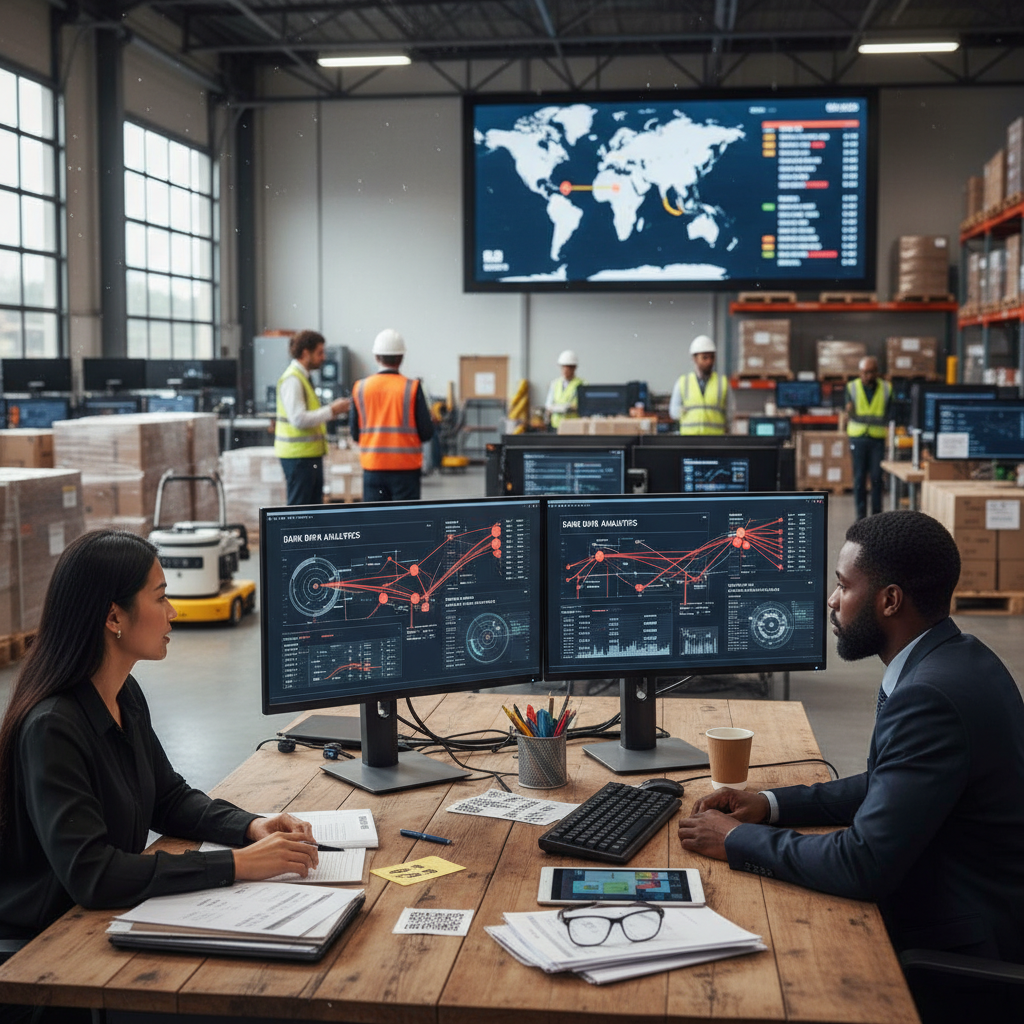
Executive Summary / Opening Intelligence
The Event: The global supply chain, once optimized for lean efficiency, is increasingly plagued by unpredictable disruptions. From geopolitical conflicts and climate change impacts to localized labor disputes, the traditional "just-in-time" model has proven fragile. A new paradigm centered on resilience, visibility, and predictive capability is rapidly emerging, driven by artificial intelligence. This shift is particularly pivotal for startups, which, despite their inherent agility, often lack the deep resource pools or established networks of larger incumbents.
Why Now: The urgency stems from a confluence of factors: persistent global instability, the lingering aftershocks of the COVID-19 pandemic, and an increasingly interconnected yet volatile global economy. Businesses today need not just to react, but to anticipate. Traditional supply chain management, reliant on structured, internal data, provides only a rearview mirror. The untapped potential lies in "dark data" - the vast ocean of unstructured information from external sources like social media, news feeds, geopolitical analyses, and sensor data. AI now offers the computational power and analytical sophistication to transform this noise into actionable signals, making today the critical inflection point for adoption.
The Stakes: The financial implications are staggering. A single significant supply chain disruption can cost companies, on average, 45% of one year's profits, with recovery often taking over a year. For startups, such an event can be existential. Conversely, those that master predictive resilience stand to gain billions in market share, avoid costly workarounds, and secure critical competitive advantages. The global supply chain analytics market, valued at over $10 billion in 2022, is projected to surge past $30 billion by 2030, underscoring the immense economic value at stake.
Key Players: Leading the charge in unlocking dark data are specialist AI platforms such as Interos, Everstream Analytics, and Altana.ai, who are building sophisticated tools for multi-tier risk mapping and predictive intelligence. These innovators are both partners and enablers for agile startups in sectors like Direct-to-Consumer (DTC), advanced manufacturing, and logistics technology. Incumbents like Maersk, DHL, SAP, and Oracle are also rapidly integrating similar AI capabilities, signaling a pervasive industry transformation.
Bottom Line: For forward-thinking CEOs, venture capitalists, and policymakers, the message is clear: AI-driven analysis of dark data is no longer a niche technological advantage but a fundamental strategic imperative for supply chain resilience. Startups that embed this capability into their core operations from inception will possess a distinct, powerful moat, allowing them to navigate volatility, secure market positions, and accelerate growth in an increasingly uncertain world.
Multi-Dimensional Strategic Analysis
Historical Context & Inflection Point
Supply chain management, as a discipline, has seen several evolutionary phases, each driven by prevailing economic conditions and technological advancements. The 1980s and 90s championed "Just-in-Time" (JIT) manufacturing, pioneered by Toyota, which prioritized efficiency, minimized inventory, and reduced waste. This philosophy, later bolstered by globalization and the rise of sophisticated Enterprise Resource Planning (ERP) systems like SAP and Oracle, became the dominant paradigm. The focus was on optimizing internal processes, reducing lead times, and achieving cost efficiencies through global sourcing.
However, the pursuit of lean efficiency often inadvertently built in fragility. Supply chains became long, linear, and hyper-optimized for specific, predictable conditions. Warnings about the inherent risks of this model, while present in academic circles, were largely overshadowed by the undeniable cost benefits.
Then came the first major jolt: the 2000s and early 2010s saw localized disruptions, such as the 2011 Tohoku earthquake and tsunami in Japan, which crippled automotive and electronics supply chains globally. This revealed the deep interdependencies of modern manufacturing and the vulnerability of single-source production. Despite these clear signals, many companies doubled down on efficiency, believing these to be isolated incidents rather than harbingers of systemic fragility. Decision-makers often underestimated the ripple effects and the extended recovery times.
Timeline with specific dates:
- Late 1970s - 2000s: Rise of Just-in-Time (JIT) and Lean Manufacturing, emphasizing efficiency and cost reduction through minimal inventory.
- 1990s - 2010s: Widespread adoption of ERP systems (SAP R/3, Oracle E-Business Suite) centralizing internal structured data.
- March 11, 2011: Tohoku earthquake and tsunami in Japan highlights severe global supply chain interdependencies and single-point-of-failure risks, leading to an estimated $210 billion in economic losses.
- 2015-2016: Escalation of trade tensions and early tariffs between major economic blocs, signaling coming geopolitical instability.
- Early 2020: COVID-19 pandemic exposes the catastrophic fragility of global JIT supply chains, triggering massive disruptions, port congestion, and unprecedented demand shocks. This event definitively shifted strategic priorities from pure efficiency to resilience and visibility.
- February 2022: Russia-Ukraine conflict further exacerbates commodity and energy price volatility, re-emphasizes geopolitical risk, and highlights the need for continuous, real-time risk monitoring.
- Late 2023 - Present: Red Sea shipping attacks demonstrate the immediate and widespread impact of regional conflicts on global logistics routes, forcing re-routing and increasing transit times and costs.
Failed predictions & lessons: The primary failed prediction was the assumption that globalization would inherently lead to increasing stability and predictability in supply chains. The lesson learned, painstakingly, is that interdependence amplifies risk when resilience is sacrificed for efficiency. Furthermore, traditional risk assessments, focused on historical data and known threats, proved inadequate against novel, complex, and simultaneous disruptions.
Why THIS moment matters: We are at a critical inflection point where the cost of not building resilience far outweighs the cost of transformation. The current geopolitical landscape, rapidly changing climate, and persistent macroeconomic uncertainties mean continuous disruption is the new normal. For startups, this moment presents an unparalleled opportunity. Unlike incumbent enterprises burdened with legacy systems and deeply entrenched processes, startups can architect their supply chains from the ground up, embedding AI-driven dark data analytics as a core operational capability. This enables them to be inherently more agile, responsive, and robust, turning potential vulnerabilities into decisive competitive advantages. This is not merely an upgrade; it is a fundamental re-design of how supply chains operate and how businesses secure their future.
Deep Technical & Business Landscape
The transition from reactive to proactive supply chain management is underpinned by a profound shift in technological capabilities, particularly in how data is perceived, collected, and analyzed. The emerging landscape is defined by the ability to ingest and process "dark data"—the vast, often unstructured information streams external to an organization's internal systems.
Technical Deep-Dive:
- Model Architecture, Benchmarks: The core of this new wave of analytical power lies in sophisticated AI models. Unlike traditional statistical models that operate on clean, structured datasets, these new architectures are designed to handle ambiguity, noise, and the sheer volume of unstructured information. Early models leveraged rule-based systems and basic machine learning for sentiment analysis, but today's leading solutions employ deep learning architectures, particularly for Natural Language Processing (NLP) and Computer Vision. Large Language Models (LLMs), like those derived from transformer architectures, are now critical for sifting through vast textual data (news, social media, reports) to identify subtle risk signals, extract entities (companies, locations, events), and discern relationships that human analysts might miss. Benchmarks no longer solely focus on accuracy against internal data but on precision and recall in identifying real-world disruptions from noisy external sources, often measured by metrics like "time-to-detection" of a supply chain event before it impacts operations. For instance, advanced NLP models can achieve F1 scores upwards of 0.85 in identifying specific risk categories from unstructured text.
- Capability Leaps, Limitations: The significant leap in capability comes from the AI's ability to contextualize and connect seemingly disparate pieces of information. For example, an NLP model can link a local news report of labor unrest in Southeast Asia to a specific supplier factory, cross-reference it with commodity price fluctuations detected by another model, and then augment this with satellite imagery showing reduced activity at the factory. This multi-modal data fusion dramatically enhances predictive power. Furthermore, knowledge graphs, acting as a dynamic map of the global supply chain, are crucial. They represent entities (companies, ports, products) as nodes and their relationships (supplier-buyer, shipment routes) as edges, allowing AI to trace complex, multi-tier dependencies that are invisible in traditional ERP systems. The primary limitation remains the "signal vs. noise" problem; discerning genuine threats from misinformation or irrelevant data. Overcoming this requires continuous model refinement, robust validation datasets, and often, human-in-the-loop validation to train the AI on nuanced real-world scenarios, particularly in the early stages of a startup's deployment. Another limitation is the computational cost associated with processing petabytes of real-time unstructured data.
Business Strategy:
- Player Breakdown with Specifics:
- Interos: A leader in multi-tier supply chain risk management. Their platform uses AI to map global supply chains down to N-tier suppliers, continuously monitoring for various risk categories including financial, operational, environmental, and geopolitical. They leverage a proprietary "knowledge graph" that models millions of entities and billions of relationships, providing a dynamic digital twin of the supply chain. Their strength is in comprehensive, continuous monitoring of complex, hidden risks.
- Everstream Analytics: Focuses on predictive insights for planning, procurement, and logistics. They combine AI-driven risk scores with human expertise, offering actionable intelligence on disruptive events such as weather, geopolitical unrest, port congestion, and cyber threats. Their platform integrates with existing ERP and TMS systems, making it easier for large enterprises and startups to onboard.
- Altana.ai: Building a "unified map" of the global supply chain by connecting public and private data sources. Their AI models build a comprehensive, shared understanding of the global trade network, enabling governments and businesses to identify illicit trade, enforce sanctions, and improve supply chain resiliency. Their focus on mapping the entire trade ecosystem differentiates them.
- Innovative Startups (The Adopters): This category includes a wide array of businesses. For example, a DTC e-commerce startup selling specialized electronics might use these platforms to monitor the stability of critical component suppliers in Asia, reroute shipments proactively based on port congestion predictions, or secure alternative manufacturing capacity before a predicted natural disaster. An advanced manufacturing startup using additive manufacturing could leverage this data to anticipate raw material shortages or price spikes, adjusting production schedules or sourcing strategies accordingly. Logistics tech startups are integrating these AI capabilities directly into their offerings, adding value-added services like predictive rerouting or dynamic warehousing.
- Product Positioning, Pricing: Specialist AI platforms generally offer SaaS-based solutions with tiered pricing models, often based on the number of monitored suppliers, data volume, or depth of analysis required. Positioning is centered on "resilience-as-a-service" or "predictive supply chain intelligence." They claim ROI through averted losses from disruptions, optimized inventory holding costs, and improved customer satisfaction due to reliable delivery. For startups, the pricing structure needs to be flexible enough to allow for gradual scaling, possibly with free tiers for basic monitoring or consumption-based models as usage grows.
- Partnerships, Competitive Advantages: The competitive landscape involves a mix of specialist AI firms, traditional logistics providers integrating AI, and analytics divisions of major tech firms. Specialist AI platforms often form partnerships with established logistics providers, customs brokers, and industry consortia to enhance data inputs and broaden market reach. For startups, integrating these AI solutions from day one creates a significant competitive advantage over more established, slower-moving incumbents. This strategic choice allows them to avoid the technical debt of legacy systems and build intrinsically agile and transparent operations. Their nimbleness enables faster decision-making when predictive warnings are issued, allowing them to pivot sourcing, manufacturing, or distribution faster than competitors. This proactive strategy means they can maintain product availability and delivery schedules where others fail, directly impacting customer loyalty and market share.
Economic & Investment Intelligence
The shift to AI-driven supply chain resilience is a major economic re-alignment, attracting significant investment and catalyzing M&A activities across various sectors. The market signal is unequivocal: capital is flowing into solutions that promise to de-risk global trade and operations.
Funding rounds, valuations, lead investors: Specialist AI supply chain companies are commanding impressive valuations, reflecting investor confidence in their long-term growth and criticality. For instance, Interos achieved a unicorn valuation, raising over $150 million in its Series C round, with investors like Kleiner Perkins and SoftBank Vision Fund 2 participating. This capital infusion is enabling aggressive R&D and market expansion. Everstream Analytics has also secured substantial funding from firms such as Morgan Stanley Expansion Capital, validating the market's appetite for sophisticated predictive intelligence. These investments are not merely growth capital; they are strategic bets on the future of global commerce, recognizing that robust supply chains are fundamental to economic stability. The average Series A for a promising supply chain analytics startup now hovers around $10-20 million, indicating a healthy early-stage investment environment driven by strong market demand and demonstrable ROI.
VC strategy, public market implications: Venture Capital (VC) firms are increasingly looking for startups that offer deep domain expertise combined with cutting-edge AI. Their strategy focuses on identifying companies that can effectively bridge the gap between complex data science and actionable supply chain insights. VCs are keen on solutions that provide not just data, but prescriptive analytics, empowering companies to make optimal decisions. For startups, this means showcasing a clear value proposition, scalable technology, and a robust data acquisition strategy. The public markets are also reacting. Companies that can demonstrate superior supply chain resilience are likely to command higher investor confidence and potentially higher valuations, especially in sectors prone to disruption like manufacturing, retail, and logistics. Incumbent players like Maersk and DHL, which are aggressively investing in their own AI capabilities, are also signaling to investors their commitment to future-proofing their operations. The long-term implication is a bifurcation; companies with resilient, AI-powered supply chains will be favored over those susceptible to disruption, translating directly into stock performance and market capitalization.
M&A activity, industry disruption: The landscape is ripe for M&A. Larger technology firms (e.g., SAP, Oracle, IBM) and logistics giants (e.g., FedEx, UPS) are actively seeking to acquire innovative AI startups to integrate these advanced capabilities into their existing platforms. This allows them to quickly gain a competitive edge and offer more comprehensive solutions to their vast client bases. For instance, acquisitions of smaller analytics firms by ERP providers are common, extending their data visibility beyond internal transactional records. This trend presents significant exit opportunities for successful startups in this niche, providing a clear path to liquidity for early investors. The disruption extends beyond mere efficiency gains; it fundamentally reshapes industry structures. Companies that fail to leverage AI for supply chain resilience risk losing market share to agile, AI-native competitors, experiencing increased operational costs, and suffering reputational damage from unfulfilled orders or delayed deliveries. Industries like automotive, electronics, and pharmaceuticals, with their complex, multi-tier supply chains, are particularly vulnerable to this disruption if they do not adapt.
Geopolitical & Regulatory Deep-Dive
The intertwined forces of geopolitics and regulation are fundamentally reshaping global supply chains, elevating the importance of AI-driven "dark data" analysis from a business optimization to a strategic national security imperative. The era of frictionless global trade is receding, replaced by one characterized by strategic competition, economic decoupling, and heightened scrutiny.
US policy, EU regulations, China strategy:
- US Policy: The United States has increasingly prioritized supply chain resilience, viewing it as critical to national security and economic competitiveness. Executive Order 14017, "America's Supply Chains," issued in February 2021, mandated reviews of critical supply chains (e.g., semiconductors, critical minerals, large capacity batteries, pharmaceuticals) and called for greater transparency and diversification. The CHIPS and Science Act of 2022 further boosted domestic semiconductor manufacturing, directly impacting global supply chain configurations. US policy is also focused on de-risking from specific geopolitical adversaries, leading to renewed emphasis on "friendshoring" or "nearshoring." For businesses, especially startups engaging in sensitive sectors, this translates to stricter due diligence requirements and incentives for diversifying supplier bases.
- EU Regulations: The European Union is driving regulatory changes focused on corporate sustainability due diligence and supply chain transparency. The proposed Corporate Sustainability Due Diligence Directive (CSDDD) would require companies to identify, prevent, mitigate, and account for negative human rights and environmental impacts in their value chains. This necessitates a deep, multi-tier understanding of supplier networks, making dark data analysis invaluable for compliance and risk management. Furthermore, the EU's Carbon Border Adjustment Mechanism (CBAM) puts a price on carbon emissions for certain imported goods, requiring detailed data on manufacturing processes across global supply chains.
- China Strategy: China's strategy under its "dual circulation" economic philosophy emphasizes bolstering domestic demand and technological self-sufficiency while maintaining its position in global trade. This includes significant investments in advanced manufacturing, AI, and domestic supply chain resilience. For international businesses, operating in or with China poses unique challenges, including geopolitical risks, intellectual property concerns, and data localization requirements. Monitoring Chinese policy shifts, economic indicators, and public sentiment through dark data analysis is crucial for navigating this complex market.
US-China competition, strategic implications: The ongoing technological and economic competition between the US and China is perhaps the single most significant geopolitical vector impacting supply chains. This rivalry manifests in export controls (e.g., restrictions on advanced semiconductors and AI chips), investment screening, and efforts to reduce strategic dependencies. Companies caught in the middle face pressures to choose sides, diversify supplier bases, or risk being cut off from critical technologies or markets. AI-driven dark data analytics becomes indispensable here, allowing companies to monitor the real-time implications of sanctions, trade tariffs, and geopolitical rhetoric, providing early warnings for potential disruptions or opportunities in emerging markets. For startups, understanding these dynamics is paramount for market entry, sourcing decisions, and fundraising, as investors are increasingly scrutinizing geopolitical exposure.
Regulatory timeline: The regulatory landscape is evolving rapidly.
- 2021: US Executive Order 14017 on Supply Chains.
- 2202-2023: US CHIPS Act passed. EU CSDDD negotiations begin, and CBAM transitional phase starts.
- 2024-2027: Expected full implementation of EU CSDDD and CBAM. Continued tightening of export controls and sanctions by US and allies. The continuous flow of new legislation and policy updates necessitates dynamic monitoring. The ability of AI to ingest, interpret, and contextualize a constant stream of regulatory updates from government websites, legal news, and policy analyses grants an unparalleled advantage. This is particularly relevant for startups that may not have large dedicated legal or compliance teams but need to remain agile and compliant, preventing costly penalties or market exclusion.
Future Forecasting & Strategic Implications
The integration of AI into supply chain management, particularly through dark data analytics, is not a transient trend but a foundational shift that will redefine how businesses operate and compete. For startups, this is both a colossal challenge and an unprecedented opportunity to build resilience and competitive advantage from the ground up, effectively jump-starting their strategy for the coming decade.
Near-Term Horizon (6-12 months): Immediate Catalysts
The next 6-12 months will see a rapid acceleration in the adoption of AI-driven supply chain resilience solutions, driven by ongoing instability and increased competitive pressures.
- Events to watch, early signals:
- Persistent Geopolitical Shocks: Continued conflicts in Eastern Europe and the Middle East, along with rising tensions in the Indo-Pacific, will maintain pressure on shipping routes and commodity prices. Startups should closely monitor geopolitical news feeds for indicators of escalation or de-escalation, specifically watching for impact on critical choke points like the Suez Canal, Panama Canal, and key straits in Southeast Asia. Early signals include increased insurance premiums for specific routes, changes in shipping container traffic reported by maritime analytics, and shifts in rhetoric from political leaders that could presage trade restrictions.
- Climate Volatility: Extreme weather events (e.g., severe droughts affecting waterways like the Rhine or Mississippi, unprecedented typhoons in Asia, wildfires impacting logistics hubs) will continue to disrupt agricultural, manufacturing, and transport networks. Early signals can be gleaned from advanced meteorological forecasts, satellite imagery showing unusual precipitation patterns, and rising futures prices for climate-sensitive commodities detected by AI.
- Labor Market Dynamics: Localized strikes, union negotiations, and shifts in labor availability (e.g., truck drivers, port workers) can cause significant bottlenecks. Sentiment analysis of social media, local news, and labor union statements can provide early warnings, allowing startups to diversify sourcing or pre-position inventory.
- Cybersecurity Threats: Increasingly sophisticated cyberattacks targeting logistics, ports, and critical infrastructure can bring operations to a standstill. Threat intelligence feeds aggregated and analyzed by AI can identify emerging attack vectors or compromised systems within the supply chain network.
- First-mover advantages, strategic plays:
- Startups that are early adopters of comprehensive dark data analytics will gain significant first-mover advantages. They can establish themselves as reliable partners in an unreliable world, attracting customers who prioritize consistent delivery and product availability.
- Strategic Play 1: Proactive Inventory Optimization: Instead of reacting to stock-outs, startups can use AI to dynamically adjust inventory levels based on predictive risk scores. For example, if AI forecasts a high probability of a supplier disruption for a critical component, the startup can pre-emptively increase safety stock or expedite orders from alternate suppliers, avoiding costly production halts.
- Strategic Play 2: Dynamic Sourcing and Routing: AI enables real-time assessment of alternative suppliers and transport routes. A startup can automatically reroute shipments to avoid congested ports or areas impacted by adverse weather, minimizing delivery delays and associated costs. For example, a garment startup could pivot manufacturing from one region to another based on raw material availability and geopolitical stability signals.
- Strategic Play 3: Enhanced Customer Trust: By consistently delivering on promises despite external volatility, startups build immense customer trust and loyalty. Clear communication with customers, enabled by early warnings from AI, about potential delays and mitigation strategies, further strengthens relationships. This translates into stronger brand equity and customer retention. Early adopters in the direct-to-consumer (DTC) space, for instance, can differentiate themselves by offering unparalleled reliability, a key differentiator in a crowded market.
- Strategic Play 4: Attract Talent and Investment: Demonstrating robust supply chain resilience, supported by cutting-edge technology, makes a startup more attractive to top talent (especially in operations and data science) and investors seeking stable, high-growth opportunities.
Mid-Term Horizon (2-3 years): Industry Restructuring
Over the next 2-3 years, the widespread adoption of AI in supply chain management will lead to significant industry restructuring, creating new winners and losers and reshaping global value chains.
- Displaced industries, new giants:
- Displaced Industries: Legacy logistics providers, traditional sourcing agencies, and manufacturing operations that remain reactive and unable to integrate AI-driven intelligence will face significant displacement. Their slower response times, higher costs due to disruptions, and inability to offer predictive insights will render them uncompetitive. Industries reliant on hyper-specialized, single-source global supply lines (e.g., complex electronics, certain pharmaceuticals) will need to fundamentally re-evaluate their entire operating model.
- New Giants: The startups and specialist AI platforms that successfully pioneer and scale dark data analytics will become the new giants of supply chain intelligence and resilience-as-a-service. Companies like Interos, Everstream Analytics, and Altana.ai, alongside innovative logistics startups that embed these capabilities, will become indispensable strategic partners across all sectors. We will also see the rise of niche "resilience consultants" or "supply chain mentors" who can guide businesses, especially smaller ones, in implementing and leveraging these complex technologies and strategy.
- Value chain shifts, workforce transformation:
- Value Chain Shifts: There will be a definitive shift from purely cost-driven global sourcing to value-driven, regionalized, or multi-sourced networks. Reshoring and friendshoring initiatives will accelerate, driven by both geopolitical considerations and the enhanced visibility AI provides into the true total cost of highly optimized, but fragile, distant supply chains. The value of data and intelligent insights will become as critical as physical goods, leading to premium pricing for suppliers who can provide granular transparency.
- Workforce Transformation: The demand for traditional supply chain managers focused on transactional tasks will decline. Instead, there will be a surge in demand for "supply chain data scientists," "AI operations specialists," and professionals skilled in interpreting AI outputs and making strategic decisions based on probabilistic forecasts. This necessitates significant upskilling and retraining initiatives. Universities and industry consortiums will need to develop new curricula to bridge the gap between traditional logistics and advanced analytics. Mentoring will play a crucial role in transferring this specialized knowledge to the next generation of supply chain leaders.
- Competitive positioning, revenue inflection:
- Competitive Positioning: Companies that embrace AI for resilience will be positioned as market leaders, offering superior reliability, faster time-to-market, and greater agility. Their ability to deliver on customer promises, even during periods of volatility, will be a powerful competitive differentiator, allowing them to capture market share from slower-moving rivals.
- Revenue Inflection: For startups leveraging this technology, the 2-3 year horizon will mark a significant revenue inflection point. As customer case studies accumulate and ROI becomes clearer, adoption will skyrocket. The value proposition shifts from damage avoidance to strategic growth enablement. Companies that successfully implement AI-driven resilience will experience reduced operational costs associated with disruptions (e.g., expedited shipping fees, lost sales), improved efficiency, and enhanced customer satisfaction, leading to sustainably higher revenues and profitability.
Long-Term Vision (5 years): Civilizational Impact
Looking 5 years out, the pervasive integration of AI and dark data analytics into supply chain operations will have profound civilizational impacts, fundamentally altering economic structures, geopolitical dynamics, and human capabilities.
- Societal transformation, economic structure: The global economy will become far more resilient, though not impervious, to shocks. Critical goods (food, medicine, energy) will flow more reliably, reducing societal anxieties and fostering greater stability. The economic structure will shift towards a more distributed, intelligent network. "Smart supply chain hubs" driven by AI will emerge as critical infrastructure, dynamically allocating resources and predicting demand with unprecedented accuracy. This enhanced resilience will stabilize prices for consumers by mitigating supply-side shocks. Economic growth will be less susceptible to external geopolitical or environmental events, leading to a more stable and predictable business environment, which directly benefits startups by reducing their inherent risk profile.
- Geopolitical order, human capability:
- Geopolitical Order: The ability to secure resilient supply chains will become a critical determinant of national power and influence. Nations that master AI-driven trade intelligence will gain significant advantages in managing strategic resources, enforcing sanctions, and securing their economic interests. Supply chain transparency, driven by AI, could foster greater global cooperation in some areas (e.g., humanitarian aid, climate change initiatives) but also intensify strategic competition in others. The concept of "supply chain diplomacy" will gain prominence, where nations leverage their robust networks as a foreign policy tool.
- Human Capability: Humans will evolve from reactive problem-solvers to strategic foresight architects. AI will handle the massive data ingestion and anomaly detection, freeing up human intelligence for higher-order tasks: strategic planning, ethical decision-making, innovation, and complex negotiation. The future workforce will be augmented by AI, allowing individuals to manage exponentially more complex and globally distributed operations. Mentoring in this context will shift from teaching operational processes to guiding strategic thinking and ethical considerations in an AI-powered world. This will redefine roles, emphasizing human creativity and strategic acumen over rote data analysis. The human capacity for complex problem-solving and rapid adaptation will be amplified, allowing for unprecedented solutions to global challenges.
Executive Conclusion & Strategic Takeaways
Bottom Line Assessment: The integration of AI-driven dark data analytics into supply chain management is not just an evolutionary step; it's a revolutionary one. For startups, this technology represents a critical leverage point to build unparalleled resilience, enabling them to navigate an increasingly volatile global landscape with superior agility and foresight. My confidence level in the transformative impact of this trend is High, bordering on Certain, given the persistent global disruptions and the accelerating pace of AI development. The market is not just demanding resilience, it is demanding predictive resilience, positioning AI as the indispensable tool.
Key Insights Summary:
- From Reactive to Proactive: AI transforms supply chain management from a reactive, historical analysis model to a proactive, predictive one by leveraging vast amounts of unstructured, "dark data."
- Startup's Competitive Edge: Forget legacy systems; startups can architect inherently resilient supply chains from inception, gaining a significant competitive moat over slower-moving incumbents.
- Multi-Modal Intelligence: The strength lies in AI's ability to fuse disparate data sources (NLP, Computer Vision, Knowledge Graphs) into actionable, multi-dimensional risk intelligence.
- Economic Imperative: Predictive resilience is now a non-negotiable for economic stability and growth, attracting substantial VC investment and driving M&A activity in specialized AI firms.
- Geopolitical Strategy: Supply chain resilience through dark data analysis is becoming a national security imperative, influencing policy, trade relations, and global competitive dynamics.
- Workforce Evolution: The demand for strategic "supply chain data scientists" and AI-augmented decision-makers will reshape talent needs and emphasize continuous mentoring and upskilling.
- Enhanced Customer Trust: Reliable delivery in an unreliable world builds profound customer loyalty and strengthens brand equity, a crucial differentiator for any startup.
The Big Question: In a perpetually uncertain world, will companies fully embrace the societal and ethical responsibilities that come with wielding such powerful, predictive AI technology to not just protect their bottom line, but to secure the global flow of essential goods and foster broader economic stability?