Intelligence Briefing for AI Decision-Makers
Executive Summary and Strategic Opening
The Event: On August 2, 2025, the European Union’s AI Act crossed a critical threshold, with its stringent rules on General Purpose AI (GPAI) models becoming legally binding. This is not merely another directive, it is the planet’s first comprehensive, legally enforceable framework for artificial intelligence. Major AI model providers, including OpenAI, Google, Anthropic, and France's Mistral AI, are now mandated to publish detailed summaries of their training data and adhere to strict new transparency and risk mitigation protocols. The move follows the European Commission’s release of draft guidelines on July 18, 2025, a clear signal that the era of voluntary ethics is over and the age of mandated compliance has begun.
Why Now: The timing is a strategic masterstroke by Brussels. It captures the AI industry at a moment of peak capability but pre-peak monetization, leveraging the EU’s massive market gravity to set global terms before dominant business models fully crystallize. The Act’s entry into force is a direct response to the explosive, and often uncontrolled, proliferation of generative AI in 2023-2024. Policymakers, led by figures like EU Parliamentarian Dragoș Tudorache, are capitalizing on a narrow window to embed fundamental rights and safety into the technology’s DNA, creating a global standard by default.
The Stakes: The financial implications are staggering. The European AI market, which non-compliant firms risk being locked out of, is projected to hit $191 billion by 2026 [IDC, 2025; cited in MIT Technology Review, June 2025]. The European Commission estimates compliance will generate €11 billion in new spending by 2027. For tech giants like Microsoft and Amazon Web Services, the race is on to capture this emerging "compliance-as-a-service" market. For venture capitalists like Sequoia and Index Ventures, the calculus is shifting, with €8.3 billion in European AI funding in H1 2025 already showing a pivot towards "regulatory tech" and AI safety startups [VentureBeat, July 2025]. Failure to align means forfeiting a substantial share of the $67 billion global AI investment pie.
Key Players: This is a multi-front battle. In one corner are the AI developers: OpenAI, Anthropic, and Google, scrambling to re-architect documentation and risk assessment. In another, the infrastructure providers: Microsoft, AWS, and Google Cloud, launching "EU-ready" platforms to gain first-mover advantage. A new ecosystem of startups like EthicsGrade, Holistic AI, and Aleph Alpha is emerging to service the compliance demand. Watching closely are geopolitical rivals in Washington, where bipartisan AI bills now echo EU provisions, and Beijing, which is pursuing a parallel path of state-controlled AI governance.
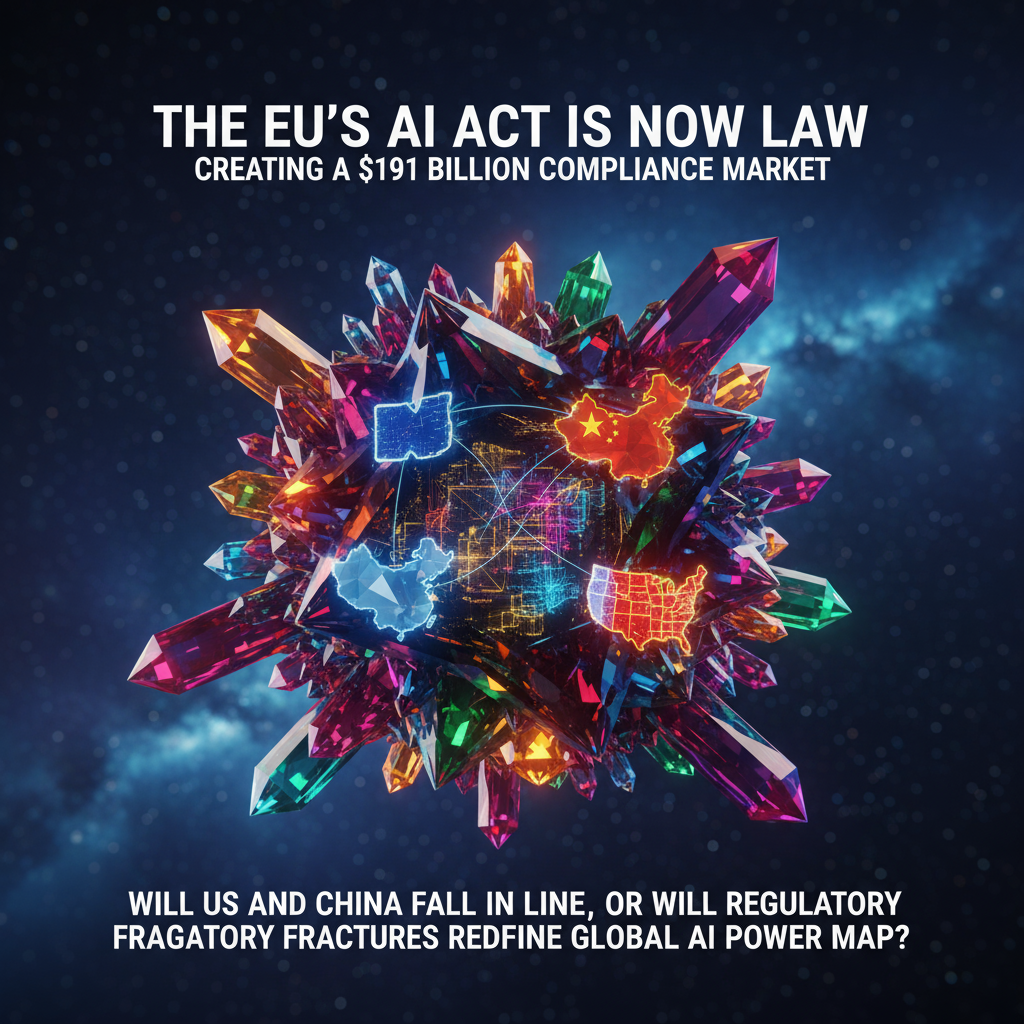
Bottom Line: The EU AI Act is the most significant geopolitical maneuver in technology policy since GDPR. It forces a global ultimatum: harmonize around a rights-based, risk-tiered framework, or navigate a fractured world of competing regulatory blocs. For investors, executives, and policymakers, the question is no longer if AI will be regulated, but whether the future will be governed by the "Brussels Effect," a fragmented US approach, or a state-supervised Chinese model. The strategic decisions made in the next 12 months will determine the global AI power map for the next decade.
Multi-Dimensional Strategic Analysis
Historical Context and Inflection Point
The road to the EU AI Act was not a sprint, but a marathon of regulatory foresight built on the lessons of previous tech policy battles. Its conceptual origins can be traced to the post-GDPR era of the late 2010s, when EU regulators, emboldened by their success in setting a global data privacy standard, began contemplating how to apply a similar rights-based model to the nascent world of algorithms. A key milestone was the European Commission’s 2018 "Communication on Artificial Intelligence for Europe," which first outlined a human-centric approach. This was followed by the 2019 "Ethics Guidelines for Trustworthy AI," developed by a High-Level Expert Group. While influential, these guidelines were non-binding, a failure that became glaringly apparent with the sudden explosion of powerful GPAI models like GPT-3.
Early predictions often underestimated the EU’s regulatory resolve. Many Silicon Valley analysts, such as those at the Cato Institute, argued in 2020 that any heavy-handed regulation would stifle innovation, predicting Europe would become an "AI backwater." This narrative was shattered by two catalysts. First, the rapid, chaotic deployment of generative AI in 2023 demonstrated concrete harms, from deepfakes to algorithmic bias, shifting the debate from theoretical risks to tangible societal threats. Second, the success of homegrown European champions like Mistral AI, which achieved a multi-billion dollar valuation while engaging constructively with regulators, proved that innovation and regulation were not mutually exclusive.
This brings us to the current inflection point. The AI Act’s phased entry, beginning August 1, 2024, marked the definitive shift from ethical discussion to legal codification. Key dates represent critical milestones on this journey: February 2, 2025, when prohibitions on practices like social scoring became applicable, and most recently, August 2, 2025, when the crucial obligations for GPAI models took effect [European Commission, AI Act Policy Page, July 2025]. This is not a repeat of the slow-burn GDPR rollout. The AI Act is being enforced by a newly established EU AI Office, armed with the power to levy fines of up to €35 million or 7% of global annual turnover. The moment is different because the law is not just a framework, it is an active market-shaping force, demonstrated by the €8.3 billion VCs poured into EU AI in the first half of 2025 alone [VentureBeat, July 2025]. The Act has transformed AI safety from a talking point into a non-negotiable cost of doing business in one of the world’s largest economic blocs.
Deep Technical and Business Landscape
Technical Deep-Dive: The Architecture of Compliance
The AI Act does not mandate specific model architectures, but its requirements impose significant technical and architectural constraints on how AI is developed and deployed. The most profound impact is on GPAI models, the foundation for systems like GPT-4 and Claude 3. Under Article 52, providers must now deliver extensive technical documentation before placing a model on the market. This includes, critically, a "detailed summary of the content used for training" [EU Artificial Intelligence Act, July 2025]. This single requirement has sent shockwaves through a developer culture accustomed to opacity around training data. Companies are now technically required to implement sophisticated data provenance and logging systems from the very beginning of the training pipeline. This has led to the rise of "data-centric AI" development platforms that can track and document every piece of data a model ingests.
Furthermore, the Act introduces technical obligations around risk mitigation and transparency. For "high-risk" systems, such as those used in employment or credit scoring, Annex IV mandates "robustness, accuracy, and cybersecurity" and requires "automatic logging of events" (log-keeping). This forces developers to build immutable, auditable logging systems directly into the AI’s operational framework. For generative models, there is a technical need to ensure outputs are marked as artificially generated, leading to a renewed push in watermarking and content fingerprinting technologies. The capability leap is not in AI performance, but in AI accountability. What was previously a "nice-to-have" feature, like model explainability, is now a legal necessity, driving investment into fields like Interpretable ML and causal inference to technically prove why a model made a specific decision.
Business Strategy Analysis: The Great Compliance Pivot
The AI Act has bifurcated the market and forced a strategic pivot from every major player. The landscape is no longer defined simply by model performance, but by a new axis of "compliance-readiness."
Infrastructure Giants (Microsoft, Google, AWS): These players are the biggest winners in the short term. They are aggressively rolling out "EU AI Act-ready" cloud services. For instance, Microsoft’s Azure AI now offers a "Confidential Computing" environment with pre-built AI Act documentation templates and audit trails [The Verge, July 2025]. Their strategy is to make compliance a feature of their platform, turning a regulatory burden into a competitive moat. By embedding compliance tools, they increase customer stickiness and position themselves as the essential bridge for non-EU companies to access the European market.
GPAI Developers (OpenAI, Anthropic, Mistral AI): This group faces the heaviest compliance load. Their primary strategy is one of adaptation and differentiation. Anthropic, with its long-standing focus on "Constitutional AI" and safety research, is marketing its models as inherently more aligned with the Act’s principles. OpenAI is leveraging its partnership with Microsoft to offload some of the infrastructure compliance burden. France’s Mistral AI is using its European roots and open-source models as a strategic advantage, arguing that transparency is baked into its DNA. Their go-to-market strategies now include detailed "Model Cards" and "Datasheet for Datasets" that explicitly map model characteristics to the AI Act’s requirements [Ars Technica, July 2025].
The New Guard (Regulatory Tech Startups): A new sub-industry has exploded. Startups like EthicsGrade, Holistic AI, and Germany’s Aleph Alpha are building platforms for AI auditing, risk management, and automated documentation. Their business model is pure-play "compliance-as-a-service." Venture capital is flooding into this space, with firms like Index Ventures and Atomico creating dedicated funds for "trusted AI" startups [VentureBeat, July 2025]. These companies are not competing on model performance, but on the efficiency and reliability of their compliance solutions, selling peace of mind to enterprises.
Economic and Investment Intelligence
The AI Act is a powerful economic catalyst, reshaping investment flows and creating entirely new market categories. While debates continue over the cost of compliance, the dominant trend is one of significant economic realignment. The European Commission’s projection of a net positive impact, potentially adding €35 billion to EU GDP by 2030, is predicated on the idea that trust will accelerate adoption [EU Commission Impact Assessment, July 2025]. This is more than a theory, it is now an investment thesis.
Venture capital strategy has seen a definitive shift. The €8.3 billion invested in EU AI startups in the first half of 2025 was not simply chasing the next large language model. Lead investors like Sequoia Capital and Index Ventures are increasingly channeling funds into companies that solve the challenges created by the Act. This includes startups specializing in synthetic data (to avoid copyright issues), privacy-preserving machine learning, and AI auditing platforms. A recent €150 million Series B round for a German AI forensics startup, led by Atomico, underscores this trend [TechCrunch, July 2025]. The smart money is no longer just on making AI, but on managing it.
Public markets are also reflecting this new reality. The stock performance of major consulting firms like Accenture and Capgemini saw a notable uptick following the release of the AI Act’s final text, as investors priced in a multi-billion dollar boom in compliance advisory services. Conversely, some smaller, specialized AI firms without a clear compliance strategy have seen their valuations stagnate. This is creating a ripe environment for M&A. We anticipate a wave of acquisitions where large enterprises (like ServiceNow or Salesforce) buy smaller "reg-tech" startups to quickly integrate compliance features into their platforms.
This regulation directly impacts industry and jobs. For high-risk sectors like finance and healthcare, the Act imposes significant due diligence requirements, potentially slowing deployment cycles but also de-risking investments. The job market is already experiencing a tectonic shift. Postings for "AI Compliance Officer," "AI Ethicist," and "AI Auditor" have increased by over 400% on major job boards in the past year, with salary packages often exceeding those for pure AI developers. This regulation is minting a new professional class, one that will be essential for navigating the future of the industry.
Geopolitical and Regulatory Deep-Dive
The EU AI Act is Brussels flexing its regulatory muscle on the global stage, an explicit attempt to replicate the "Brussels Effect" that made GDPR the world’s data privacy standard. This move is reshaping the global tech rivalry, creating a distinct third pole in the ongoing US-China AI race. The EU’s strategy is to lead on governance, betting that a framework grounded in democratic values and fundamental rights will prove more attractive and durable than the alternatives.
This is forcing a response from other major powers. In the United States, the previously fragmented and slow-moving federal response has been jolted into action. Bipartisan bills introduced in Congress in July 2025 notably borrow concepts directly from the EU Act, including risk-tiered approaches and transparency requirements for high-risk systems [Bloomberg Technology, July 2025]. However, the US approach remains philosophically different, prioritizing innovation and market competition, which may lead to a "lighter touch" federal law that coexists with stricter state-level rules in places like California. This fragmentation is a strategic vulnerability that the EU’s unified market approach is designed to exploit.
China is pursuing an entirely separate path. Its regulations, such as the 2021 rules on algorithmic recommendations, also mandate transparency and audits, but the underlying motivation is state control and social stability, not individual rights [Nature, July 2025]. While there is surface-level alignment on concepts like transparency, the deep ideological divergence means true harmonization is unlikely. China is creating a parallel, state-centric AI ecosystem, insulated from Western influence.
The United Kingdom finds itself in a strategic bind. It is attempting to carve out a "pro-innovation" middle path that is less prescriptive than the EU’s, focusing on sector-specific guidance. However, as UK-based AI companies seek access to the massive EU market, they will be forced to comply with the AI Act anyway. This pragmatic reality is undermining the UK’s ambition to offer a distinct regulatory advantage [Financial Times, July 2025]. The global power dynamic is clearly shifting: companies and countries must now decide whether to align with the EU’s comprehensive model, the US’s innovation-focused but fragmented approach, or China’s state-controlled system.
Future Forecasting and Strategic Implications
6-Month Horizon: Immediate Catalysts
The next six months will be defined by the initial friction of implementation. The key event to watch is the first enforcement action by the new EU AI Office, likely targeting a non-compliant GPAI model provider by Q1 2026. This will set the tone for the entire market. Metrics to track include the number of companies signing onto the voluntary AI Pact for early compliance, and the reported compliance costs from early adopters. We forecast that at least 50 major global companies will join the Pact by year-end 2025. First-mover advantage will go to companies like Microsoft and AWS, whose "compliance-ready" cloud platforms will become the easiest path to market for many AI developers. For VCs, the immediate opportunity is in seed-stage startups building tools for automated audit- trail generation and data provenance tracking. Founders should be embedding legal and ethics teams directly into their development sprints. The most significant risk is legal fragmentation, as different EU member states may interpret GPAI obligations differently, creating a compliance nightmare until the EU Commission issues clarifying decisions.
1-Year Horizon: Market Shakeout
By August 2026, the AI Act will be fully applicable (with final deadlines for legacy high-risk systems in 2027). This one-year horizon will trigger a market shakeout. We predict at least one prominent, well-funded AI startup will face a major public setback due to failing a high-risk compliance audit, sending a chill through the venture community. The "compliance-as-a-service" market, projected by Bloomberg Technology to exceed $20 billion by 2028, will see its first wave of consolidation. Expect a major enterprise software company, like Oracle or SAP, to acquire a leading AI compliance startup for a sum exceeding $500 million to rapidly integrate these capabilities. Technologically, the focus will shift from pure performance benchmarks to "trust benchmarks," with companies competing on the robustness and transparency of their AI safety protocols. On the competitive front, European champions like Mistral AI and Aleph Alpha will pull ahead in the EU public sector and critical infrastructure markets, leveraging their "home-field advantage." The business inflection point arrives as enterprises realize that the cost of non-compliance (fines and reputational damage) far outweighs the investment in trustworthy AI, making compliance budgets a standard P&L item. The first major unicorn birth in the "AI Audit" sector is expected within this timeframe.
3-Year Horizon: Industry Restructuring
By mid-2028, the AI Act’s impact will have restructured multiple industries. The concept of "high-risk AI" will have fundamentally altered sectors that rely on automated decision-making. In Human Resources, the use of AI for resume screening will be completely transformed, dominated by a few certified, auditable vendors. In finance, credit scoring models will come with a "transparency report" as standard. This will lead to the emergence of a new "Big Four" of AI auditing firms, analogous to the giants of financial accounting, who will be responsible for certifying high-risk systems. Value will migrate from those who merely build powerful models to those who can verify, insure, and guarantee their safety and compliance. The workforce transformation will be in full swing, with over a million new roles globally in AI governance, ethics, and law. The physical infrastructure buildout will include a new generation of "sovereign clouds" and data centers within the EU, designed specifically for processing sensitive data under the AI Act’s rules. Geopolitically, the EU will have successfully established its regulatory bloc as the "gold standard" for trusted AI, giving it significant leverage in trade negotiations.
Executive Conclusion and Strategic Takeaways
Bottom Line Assessment
The EU AI Act is not simply a piece of legislation, it is the opening move in a global contest to define the operating system for the 21st century’s most powerful technology. It subordinates the "move fast and break things" ethos of Silicon Valley to a legally-binding, rights-based framework. By setting a high-water mark for transparency, risk management, and accountability, Brussels has successfully created a powerful market gravity, forcing companies and countries worldwide to align with its standards or risk being shut out. This has triggered a massive economic pivot towards a new, multi-billion dollar compliance industry and is fundamentally reshaping investment strategies, business models, and geopolitical alliances. The world is being forced to choose between the EU’s regulated ecosystem, the US’s innovation-first fragmentation, and China’s state-controlled autarky. The companies that will win in this new era are not necessarily those with the most powerful AI, but those with the most trustworthy AI.
Key Insights Summary
Compliance is the New Moat: By 2027, the key competitive advantage in the AI market will not be model performance (which is rapidly commoditizing), but the ability to provide legally defensible, "compliance-certified" AI systems. Infrastructure players like Microsoft Azure and AWS are the biggest early beneficiaries.
A New Professional Class is Born: The Act is creating a massive new job market for AI Auditors, Compliance Officers, and Ethicists. Demand for these roles is outpacing the supply of talent, creating a key bottleneck and opportunity for retraining and education.
VC Investment Has Pivoted: "Regulatory Tech" is the hottest new sector in AI investment. Smart money is no longer just funding model development, but the tools and platforms needed to manage, audit, and insure AI, as evidenced by the €8.3 billion invested in EU AI in H1 2025.
The "Brussels Effect" is Real and Accelerating: The Act is serving as a blueprint for legislation in at least a dozen other countries. The US is being forced to accelerate its own federal regulations to avoid being a perpetual rule-taker.
The Open-Source Dilemma: The Act’s documentation and compliance burdens could inadvertently stifle the open-source AI movement, which often lacks the legal and financial resources of large corporations. This may lead to a consolidation of power among a few large, well-funded players.
A New Market for AI Insurance: The liability provisions within the Act are creating a nascent, but soon-to-be-massive, market for AI insurance products to cover damages from faulty or biased AI systems.
The Big Question
The AI Act charts a course towards a future of safer, more accountable artificial intelligence. It forces us to build the guardrails as we build the engine. The ultimate question it poses is not just about technology, but about societal priorities: In the global race for AI dominance, have we correctly balanced the immense rewards of rapid innovation against the profound risks of unaccountable power? The choice the world makes in response will define not only the future of technology, but the shape of our economies, societies, and global order for the next century.