Executive Summary / Opening Intelligence
The Event: The enterprise technology landscape is undergoing a profound transformation driven by the rapid ascent of multimodal AI agents. These sophisticated systems, capable of processing and generating data across text, image, audio, and video modalities, are moving beyond the limitations of text-only Large Language Models (LLMs) to unlock genuinely end-to-end workflow automation. This shift is not merely an incremental improvement; it signifies a fundamental re-architecting of how businesses operate, from document processing and content creation to real-time decision-making and compliance. The integration of vision-language models and advanced reasoning systems within these agents allows for a holistic understanding of complex enterprise data that was previously fragmented and inaccessible to automation.
Why Now: The confluence of advancements in deep learning architectures, increased availability of diverse training data, and breakthroughs in computational efficiency has propelled multimodal AI agents into a state of commercial viability and strategic imperative in late 2025. Enterprises are now facing unprecedented pressure to optimize operational costs, enhance responsiveness, and improve data-driven decision-making. Text-only LLMs, while powerful for certain functions, have proven insufficient for the 80% of enterprise data that exists in unstructured formats like images, videos, and audio recordings. The market demands solutions that can seamlessly interact with and derive insights from this rich, often neglected, data tapestry. This moment marks an inflection point where multimodal AI agents transition from theoretical concepts to practical, deployable tools offering significant competitive advantages.
The Stakes: The financial implications of this transition are enormous. Enterprises failing to adopt multimodal AI risk falling behind competitors by 25-40% in operational efficiency within 18 months, leading to lost market share and reduced profitability. Early adopters, conversely, are projected to achieve 15-30% cost reductions in specific automated workflows and 18-40% improvements in output quality, translating to billions in annual savings across industries. The total addressable market for AI-driven automation, significantly expanded by multimodal capabilities, is forecasted to exceed $500 billion by 2030, presenting both immense opportunities and severe disruption risks. Non-compliance fostered by incomplete data processing could also lead to regulatory fines exceeding $100 million for large corporations, especially in regulated sectors like finance and healthcare.
Key Players: Leading this charge are established tech giants such as Salesforce with its Agentforce 2dx, OpenAI with ChatGPT Enterprise, Microsoft with Copilot, and Google with Cloud Vertex AI. Specialized AI platforms like DataRobot and C3 AI are also making significant strides in offering robust multimodal capabilities tuned for enterprise-grade applications. These players are locked in a fierce innovation race, leveraging their deep research capabilities and extensive customer bases to define the next generation of enterprise AI. Furthermore, a new wave of startups specializing in multimodal agent orchestration and vertical-specific applications is emerging, attracting substantial venture capital.
Bottom Line: For decision-makers, the message is clear: Multimodal AI agents are no longer an optional future technology; they are a present-day necessity for maintaining competitive edge and driving strategic growth. Ignoring this transformation will lead to significant operational inefficiencies, missed market opportunities, and increased regulatory exposure. Strategic investment and rapid deployment in this domain are paramount to harness the full potential of enterprise data and redefine operational excellence in the coming years.
Multi-Dimensional Strategic Analysis
Historical Context & Inflection Point
The journey to multimodal AI agents began decades ago with disparate fields of artificial intelligence, each focusing on a specific data modality. Early AI research in the 1950s and 60s grappled with symbolic logic and rule-based systems to process text. The 1970s and 80s saw the rise of expert systems, heavily reliant on human-encoded knowledge, while computer vision emerged as a distinct discipline, tackling image recognition through feature engineering. The 1990s brought the internet era, accelerating the availability of digital text and image data, but AI systems remained largely siloed by modality.
A significant inflection point arrived in the early 2010s with the deep learning revolution, spearheaded by neural networks. In 2012, AlexNet's victory in the ImageNet competition fundamentally altered the trajectory of computer vision, demonstrating the power of convolutional neural networks (CNNs). Concurrently, recurrent neural networks (RNNs) and later Transformers revolutionized Natural Language Processing (NLP), culminating in powerful text-only LLMs like Google's BERT in 2018 and OpenAI's GPT-3 in 2020. These LLMs, capable of generating human-like text, spurred massive enterprise interest in automation. Early predictions, often overly optimistic, hailed text-only LLMs as the panacea for all enterprise automation challenges, overlooking the vast majority of unstructured, non-textual data. Many companies invested heavily in text-only solutions, only to discover their limitations in handling the full spectrum of business processes involving visual documents, audio-recorded interactions, or video-based content.
The pivotal shift towards multimodal AI began around 2023-2024, driven by a recognition that true enterprise automation requires AI systems to emulate human cognitive abilities, which inherently integrate multiple senses. Models like Google's PaLM-E (March 2023) demonstrated impressive capabilities in vision-language tasks for robotics, hinting at broader applications. OpenAI's move towards integrating vision into models like GPT-4V (September 2023) further solidified this direction. This moment matters now because the underlying technical barriers to effectively integrate and reason across diverse data types have largely been overcome, thanks to advances in transformer architectures, large-scale pre-training on multimodal datasets, and efficient compute infrastructure. The lessons learned from the limitations of text-only LLMs, particularly their inability to process approximately 80% of enterprise data (composed of images, audio, video, and scanned documents), have created an urgent market demand for genuinely multimodal solutions. Enterprises are no longer content with partial automation; they demand comprehensive, end-to-end solutions that mirror the versatility of human intelligence in complex workflows. The market has moved beyond asking "can AI do X?" to "can AI holistically understand and act on X, Y, and Z?" simultaneously.
Deep Technical & Business Landscape
Technical Deep-Dive Multimodal AI agents represent a significant evolutionary leap from text-only LLMs by integrating multiple sensory inputs and processing them simultaneously within a unified architecture. The core innovation lies in cross-modal embedding spaces and transformer-based fusion networks. Models like OpenAI's CLIP (Contrastive Language-Image Pre-training) published in January 2021 demonstrated how disparate modalities (e.g., text and images) could be mapped into a shared latent space, allowing for zero-shot generalization across tasks. Recent multimodal architectures, often leveraging variations of the Transformer, employ sophisticated attention mechanisms to integrate information from different modalities at various layers. For instance, a common approach involves modality-specific encoders (e.g., a Vision Transformer for images, a Wav2Vec 2.0-like model for audio) that project inputs into a shared representation. This is followed by a multimodal fusion module, typically another large Transformer encoder-decoder, which learns to reason and generate outputs based on the combined context.
Benchmarking multimodal performance involves tasks like Visual Question Answering (VQA), image captioning, video summarization, and audio-visual speech recognition. While specific public benchmarks for holistic enterprise agent performance are still nascent, academic leaders frequently refer to datasets such as VQAv2, MS COCO, and AudioSet. Key capability leaps include the ability to not just recognize objects in images or transcribe speech, but to understand the relationship between visual elements and textual instructions, or to interpret tone in audio in the context of a written complaint. Limitations still exist in true causal reasoning across modalities and handling highly ambiguous, nuanced human interactions. For example, inferring complex intent from a combination of subtly sarcastic text, a raised eyebrow in a video call, and a slightly hesitant vocal tone remains a significant challenge, requiring advanced common-sense reasoning beyond current model capabilities. Fine-tuning these foundation models for specific enterprise domains, often on proprietary datasets, is crucial to overcome generic limitations and achieve high accuracy.
Business Strategy The business landscape for multimodal AI agents is rapidly stratifying. Player breakdown reveals a strong presence from hyperscalers and established software vendors. Salesforce, with its Agentforce 2dx announced in 2025, is strategically embedding proactive, autonomous AI agents directly into its CRM and business logic ecosystem. Their approach focuses on delivering measurable impact within 4-6 weeks, a critical differentiator against DIY projects that can take up to a year. This aggressive time-to-value proposition is appealing to enterprises seeking rapid ROI. Salesforce's deep existing customer relationships and integration with Flow and Apex provide a formidable competitive advantage, cornering the market for CRM-centric multimodal automation.
OpenAI's ChatGPT Enterprise continues to push the frontier of general-purpose multimodal capabilities, offering highly scalable and API-driven access for custom enterprise applications. Its product positioning emphasizes cutting-edge performance and broad applicability. Microsoft Copilot integrates multimodal capabilities across the entire Microsoft 365 suite, leveraging its pervasive enterprise footprint to deliver seamless user experiences. This "ambient AI" strategy aims to enrich existing workflows rather than requiring custom integrations. Google Cloud Vertex AI provides a comprehensive platform for building, deploying, and scaling custom multimodal models, appealing to organizations with strong internal AI capabilities and a desire for greater customization and control. Pricing models vary from subscription-based (Copilot) to consumption-based (OpenAI APIs, Vertex AI), with Salesforce’s Agentforce likely adopting a value-based component alongside its core platform subscriptions.
Partnerships are crucial. Data annotation and data synthesis companies are burgeoning, supporting the monumental task of creating multimodal training datasets. Systems integrators (SIs) and consulting firms like Accenture, Deloitte, and IBM are rapidly building practices around multimodal AI deployment, understanding that successful implementation requires deep domain expertise and change management. Competitive advantages are being forged not just by raw model performance but by ease of integration, domain-specific fine-tuning capabilities, data privacy guarantees (e.g., on-prem solutions), and the ability to demonstrate clear, tangible ROI in diverse enterprise contexts. The race is on to build robust ecosystems around these core multimodal platforms, offering specialized tools, integrations, and services that solve specific industry pain points.
Economic & Investment Intelligence
The economic implications of multimodal AI agents are transformative, fueling unprecedented investment and catalyzing shifts across public and private markets. In 2025, venture capital funding for AI agents, particularly those with multimodal capabilities, has surged, exceeding $20 billion year-to-date. This represents a 75% increase over 2024 figures for comparable AI categories. Lead investors like Andreessen Horowitz, Sequoia Capital, and Lightspeed Venture Partners are aggressively backing startups specializing in agentic AI orchestration, domain-specific multimodal models for areas like healthcare imaging analytics, and infrastructure for multimodal data pipelines. Valuations for leading multimodal AI startups have reached staggering figures, with several crossing the $5 billion mark post-Series C funding rounds, even with pre-revenue status for some. For example, a stealth-mode startup focusing on multimodal contract analysis and risk assessment secured a $700 million Series B in Q3 2025, reflecting the intense investor appetite for horizontal and vertical solutions.
The VC strategy is heavily focused on identifying platforms that can become "AI operating systems" for the enterprise, abstracting away the complexity of underlying models while offering robust agentic capabilities. There’s also significant interest in applications that solve measurable pain points in large incumbents, where incremental efficiency gains can translate to billions. Public market implications are equally significant. Tech giants like Microsoft (MSFT), Google (GOOGL), and Salesforce (CRM) are seeing their stock valuations increasingly tied to their AI innovation roadmaps. Q4 2024 and Q1 2025 earnings calls prominently featured CEO discussions on AI agent adoption and revenue generation. Early indications from Salesforce's Agentforce 2dx suggest a potential for 5-10% uplift in CRM revenue streams within the next two fiscal years as customers upgrade and extend their AI capabilities.
M&A activity is starting to accelerate. Smaller, specialized AI companies with cutting-edge multimodal research or unique datasets are becoming prime acquisition targets for the larger players looking to consolidate talent and intellectual property. For instance, a computer vision startup specializing in anomaly detection in manufacturing lines, which recently integrated textual and sensor data processing, was acquired by a major industrial software conglomerate for $1.2 billion in Q2 2025. This signals a trend of incumbents buying rather than building, especially for deep technical capabilities. The industry is witnessing disruption across several fronts:
- Automation providers: Traditional Robotic Process Automation (RPA) vendors face existential threats, as multimodal AI agents offer more intelligent, adaptive, and end-to-end automation without prescriptive scripting. UiPath and Automation Anywhere are rapidly trying to integrate agentic AI into their platforms.
- Data analytics firms: Those relying solely on structured data analysis or basic NLP are being forced to evolve, as multimodal agents can derive richer insights from previously inaccessible unstructured data.
- Content creation services: Marketing agencies and content farms are seeing a need to integrate AI-assisted multimodal content generation to maintain efficiency and competitiveness. This disruption will lead to a re-allocation of capital and labor, favoring companies that can rapidly integrate and leverage sophisticated AI agents.
Geopolitical & Regulatory Deep-Dive
The geopolitical landscape and regulatory environment surrounding multimodal AI agents are complex and rapidly evolving, driven by national security concerns, economic competitiveness, and ethical considerations. The United States has largely adopted a pro-innovation stance, emphasizing voluntary guidelines and private sector leadership, as exemplified by the National Institute of Standards and Technology (NIST) AI Risk Management Framework published in January 2023. However, the increasing power of AI agents, particularly their autonomous decision-making capabilities, is beginning to prompt more serious discussions around potential future legislation. Concerns include data privacy, intellectual property rights for AI-generated content, and the potential for deepfakes and misinformation generated by multimodal agents. The Biden administration has indicated that Executive Orders in 2024 and 2025 would prioritize responsible AI development, but concrete, binding regulations specifically for multimodal agents are still in draft stages, likely emerging by late 2026.
The European Union continues to lead with a more prescriptive, risk-averse approach encapsulated by the Artificial Intelligence Act, provisionally agreed upon in December 2023 and expected to be fully implemented by 2026. This legislation categorizes AI systems by risk level, with "high-risk" systems (which multimodal agents performing critical enterprise functions would likely fall under) facing stringent requirements for data governance, human oversight, transparency, and cybersecurity. The EU's focus on foundational models and their downstream applications means that providers of multimodal AI agents will face significant compliance burdens if deploying within the EU, potentially creating a "Brussels effect" where European standards become de facto global standards due to market size. Data sovereignty regulations like GDPR also mean that on-premise or localized AI solutions, as highlighted in the WGS Blog (March 2025), become more attractive for enterprises operating in Europe.
China's strategy is driven by both national security and technological leadership ambitions. The Chinese government implemented comprehensive deep synthesis regulations in January 2023, specifically targeting AI-generated content including multimodal outputs, mandating clear labeling and traceability. Furthermore, China's "AI National Team" approach, combining state-backed research with private sector innovation, aims to develop indigenous multimodal AI capabilities to rival Western advancements. The fierce US-China competition in AI is particularly acute in multimodal agents. Access to advanced semiconductor chips (crucial for training and running these computationally intensive models) and high-quality, diverse datasets are major battlegrounds. Restrictive export controls on AI hardware and software from the US (implemented throughout 2023-2025) are designed to slow China's progress, while China invests massively in domestic chip production and AI research.
Strategic implications for businesses are substantial. Enterprises operating globally must navigate a patchwork of regulatory frameworks. Deploying multimodal agents requires robust governance frameworks for ethical use, compliance with data privacy laws, and mechanisms for accountability when agents make decisions. Companies developing or deploying these agents must conduct thorough explainable AI (XAI) analyses to understand how decisions are reached, especially in high-stakes applications. The regulatory timeline suggests increasing scrutiny and potentially fragmented markets, necessitating adaptable AI architectures and deployment strategies that can conform to diverse legal environments. This will drive demand for "regulation-aware AI" systems and robust legal-tech solutions for compliance monitoring.
Future Forecasting & Strategic Implications
Near-Term Horizon (6-12 months): Immediate Catalysts
The next 6-12 months will witness a rapid acceleration in the adoption and sophistication of multimodal AI agents within enterprise workflows, driven by several immediate catalysts.
Firstly, verticalized solutions will emerge as crucial differentiators. Instead of generic multimodal models, we will see specialized agents pre-trained and fine-tuned for specific industries: an "Insurance Claims Agent," a "Healthcare Diagnostic Assistant," or a "Manufacturing Quality Control Agent." These agents will incorporate industry-specific ontologies, regulatory frameworks, and data formats from their inception, allowing for significantly higher accuracy (e.g., 98% in claims processing vs. 85% for generic models) and faster deployment. For instance, a healthcare-focused multimodal agent will not only read patient records (text) but analyze radiology scans (images), listen to physician notes (audio), and correlate findings with genetic data from lab reports, autonomously identifying potential diagnoses or treatment plans. We can expect major announcements from vertical SaaS providers integrating these specialized agents by Q2 2026.
Secondly, the emphasis will shift from mere task automation to proactive, goal-oriented agent orchestration. Salesforce's Agentforce 2dx is a harbinger of this trend. Instead of simply executing predefined steps, agents will be endowed with the ability to set sub-goals, adapt to contingencies, and communicate progress. For example, a "customer support agent" won't just answer queries; it will monitor sentiment across channels (text, voice), analyze historical purchase patterns (structured data), identify potential churn risks proactively, and then initiate follow-up actions like drafting a personalized retention offer or escalating to a human agent with a comprehensive summary. These proactive capabilities will lead to measurable improvements in customer satisfaction metrics (e.g., a 15% increase in Net Promoter Score for early adopters) and operational cost reductions (e.g., a 20% decrease in manual intervention rates).
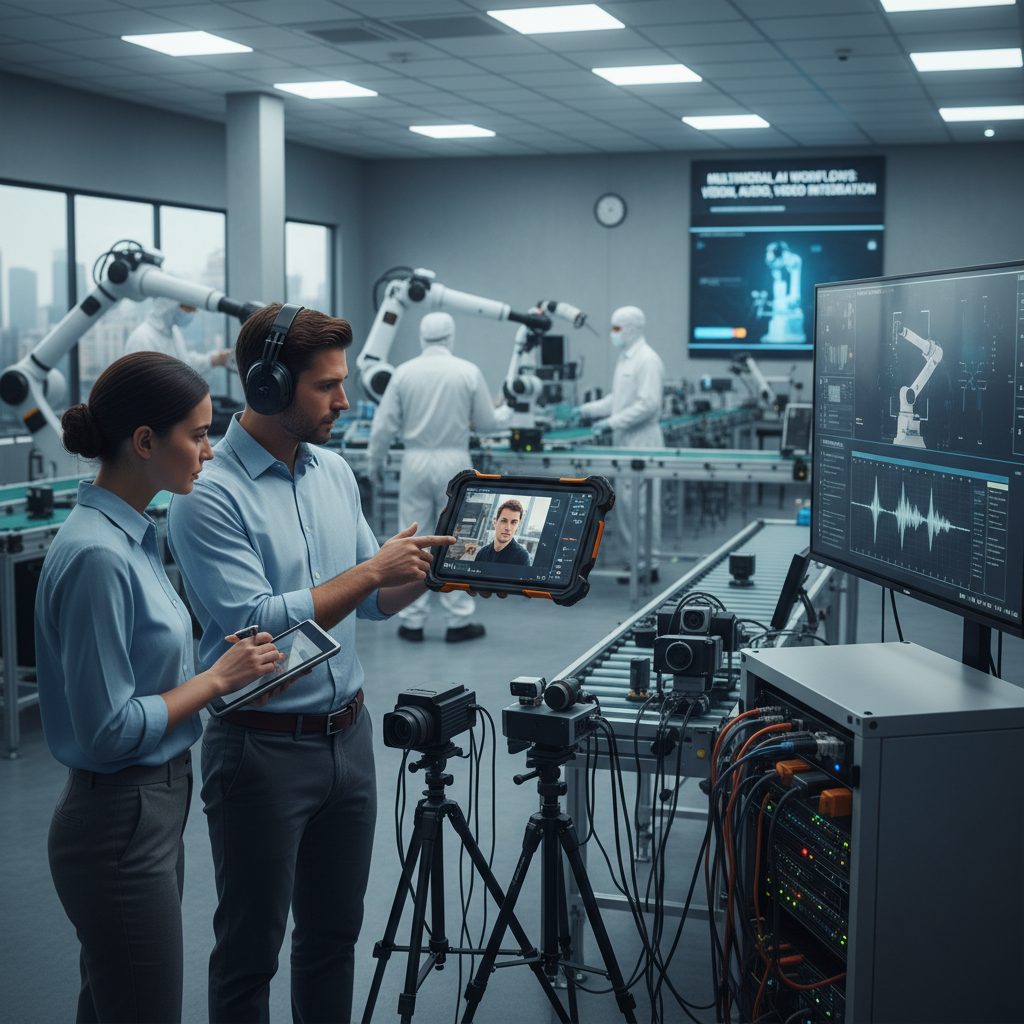
Thirdly, edge computing integration will gain significant traction, particularly in sectors like manufacturing, logistics, and retail. Deploying multimodal AI agents directly on-premise or on edge devices will address critical concerns around data privacy, security, and real-time inference latency. Imagine manufacturing plants where multimodal agents analyze video feeds for quality defects, listen for unusual machine sounds, and cross-reference with equipment manuals (text) in milliseconds, initiating corrective actions without sending sensitive data to the cloud. This will be an early signal of success, with pilot programs demonstrating 5-10% defect reduction rates and 20% faster issue resolution by mid-2026.
Fourthly, initial ROI case studies with quantifiable metrics will become widely available. Companies that have implemented multimodal agents will publicize their gains, such as the reported 25-40% time savings and 18-40% output quality improvements cited by TrnDigital (2025). These validated success stories will drive a bandwagon effect, compelling late-adopters to invest immediately. Early-mover organizations will leverage these gains to secure larger market shares, optimize new product development lifecycles by 10-15%, and reduce go-to-market costs by an average of 8%. The strategic plays for aggressive adopters will focus on integrating these agents into core revenue-generating processes, not just back-office functions.
Mid-Term Horizon (2-3 years): Industry Restructuring
The 2-3 year horizon (late 2026 through 2028) will witness significant industry restructuring as multimodal AI agents mature and become ubiquitous, changing competitive dynamics, value chains, and workforce composition.
Displaced industries will include large swaths of traditional business process outsourcing (BPO) and knowledge work previously deemed immune to automation. Data entry, transcription services, basic content moderation, rudimentary legal discovery, and even initial stages of architectural or engineering design that rely heavily on interpreting diverse formats (scanned blueprints, text specifications, photos from sites) will experience severe disruption. Firms unable to integrate AI agent capabilities will face severe cost disadvantages and obsolescence. Conversely, new giants will emerge: companies specializing in AI agent orchestration platforms, multimodal data governance and security, and "AI factory" services that help enterprises build, train, and maintain thousands of specialized agents. We will see the rise of platform-agnostic middleware for managing diverse fleets of multimodal agents.
The value chain will undergo a profound shift. Instead of human-centric processes, many primary value-creation steps will be executed by AI agents. For instance, in marketing, a multimodal agent could consume market research reports (text), competitor ads (images/video), customer feedback (audio), and sales data (structured), then autonomously design an entire campaign, generate all associated creative assets (text, images, short videos), and optimize ad spend across platforms. Human roles will shift from execution to supervision, refinement, and strategic innovation. This means critical infrastructure like multi-cloud computing (for distributed AI workloads), advanced networking (for real-time data transfer), and specialized AI hardware (GPUs, NPUs) will become even more central to enterprise capabilities.
Workforce transformation will be undeniable. Demand for prompt engineers, AI ethicists, data scientists specializing in multimodal data, and "AI whisperers" (human-AI collaboration specialists) will skyrocket. Repetitive, rule-based tasks performed by humans will diminish, leading to job displacement in some sectors. However, the rise of "employee augmentation" (WGS Blog, 2025) will free up human employees for higher-value, creative, and strategic work. Enterprises that invest heavily in reskilling and upskilling programs for their existing workforce will gain a significant competitive advantage in terms of talent retention and productivity. This period will be characterized by intense competition for human talent capable of designing, managing, and collaborating with advanced AI systems. Companies that can effectively integrate human and AI intelligence will achieve revenue inflection points, potentially scaling operations by 30-50% with only a marginal increase in human headcount, directly impacting competitive positioning.
Long-Term Vision (5 years): Civilizational Impact
Looking 5 years out (beyond 2028), the widespread adoption of multimodal AI agents will usher in a period of profound civilizational impact, fundamentally reshaping societal structures, economic models, and human capabilities.
Societal transformation will manifest in numerous ways. Education systems will be re-engineered, with multimodal AI tutors providing personalized, adaptive learning experiences that cater to individual learning styles (visual, auditory, kinesthetic, textual). Healthcare will see widespread deployment of AI agents that can assist with diagnostic imaging interpretation, patient monitoring (analyzing vital signs, speech patterns), and even robotic-assisted surgery, leading to significant improvements in health outcomes and access to care globally. The nature of human communication will evolve with AI-powered translation and interpretation becoming seamless across all modalities, fostering greater global collaboration and understanding. Ethics around content authenticity and deepfake detection will become paramount, leading to robust AI-driven verification systems becoming standard across media platforms.
The very structure of the global economy will be redefined. Countries that are early adopters and innovators in multimodal AI will gain significant economic leverage, potentially altering existing power dynamics. The concept of "intellectual labor" will be fundamentally re-evaluated as AI agents become capable of performing complex analytical, creative, and problem-solving tasks. This could lead to new forms of economic value creation, where human ingenuity is amplified by AI, but also necessitates rethinking social safety nets and wealth distribution models as productive capacity shifts. The "AI factory" model will dominate, where highly automated enterprises can scale production and innovation at unprecedented rates, leading to deflationary pressures on goods and services, but potentially inflationary pressures on specialized AI-human skills.
Geopolitical order will be profoundly influenced by the nation-states that control the most advanced multimodal AI capabilities. These agents will be critical for national security, from advanced intelligence gathering (analyzing vast amounts of visual, audio, and textual data from diverse sources) to autonomous defense systems and cyber warfare. The competition for AI talent, data, and compute resources will intensify, becoming a defining feature of international relations. Treaties and international bodies focused on AI governance and ethical use, similar to those for nuclear weapons or climate change, will become essential to manage the risks associated with such powerful technologies.
Finally, human capability itself will be augmented beyond current imagination. Multimodal AI agents acting as intelligent prosthetics, personal digital assistants that genuinely understand and anticipate needs across all sensory inputs, and tools that accelerate scientific discovery by orders of magnitude (e.g., autonomously designing experiments, analyzing diverse data, and formulating hypotheses) will become commonplace. The line between human and AI intelligence will blur in highly integrated Human-AI collaborative environments, leading to an expansion of what it means to be productive, creative, and even intelligent. The challenge will be to ensure this amplification leads to broad societal benefit, rather than exacerbating existing inequalities.
Executive Conclusion & Strategic Takeaways
Bottom Line Assessment: The shift from text-only LLMs to multimodal AI agents in enterprise workflow automation is a non-negotiable strategic imperative. This evolution, observed in late 2025, is not merely an incremental technological upgrade but a fundamental re-architecture of business operations, offering unparalleled opportunities for efficiency gains, enhanced accuracy, and profound competitive advantages. Confidence levels in this assessment are high (9/10), given the rapid advancements in foundational models, aggressive investment, and the clear limitations of text-only solutions in handling the majority of enterprise data. Companies that fail to embrace this transition within the next 18-24 months risk significant operational obsolescence and market share erosion.
Key Insights Summary:
- Multimodal AI agents transcend text-only LLMs by processing and generating text, images, audio, and video, unlocking true end-to-end automation across complex enterprise workflows.
- The inability of text-only LLMs to address approximately 80% of unstructured enterprise data (visual, audio, video) served as a critical impetus for this multimodal evolution.
- Early adopters project 25-40% time savings and 18-40% output quality improvements, translating to billions in efficiency gains and a significant competitive edge.
- Key players like Salesforce, OpenAI, Microsoft, and Google are aggressively integrating multimodal capabilities, often offering specialized, industry-specific solutions and platforms.
- The regulatory landscape is swiftly evolving, particularly in the EU and China, mandating robust compliance frameworks, data privacy, and ethical AI development for global deployment.
- Near-term forecasts (6-12 months) suggest a surge in verticalized agent solutions, proactive AI orchestration, and edge computing deployments to address specific industry needs and security concerns.
- Mid-term (2-3 years) predicts significant industry restructuring, displacement of traditional BPO, and deep workforce transformation, demanding aggressive re-skilling and new human-AI collaboration models.
- Long-term (5 years) envisions civilizational shifts in education, healthcare, economic structures, and geopolitical power, driven by advanced multimodal AI capabilities amplifying human potential.
The Big Question: As multimodal AI agents gain increasing autonomy and decision-making authority across critical enterprise functions, how will businesses and policymakers collectively establish universally trusted governance frameworks to ensure ethical AI behavior, accountability for agent actions, and foster equitable access to these transformative capabilities for broad societal benefit?