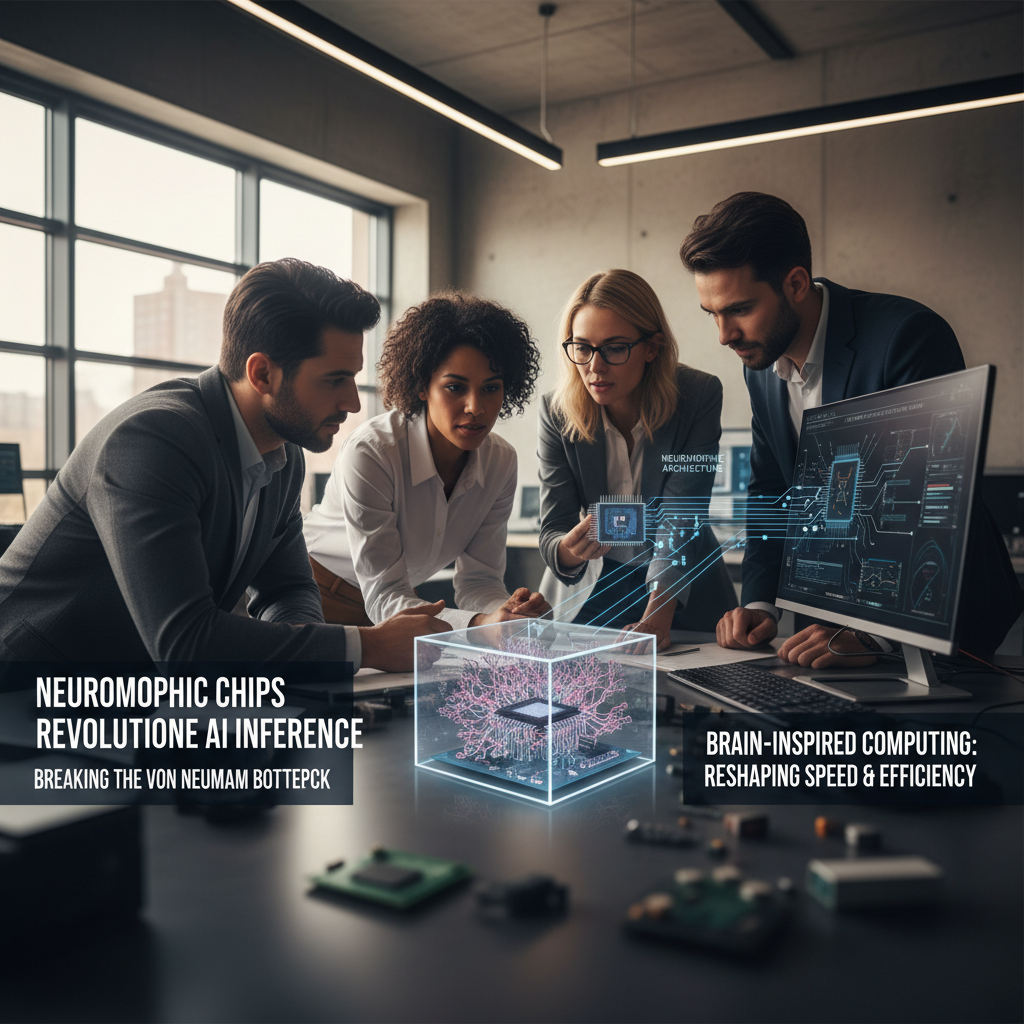
Executive Summary / Opening Intelligence
The Event: A fundamental architectural shift is underway in artificial intelligence hardware, driven by the increasing limitations of the traditional von Neumann computing model. Neuromorphic chips, inspired by the biological brain, are demonstrating unparalleled efficiency and speed gains for AI inference by fundamentally redesigning how computation and memory interact. This paradigm shift directly addresses the "von Neumann bottleneck," a long-acknowledged Achilles' heel of modern computing.
Why Now: The urgency for this shift has reached critical mass due to the escalating demands of deployable AI. Transformer-based models, now ubiquitous in natural language processing and computer vision, require immense computational resources. Their inference, while less demanding than training, still consumes significant power and introduces latency, particularly at the edge. Enterprise and hyperscale data centers are facing ballooning energy costs, with AI workloads being a primary driver. Furthermore, the push for ubiquitous, always-on AI in IoT devices, autonomous systems, and real-time decision-making necessitates a form of computing that is orders of magnitude more energy-efficient and faster than current general-purpose solutions. The maturity of non-volatile memory (NVM) technologies and advanced manufacturing processes makes large-scale neuromorphic chip production viable today.
The Stakes: The economic ramifications are colossal. The global AI chip market, valued at approximately $45 billion in 2023, is projected to exceed $300 billion by 2030, according to industry reports from IDC and KPMG. A significant portion of this growth will be driven by specialized inference accelerators. Companies unwilling or unable to adopt these new architectures for their AI deployments risk being outcompeted on cost, performance, and environmental footprint. Energy consumption from AI could rival that of small nations within the decade; breaking the von Neumann bottleneck is not just an optimization, but a necessity for sustainable AI growth. Billions of dollars in operating expenses and capital expenditure hang in the balance, alongside strategic advantages in AI productization.
Key Players: Leading this charge are established technology giants and innovative startups. IBM with its TrueNorth project and ongoing research in analog in-memory computing (e.g., phase-change memory arrays), Intel with its Loihi series of neuromorphic processors, and a cohort of well-funded startups such as Mythic, Rain AI, BrainChip, and SynSense are all at the forefront. Hyperscalers like Google (though largely focused on TPUs for dense matrix operations) are also exploring specialized architectures to optimize their massive inference loads. Policymakers in the US, EU, and China are increasingly recognizing neuromorphic computing as a strategic technology for national AI competitiveness and energy independence.
Bottom Line: Decision-makers must understand that the future of economically viable and ubiquitous AI inference hinges on moving beyond the limitations of sequential von Neumann architectures. Neuromorphic and in-memory computing offers a path to staggering improvements in energy efficiency and latency for key AI workloads. Strategic investment in these technologies, coupled with a deep understanding of their application-specific advantages, is paramount for maintaining leadership in the rapidly evolving AI landscape. Ignoring this architectural shift would be akin to doubling down on vacuum tubes in the transistor era.
Multi-Dimensional Strategic Analysis
Historical Context & Inflection Point
The quest for computational architectures that mimic the brain is not new. Early cyberneticists in the mid-20th century, like Warren McCulloch and Walter Pitts, laid the theoretical groundwork for artificial neurons in the 1940s. The Perceptron, invented by Frank Rosenblatt in 1957, was an early attempt at hardware-based neural computation. However, the subsequent dominance of the von Neumann architecture, with its clear separation of processing and memory, sidelined these biologically inspired approaches for decades. The reason was pragmatic: sequential computers were easier to program, more precise, and general-purpose enough to handle the nascent computational needs of the time efficiently.
Timeline with specific dates:
- 1945: John von Neumann publishes "First Draft of a Report on the EDVAC," formalizing the stored-program computer architecture. This design, while revolutionary, introduces the memory-processor bottleneck.
- 1957: Frank Rosenblatt invents the Perceptron, an early artificial neural network model. Initial hardware implementations are explored but face limitations.
- 1980s: Carver Mead at Caltech coins the term "neuromorphic engineering," advocating for very large scale integration (VLSI) systems that directly mimic neural structures and processes. This period sees the rise of analog neuro-computing research.
- 1990s-2000s: Deep learning sees a resurgence, largely driven by algorithmic advancements and the availability of powerful general-purpose CPUs and GPUs. However, the energy cost of running these models accelerates discussions around specialized hardware.
- 2008-2011: IBM initiates the SyNAPSE program, leading to the TrueNorth chip. Intel launches its Loihi project in 2017. These initiatives mark a significant industrial commitment to large-scale neuromorphic chip development.
- 2015-Present: Emergence of commercial startups focused on in-memory computing and analog AI accelerators, leveraging advancements in non-volatile memory (NVM) technologies like RRAM and PCM. This period signifies the transition from pure research to commercialization potential.
Failed predictions & lessons: Many previous predictions of neuromorphic computing's widespread adoption failed because the technology was too immature, difficult to program, and couldn't match the general applicability and rapidly improving performance of CPUs/GPUs. Researchers also underestimated the ability of conventional architectures to scale, albeit with increasing energy penalties. The key lesson learned is that neuromorphic systems must offer a compelling, quantifiable advantage for specific, high-value workloads to justify their specialized nature and the associated software ecosystem development. Mere biological inspiration is insufficient; practical benefits in energy, latency, and form factor are essential. Early attempts often focused on mimicking the brain's complexity without a clear path to commercial application or robust software tooling.
Why THIS moment matters: This particular juncture represents a true inflection point. First, fundamental physics is pushing current digital architectures to their limits; Dennard scaling has ended, and power density issues are paramount. Second, the ubiquity of AI inference is creating unprecedented demand for efficiency at the edge and in the cloud, where the von Neumann bottleneck's impact on energy and latency is most acutely felt. Third, the maturity of NVM technologies (RRAM, PCM, MRAM) provides the physical substrate to truly co-locate memory and compute in a non-volatile, high-density, and energy-efficient way. Fourth, recent breakthroughs in training techniques for Spiking Neural Networks (SNNs) and hybrid analog-digital AI models are closing the accuracy gap with traditional ANNs, making neuromorphic solutions practically viable for more complex tasks. This convergence of architectural necessity, application demand, and technological readiness makes today a pivotal moment.
Deep Technical & Business Landscape
Technical Deep-Dive
Neuromorphic computing fundamentally breaks from the synchronous, clock-driven, instruction-set architecture of von Neumann machines. Instead, it adopts an event-driven, asynchronous paradigm inspired by biological neurons.
Model architecture: The core architectural feature is the tight integration, or even physical fusion, of memory and processing elements. This is achieved through various means:
In-Memory Computing (IMC) with Non-Volatile Memory (NVM) Crossbar Arrays: This is a leading approach. Devices like Resistive Random-Access Memory (RRAM), Phase-Change Memory (PCM), and Magnetic Random-Access Memory (MRAM) are organized into dense crossbar arrays. Each memory cell within the array can store a weight (e.g., synaptic strength) as a varying resistance or conductance. Crucially, these arrays can perform analog matrix-vector multiplication directly within the memory array using Kirchhoff's and Ohm's laws. When voltages representing input activations are applied to the rows, currents representing weighted sums are generated in the columns simultaneously. This intrinsic parallelism and the elimination of data movement between separate memory and processing units are the primary mechanisms for bypassing the von Neumann bottleneck. For example, a single crossbar array operation can compute an entire layer's matrix multiplication, whereas a traditional CPU/GPU would fetch weights, multiply, accumulate, then store results in a sequential or pipelined fashion.
Spiking Neural Networks (SNNs): These are the closest computational models to biological brains. Instead of transmitting continuous activation values, SNNs communicate via discrete, asynchronous "spikes" or events. Neurons in SNNs "fire" only when their membrane potential (an internal state variable) crosses a threshold. The computation is therefore event-driven and sparse. If a neuron receives no input spikes, it consumes almost no energy. This contrasts sharply with Artificial Neural Networks (ANNs) which process continuous values and involve operations even for zero-valued inputs (e.g., ReLU outputs). SNN architectures map well to neuromorphic hardware because they naturally exploit this temporal and spatial sparsity for extreme energy efficiency.
Benchmarks:
- IBM TrueNorth (2014): A pioneering SNN chip with 1 million spiking neurons and 256 million synapses. Demonstrated 46 giga-synaptic operations per second per watt (GSynOPS/W) on specific image recognition tasks, consuming only 70 mW, orders of magnitude more efficient than contemporary CPUs/GPUs for sparse, event-driven pattern recognition. While not a direct speed comparison for dense ANNs, it proved the energy efficiency of event-driven processing.
- Intel Loihi (2017) / Loihi 2 (2021): These chips feature 128 (Loihi) or 1 million (Loihi 2) neuromorphic cores, each with local memory for neurons and synapses. Intel has reported 10-100x better energy efficiency for certain SNN workloads (e.g., gesture recognition, path planning, constraint satisfaction) compared to GPUs/CPUs, achieving speeds in real-time sensor processing that conventional architectures struggle with under similar power budgets. For instance, on a keyword spotting task, Loihi achieved over 1000x energy efficiency improvement over a mobile CPU while maintaining accuracy.
- Commercial Analog IMC Accelerators (e.g., Mythic M1076, Rain AI): While specific public production benchmarks against state-of-the-art GPUs are often proprietary, companies claim >10x energy efficiency gains (TOPS/W) for deep neural network inference on edge devices. Mythic's M1076, for example, is reported to achieve up to 35 TOPS at <4W, roughly 8.75 TOPS/W. A high-end GPU might deliver >100 TOPS, but at hundreds of watts, yielding a much lower TOPS/W. The critical advantage is keeping large model weights entirely on-chip within NVM arrays, virtually eliminating external memory accesses which dominate energy consumption in conventional chips.
Capability leaps and limitations: Neuromorphic chips excel in latency-critical, low-power, event-driven, or sparse applications like sensor processing, real-time control, pattern detection, and continual on-device learning. Their massive parallel in-memory computation makes them highly efficient for matrix-vector multiplications, the core operation of neural networks.
However, limitations exist:
- Programmability and Software Stack: The non-von Neumann architecture requires a different programming paradigm. Mainstream AI frameworks are optimized for dense, floating-point operations on GPUs. Developing compilers and toolchains to efficiently map diverse neural networks (especially dense ANNs) onto SNN or analog IMC hardware is an ongoing challenge.
- Precision: Analog computation inherently involves noise and variability. While many AI inference tasks are robust to reduced precision (INT8, INT4), achieving FP32 equivalent accuracy requires clever architectural design, calibration, and training techniques.
- Training vs. Inference: Neuromorphic chips are primarily optimized for inference. Training large, complex models on-chip remains an active research area due to weight updates requiring high precision and sometimes complex backpropagation algorithms that are not naturally suited to analog or spiking domains. Although in-situ learning and local plasticity rules are being explored.
Business Strategy
The business landscape for neuromorphic and in-memory computing is characterized by intense innovation, strategic partnerships, and a clear focus on high-value niche markets before broader displacement.
Player breakdown with specifics:
Integrated Device Manufacturers (IDMs):
- IBM: Continues to be a significant research player. Their focus is on advancing PCM-based analog in-memory computing for AI inference and exploring its commercial viability in IBM's enterprise AI offerings. While TrueNorth was a research platform, their current emphasis is on integrating analog AI acceleration into server-level solutions for hyperscalers and large enterprises.
- Intel: With Loihi and Loihi 2, Intel is positioning itself as a leader in SNN-based neuromorphic hardware. Through the Intel Neuromorphic Research Community (INRC), they are fostering an ecosystem of academic and industrial partners to explore applications ranging from robotic control to scientific computing. Their strategy appears to be building a platform technology and finding "killer applications" where their energy efficiency advantage is undeniable, initially for research and specialized embedded systems.
- Samsung, SK Hynix, Micron: While not pure neuromorphic players, these memory giants are heavily investing in novel NVM technologies (MRAM, RRAM, PCM) that are critical enablers for in-memory computing. Their strategic interest lies in broadening the applications of their memory products into computational domains.
Startups and Pure-Play Accelerators:
- Mythic: Emphasizes analog compute-in-memory using flash memory technology. Targets edge AI applications requiring high throughput at ultra-low power (e.g., smart cameras, drones, automotive). Their product, the Mythic AMP, integrates NVM and digital processing to handle full DNN inference on-chip.
- Rain AI: Similar to Mythic, focusing on in-memory computation through RRAM for efficient AI inference. Secured significant funding, looking to deploy in data centers and edge devices.
- BrainChip: Develops the Akida™ neuromorphic processor, architected specifically for SNNs. Targets always-on, low-power, on-device AI for embedded systems, IoT, and industrial applications. Provides a full software development kit (MetaTF) to convert ANNs to SNNs.
- SynSense: Spun out of the University of Zurich and ETH Zurich, commercializing neuromorphic vision and audio sensors, alongside processor chips. Their Xylo series targets ultra-low power event-driven AI for mobile and embedded applications.
Product positioning, pricing: These chips are generally positioned as specialized accelerators rather than general-purpose processors intended to replace CPUs or GPUs entirely.
- Edge/Embedded: Small form factor, ultra-low power consumption, real-time response. Priced competitively against other embedded AI accelerators (e.g., NVIDIA Jetson, Google Coral), but offering superior energy efficiency for specific tasks.
- Data Center/Hyperscale: Focus on TCO reduction through dramatically lower power consumption per inference, enabling higher density AI inference servers. Priced as premium accelerators, justified by operational savings and environmental benefits. Pricing models often involve silicon sales, but also intellectual property (IP) licensing for integrating neuromorphic cores into larger SoCs, and potentially software subscriptions for development tools.
Partnerships, competitive advantages:
- Ecosystem Development: Key partnerships involve software companies, system integrators, and large original equipment manufacturers (OEMs) to integrate these chips into final products. Intel's INRC is a prime example of building an ecosystem.
- Foundry and IP Collaboration: Partnerships with leading foundries (TSMC, GlobalFoundries, Samsung Foundry) are critical for manufacturing these advanced chips, often involving co-development of process technologies tailored for NVM-based compute.
- Algorithm-Hardware Co-design: Collaborations with AI research groups and developers to optimize SNNs and other sparse/low-precision models for energy efficiency gain. The competitive advantage lies in:
- Orders of magnitude better energy efficiency for targeted inference tasks.
- Ultra-low latency for real-time applications by avoiding memory bottlenecks.
- Smaller form factors and lower thermal envelopes, enabling AI where it wasn't previously feasible (e.g., tiny IoT devices).
- Enabling new AI capabilities such as dynamic learning on the device and processing sparse, event-driven data streams directly from specialized sensors (e.g., neuromorphic cameras).
Economic & Investment Intelligence
The economic landscape surrounding neuromorphic computing is dynamic, characterized by significant R&D investment, strategic venture capital deployment, and the promise of substantial market disruption.
Funding rounds, valuations, lead investors: Venture capital has flowed steadily into neuromorphic and in-memory computing startups over the past 5-7 years, reflecting confidence in the long-term potential.
- Mythic: Raised over $165 million across multiple rounds (Series A, B, C), with lead investors including SoftBank Ventures Asia, BlackRock, and Valor Equity Partners. Their valuation was reportedly around $500 million (as of 2021 funding rounds), though private valuations are fluid.
- Rain AI: Secured $25M Series A from Playground Global and others.
- Koniku: Focused on combining biological neurons with silicon, raised significant seed funding from firms like Jazz Venture Partners, suggesting interest in even more radical bio-hybrid approaches.
- SynSense: Raised over $40 million in Series A and A+ funding from investors including Robert Bosch Venture Capital (RBVC) and Prospect Avenue Capital, demonstrating strong institutional belief in their event-driven AI solutions for edge. These funding rounds indicate strong investor appetite for solutions that tackle the fundamental power and performance constraints of AI.
VC strategy, public market implications: VCs are employing a "picks-and-shovels" strategy, investing in foundational hardware that enables the next wave of AI applications. They understand that while software is critical, hardware innovation is becoming a differentiator. The strategy often involves:
- Early-stage investment (Seed/Series A): Backing startups with disruptive IP and strong technical teams, often spun out of university research.
- Strategic growth funding (Series B/C): Supporting productization, scaling manufacturing, and ecosystem development.
- Targeting immediate high-value markets: Focusing on edge AI, IoT, automotive, and data center inference where power efficiency is a critical determinant of product viability. The public market implications are significant. As these technologies mature, they will likely generate:
- Acquisition targets: Established semiconductor companies (e.g., Qualcomm, Broadcom, AMD, Intel, NVIDIA) and hyperscalers (Google, Microsoft, Amazon) will be keen to acquire leading startups to integrate their specialized IP.
- New public listings: Successful companies in this space may pursue IPOs, offering public investors access to the high-growth AI hardware market.
- Re-rating of incumbents: Companies agile enough to integrate these new architectures will see their market valuations bolstered, while those clinging solely to traditional architectures might face pressures.
M&A activity, industry disruption: While large-scale M&A activity focused purely on neuromorphic firms has been limited so far (major players are still early-stage), strategic acquisitions linking traditional chip design with NVM/IMC expertise are likely. Examples of this strategic interest are seen in NVIDIA’s acquisition of Mellanox (for high-speed interconnects crucial for data centers) and Intel's internal development of Loihi, rather than always acquiring. However, as certain startups gain traction, targeted acquisitions by larger tech firms to gain a foothold in this sector or solidify existing competitive advantages are highly probable.
Industry disruption will occur across several layers:
- Semiconductor Manufacturing: Foundries will need to adapt their processes for NVM integration and novel transistor architectures.
- AI Accelerator Market: Currently dominated by GPUs, this market will see increasing fragmentation, with neuromorphic and IMC chips taking significant shares in specific inference domains.
- System Design: OEM system architects for edge devices, automotive, and data centers will fundamentally rethink their hardware platforms to incorporate these specialized accelerators, leading to more heterogeneous computing.
- Software and Tools: A new ecosystem of compilers, libraries, and application-specific frameworks will emerge, shifting developer focus.
The estimated market for edge AI hardware alone is projected to reach over $50 billion by 2027 (Statista), with neuromorphic and IMC chips poised to capture a substantial segment by offering unprecedented performance per watt.
Geopolitical & Regulatory Deep-Dive
The development and deployment of advanced AI hardware, particularly neuromorphic chips, are inextricably linked to geopolitical competition and evolving regulatory frameworks. This domain is viewed as a critical component of national AI strategy and technological sovereignty.
US policy, EU regulations, China strategy:
- United States: The US government, primarily through entities like DARPA and the National Science Foundation (NSF), has been a long-standing funder of neuromorphic research (e.g., IBM's SyNAPSE program). Current policy emphasizes maintaining leadership in advanced computing, including AI hardware, to ensure national security and economic competitiveness. Export controls on leading-edge semiconductor technology, particularly to China, are a key tool. The CHIPS and Science Act of 2022 aims to bolster domestic semiconductor manufacturing and R&D, which directly benefits the ecosystem for advanced chips like neuromorphic processors. There is a strong push to ensure American companies are at the forefront of this technology.
- European Union: The EU's strategy revolves around fostering innovation within its member states while adhering to its strict data privacy (GDPR) and ethical AI guidelines. Initiatives like the Human Brain Project (HBP) have included neuromorphic hardware development (e.g., SpiNNaker and BrainScaleS projects), positioning the EU as a key player in academic research. Regulations like the AI Act, while primarily focused on software, will indirectly influence hardware design by ensuring transparency, robustness, and energy efficiency for AI systems, potentially favoring low-power neuromorphic solutions for certain applications. The EU's push for "digital sovereignty" includes developing indigenous capabilities in advanced semiconductors.
- China: China recognizes neuromorphic computing as a strategic domain to bypass reliance on Western chip architectures and achieve technological self-sufficiency in AI. Significant investments are being made by the central government and state-backed enterprises in research and development, aiming to catch up or even surpass the US in this area. Institutes like Tsinghua University are actively developing their own neuromorphic chips. China's "Made in China 2025" and subsequent national AI strategies explicitly prioritize advanced chips, including neuromorphic designs, emphasizing both military and economic applications. The US export controls have only accelerated China's efforts to develop domestic alternatives.
US-China competition, strategic implications: The US-China tech rivalry is a major driver in the neuromorphic chip space.
- Access to Talent and IP: Both nations are vying for top talent in neuromorphic engineering and are keenly aware of the strategic importance of intellectual property in this domain.
- Supply Chain Resilience: The pandemic and geopolitical tensions have highlighted vulnerabilities in global semiconductor supply chains. Both the US and China are investing in domestic manufacturing capabilities, including advanced packaging and specialized fabs for emerging architectures.
- Military Applications: The energy efficiency and real-time processing capabilities of neuromorphic chips have significant implications for defense applications, including autonomous weapons systems, sophisticated surveillance, and secure low-power edge AI for battlefield deployment. This raises concerns about maintaining a technological edge.
- Dual-Use Technology: Neuromorphic chips are inherently dual-use, capable of both civilian and military applications. This complicates export control regimes and necessitates careful policy consideration. The race is on to secure a first-mover advantage, or at least parity, in this critical technology.
Regulatory timeline:
- Past (2018-2023): Initial focus on general AI ethics and data privacy (GDPR). Export controls on advanced semiconductors (e.g., high-end GPUs to China) have been implemented.
- Near-Term (2024-2026): Expect more specific regulations related to AI hardware's energy consumption and carbon footprint, particularly for large data centers. Debates around traceability of AI models to specific hardware and their supply chains will intensify. Discussions on regulating the military use of AI, including hardware implications, will continue at international forums. Potential for new industry-specific standards for neuromorphic benchmarks and interoperability.
- Mid-Term (2027+): Possible formation of international consortia or regulatory bodies to manage the development and proliferation of highly advanced, potentially autonomous AI powered by neuromorphic processors. Policies addressing the "digital divide" in access to advanced AI hardware will gain prominence. Further tightening of export controls based on emerging capabilities of neuromorphic chips.
The geopolitical landscape dictates that neuromorphic computing is not just a technological challenge but a strategic imperative, shaping future economic power balances and national security postures.
Future Forecasting & Strategic Implications
Near-Term Horizon (6-12 months): Immediate Catalysts
The next 6-12 months will be crucial for validating neuromorphic computing's commercial readiness and establishing its initial foothold in key markets. Several catalysts will accelerate adoption and clarify the competitive landscape.
Events to watch, early signals:
- Release of Third-Generation Neuromorphic Processors: Expect Intel's follow-up to Loihi 2, potentially with higher neuron/synapse counts, improved power efficiency, and enhanced software tools for easier SNN mapping. Similarly, next-generation chips from startups like BrainChip, Mythic, and SynSense will feature increased density, improved analog-to-digital conversion, and more robust error correction, pushing performance boundaries. These releases are critical for showcasing tangible improvements over current devices.
- Major OEM Integrations: Look for announcements from Tier 1 automotive suppliers (e.g., Bosch, Continental), industrial automation companies (e.g., Siemens, ABB), and consumer electronics giants (e.g., Samsung, Qualcomm) announcing pilot programs or initial product integrations featuring neuromorphic or in-memory AI accelerators from their partners. These would signal market validation. For example, a major automotive manufacturer could announce a new advanced driver-assistance system (ADAS) module that leverages a neuromorphic chip for ultra-low-latency sensor fusion.
- Benchmark Standardizaton: The industry will likely see the emergence of specialized benchmarks for neuromorphic chips, beyond FLOPS or TOPS, focusing on metrics like "Events/Second/Watt," "SNN-TOPS/W," or "Latency-per-Inference-for-Sparsity." Organizations like MLPerf or specific industry consortia will be pivotal in defining these. This will allow for more direct and fair comparisons against conventional GPUs/CPUs on workloads where neuromorphic excels.
- AI Framework Extensions: Expect major AI frameworks (PyTorch, TensorFlow) to officially release, or significantly enhance, their support for SNNs and quantized low-precision models, including specific compilers or conversion tools for neuromorphic hardware targets. This reduces the friction for developers to experiment and deploy. For instance, enhanced ONNX support for SNN models could simplify deployment across heterogeneous hardware.
- Hyperscaler Pilot Deployments: Cloud providers like AWS, Azure, and Google Cloud might announce specialized instances or services featuring neuromorphic processing units (NPUs) for specific, customer-identified inference workloads (e.g., real-time data stream analytics, pervasive sensing). These limited deployments will serve as testbeds for scaling and integration challenges. These might be initially offered to select enterprise clients for specific niche applications where energy efficiency and latency are at a premium.
First-mover advantages, strategic plays: Companies that move swiftly to integrate neuromorphic capabilities into their product lines will gain significant first-mover advantages, particularly in:
- Edge Computing & IoT: Early adopters can deliver devices with unprecedented battery life and always-on AI capabilities (e.g., smart home devices that truly run AI locally without cloud dependence). This creates new application spaces and disrupts existing markets where power is a constraint.
- Real-time Autonomous Systems: In robotics, drones, and autonomous vehicles, the ultra-low latency and power of neuromorphic chips enable faster decision-making and longer operational times. A robotics company utilizing neuromorphic vision processing could gain a competitive edge in manufacturing or logistics.
- Cost-Leader in Inference as a Service: Hyperscalers leveraging neuromorphic hardware in their custom server designs could offer inference services at significantly lower operational costs per query, attracting price-sensitive customers and increasing their market share in specific inference categories.
- Proprietary Algorithm Development: Firms that concurrently develop novel SNN algorithms optimized for neuromorphic hardware will establish strong IP portfolios and create defensible Moats. This co-design strategy is critical, as off-the-shelf ANNs may not fully exploit the hardware's potential.
Strategic plays will involve deep partnerships between hardware vendors and software/application developers, establishing intellectual property through patents on architecture and algorithms, and targeted market entries focusing on pain points (power, latency) that conventional AI struggles to address economically. For example, a medical device company might partner with BrainChip to create a new generation of implantable bio-sensors that perform on-device anomaly detection with minimal power drain.
Mid-Term Horizon (2-3 years): Industry Restructuring
Over the next 2-3 years, neuromorphic and in-memory computing will catalyze a significant restructuring across several industries, redefining value chains and workforce demands.
Displaced industries, new giants:
- Displaced:
- Low-end, General-Purpose Edge AI Accelerators: Many current low-to-mid range FPGA and micro-GPU based edge AI solutions will be displaced, particularly in power-constrained environments, as neuromorphic chips offer superior energy efficiency and price-performance for specific tasks.
- Data Center Inference Farms for Repetitive Tasks: Existing cloud inference infrastructures that perform massive numbers of highly repetitive, low-latency, and sparse inferences (e.g., anomaly detection in logs, simple recommendation engines) will face severe power and cost pressure from specialized neuromorphic hardware, potentially leading to gradual migration.
- Traditional Sensor-to-Cloud Workflows: Industries reliant on continuously streaming raw sensor data to the cloud for processing (e.g., traditional smart cities, industrial IoT) will shift towards local, on-device neuromorphic processing, reducing bandwidth and storage costs.
- New Giants:
- Integrated Neuromorphic Solution Providers: Companies that successfully integrate hardware, software (SNN frameworks), and application-specific AI models will emerge as market leaders. These might be current startups or agile divisions of larger tech conglomerates.
- Specialized AI Foundry Services: Foundries capable of reliably producing specialized NVM and complex analog-digital mixed-signal chips will become highly strategic partners, experiencing increased demand and revenue.
- Neuromorphic IP Licensers: Companies owning critical neuromorphic IP (e.g., energy-efficient spiking neuron models, robust in-memory compute arrays) will thrive through licensing agreements with broader semiconductor manufacturers.
Value chain shifts, workforce transformation:
- Value Chain Shifts:
- From "Compute-centric" to "Data-Proximity" Design: The emphasis will shift from optimizing raw MIPS/FLOPS to optimizing data movement. This means closer collaboration between memory manufacturers, chip designers, and system architects. The "memory wall" becomes the central design challenge, shifting value away from pure processor speed to system-level integration of memory and compute.
- Algorithm Engineering Ascends: The ability to translate existing ANNs into efficient SNNs or design SNNs from scratch will become a premium skill. Similarly, optimizing algorithms for analog hardware constraints (noise, precision) will be key.
- Shift in Tooling: The value chain for AI software development will expand to include specialized compilers, simulators, and debugging tools for neuromorphic hardware, creating new software service opportunities.
- Workforce Transformation:
- Demand for Neuromorphic Engineers: A new class of hardware/software co-designers, proficient in SNN theory, NVM device physics, mixed-signal circuit design, and specialized AI frameworks, will be in high demand. Universities will adapt curricula to meet this need.
- Reskilling of AI Developers: AI product developers will need to learn how to frame problems in an event-driven or sparse computational paradigm. Existing ML engineers will require reskilling in SNN conversion techniques and neuromorphic programming.
- Rise of "AI Hardware Architects": Professionals specifically focused on designing heterogeneous AI systems that optimally combine conventional CPUs/GPUs with specialized neuromorphic accelerators will become indispensable.
Competitive positioning, revenue inflection:
- Competitive Positioning: Companies that leverage neuromorphic chips will aggressively position themselves as leaders in energy-efficient AI, real-time edge processing, and sustainable computing. This will differentiate them in environmentally conscious markets and provide a strong cost advantage. Enterprises deploying neuromorphic solutions will highlight their lower carbon footprint and operational costs.
- Revenue Inflection: A significant revenue inflection point is expected as the technology moves beyond initial pilot programs and into mainstream adoption within target niches. This could be triggered by large-scale deployments in industries like smart manufacturing (e.g., predictive maintenance with always-on sensors), autonomous logistics, or pervasive healthcare monitoring. The "hockey stick" growth will kick in once the software ecosystem matures and design tools become widely accessible, allowing more developers to easily integrate neuromorphic capabilities without deep hardware expertise. This could shift billions in CapEx and OpEx, fueling the growth of dedicated neuromorphic businesses.
Long-Term Vision (5 years): Civilizational Impact
Looking five years out, neuromorphic computing promises to instigate profound civilizational shifts, transforming not just technology but enabling new forms of societal organization, economic structures, and potentially reshaping human capabilities.
Societal transformation, economic structure:
- Ubiquitous, Invisible AI: Neuromorphic chips will enable truly ubiquitous and always-on AI that is embedded seamlessly into the environment, from smart materials to infrastructure. Imagine buildings that intelligently manage energy based on real-time occupancy and collective behavior, or predictive maintenance systems in public transport that anticipate failures with pinpoint accuracy and zero latency, all running on tiny, self-powered neuromorphic processors. This will lead to enhanced safety, efficiency, and comfort in daily life, often without explicit user interaction.
- Democratization of Advanced AI: By drastically reducing the power and cost of inference, advanced AI capabilities will become accessible to a wider range of devices and applications, particularly in developing regions. Low-power, low-cost AI can power off-grid solutions, precision agriculture in remote areas, or provide personalized healthcare diagnostics in rural communities, fostering greater economic inclusion.
- Hyper-Personalization and Real-time Adaptation: The ability to perform on-device, continual learning with neuromorphic chips will enable highly personalized AI experiences that adapt in real-time to individual users and dynamic environments. This reshapes sectors from personalized education and tutoring to bespoke manufacturing, where products can adapt to real-time feedback from their environment or users.
- Resource Efficiency Revolution: The energy efficiency of neuromorphic computing will become a critical component of global sustainability efforts. Data centers will dramatically reduce their energy footprint for inference workloads, and billions of edge devices will operate with minimal power, reducing e-waste and extending device lifespans. This contributes to global climate goals and addresses the looming energy crisis posed by escalating AI demands.
Geopolitical order, human capability:
- Shifting AI Power Dynamics: Nations that master neuromorphic technology, both in hardware design and application development, will gain significant geopolitical leverage. This could lead to a multi-polar AI world, with different regions specializing in different aspects of AI hardware. The US, EU, and China will fiercely compete for dominance, with implications for economic influence, military advantage, and technological standards. Nations unable to develop or access this technology may fall further behind in the global AI race.
- Enhanced Human-Machine Interfaces: The low-latency, event-driven nature of neuromorphic chips is ideal for direct brain-computer interfaces (BCIs) and advanced prosthetics. Seamless, intuitive control over robotic systems or digital environments could become commonplace, fundamentally extending human capabilities and interaction with the digital world. For example, neural prosthetics that process signals in real-time with biological-like efficiency could offer unprecedented fidelity for individuals with disabilities.
- AI as a "Natural Resource": Advanced neuromorphic systems may become so integral to infrastructure and daily life that AI begins to be viewed as a vital utility, akin to electricity or water. Control over the foundational hardware (neuromorphic chips) and the data processed by it will become a new form of geopolitical power.
- Exploration of Artificial General Intelligence (AGI): While speculative, if neuromorphic architectures can efficiently scale to brain-like complexities with their inherent energy efficiency, they may offer a more plausible hardware substrate for the development of Artificial General Intelligence (AGI). The ability to process information sparsely and learn continually, like a biological brain, could unlock new pathways for truly intelligent and adaptable AI systems, ushering in a new era of scientific discovery and human augmentation. This will ignite renewed ethical debates and policy discussions about the nature and control of superintelligent systems.
Executive Conclusion & Strategic Takeaways
Bottom Line Assessment: Neuromorphic computing, particularly through its embodiment in in-memory computing with non-volatile memory (NVM) and spiking neural network (SNN) architectures, represents a decisive and necessary architectural evolution that directly addresses the fundamental von Neumann bottleneck limiting AI inference today. Our assessment is with high confidence (9/10) that these technologies will move from niche applications to widespread adoption in specific, high-value domains over the next 3-5 years, fundamentally reshaping the AI hardware landscape. While not a universal replacement for all GPUs, their orders-of-magnitude advantage in energy efficiency and latency for event-driven, sparse, and low-precision AI workloads is undeniable and strategically critical for sustainable AI growth.
Key Insights Summary:
- Von Neumann Bottleneck is Costly: The persistent separation of memory and compute in traditional architectures leads to massive energy consumption and latency during data movement, costing enterprises billions annually.
- Brain-Inspired Solutions Offer Breakthroughs: Neuromorphic chips fuse memory and compute, leveraging NVM crossbar arrays and event-driven SNNs to achieve unprecedented power savings and real-time inference speeds.
- Targeted Excellence: These chips excel in edge AI, IoT, autonomous systems, and data center inference for specific, sparse workloads, often delivering 10-100x better energy efficiency than conventional GPUs.
- Ecosystem Development is Key: Maturing software stacks, standardized benchmarks, and broad industry partnerships are crucial for accelerating adoption beyond specialized research.
- Geopolitical and Economic Imperative: Neuromorphic computing is a strategic technology; nations and corporations that master it will gain significant economic and security advantages, influencing future AI leadership and market share.
- Industry Restructuring Underway: Expect significant shifts in hardware value chains, the emergence of new market leaders, and a demand for a specialized workforce skilled in hardware-algorithm co-design.
- Civilizational Impact is Broad: From ubiquitous, invisible AI and hyper-personalization to global resource efficiency and potentially enabling more advanced forms of intelligence, the long-term societal transformation is profound.
The Big Question: Given the inherent limitations of current deep learning models on traditional von Neumann architectures, will the next generation of AI breakthroughs come from purely algorithmic advancements, or will it be hardware-algorithm co-design on neuromorphic platforms that finally unlocks truly adaptive, continually learning, and massively energy-efficient intelligence, mirroring biology's success?