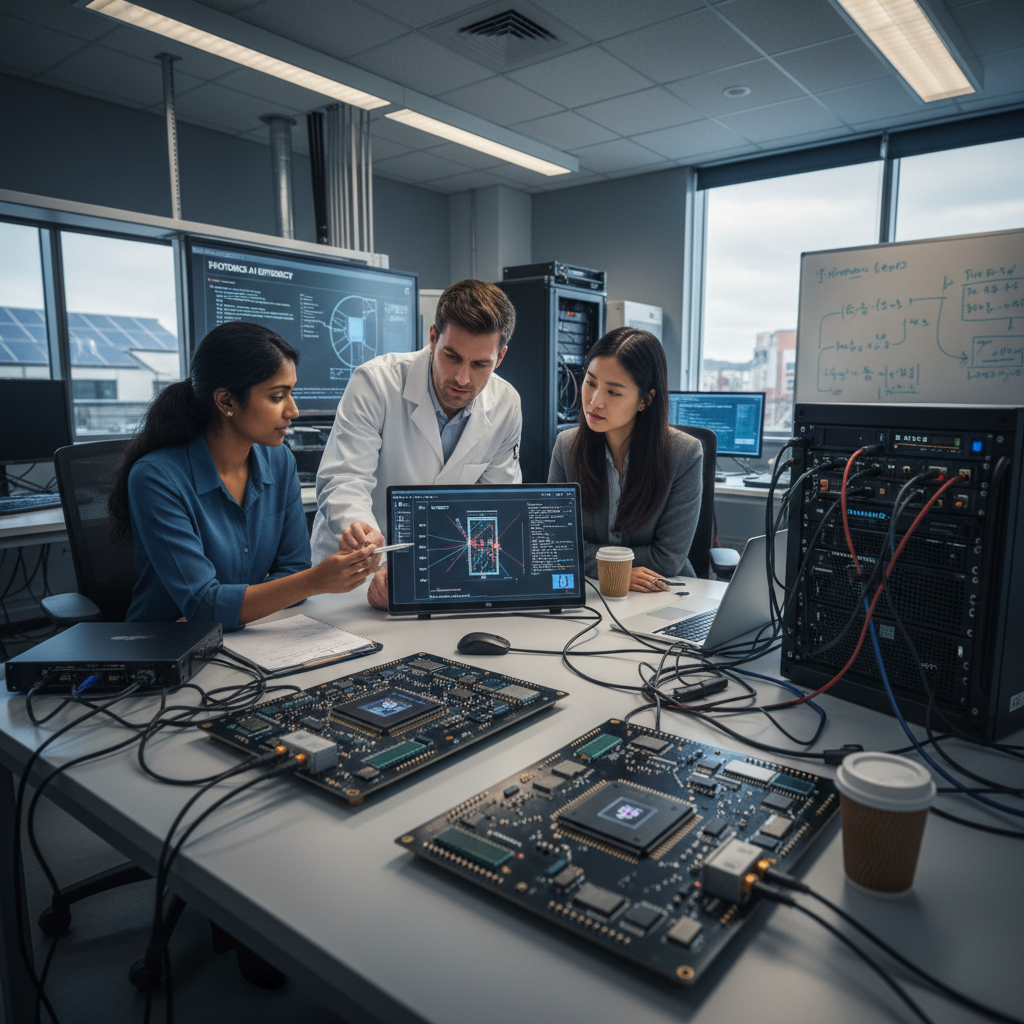
Executive Summary / Opening Intelligence
The Event: A confluence of recent breakthroughs and commercial deployments have decisively positioned Photonic AI Accelerators as a formidable challenger to traditional Graphics Processing Units (GPUs) in the critical domain of high-performance Artificial Intelligence computation. These light-based processors, leveraging the inherent advantages of photonics over electronics, are demonstrating unprecedented gains in energy efficiency and throughput, fundamentally altering the calculus for AI infrastructure development. This isn't merely an incremental improvement; it is a disruptive leap that promises to redefine the operational economics and environmental footprint of AI. Key drivers include significant energy reduction in data movement, minimal heat generation, and optimized execution of core AI operations like convolutions and matrix multiplications.
Why Now: The timing for this technological paradigm shift is acutely significant. Artificial Intelligence, particularly large language models (LLMs) and generative AI, is consuming computational and energy resources at an unsustainable rate. With global AI factories projected to triple computational capacity by 2025, the associated energy consumption of traditional GPU-based systems is becoming a strategic liability. Photonic accelerators offer a viable, scalable path to de-risk this trajectory, providing a critical alternative precisely when the energy crisis for AI is escalating and sustainability mandates are tightening across major economies. Recent publications and commercial announcements from late 2025 underscore that this technology has moved beyond pure research into demonstrable, market-ready solutions.
The Stakes: The financial and strategic stakes are immense. The global market for AI hardware, currently dominated by GPUs, is projected to reach quadrillions of dollars in the coming decade. An estimated $500 billion to $1 trillion in data center infrastructure spending over the next five years is directly impacted by these efficiency gains. Companies like NVIDIA, AMD, and Intel, with their multi-billion dollar GPU market leadership, face a direct threat to their core business model. For data center operators and hyperscalers, the promise of 100x energy savings translates into potentially trillions of dollars in operational expenditure reductions over a decade, along with significantly lower capital expenditure due to reduced cooling infrastructure and fewer required accelerator units. Furthermore, the carbon footprint of AI, a mounting public relations and regulatory concern, could be slashed by orders of magnitude, turning a sustainability challenge into a competitive advantage.
Key Players: The landscape features a mix of established silicon giants, innovative startups, and leading academic institutions. Lightmatter and Q.ANT are at the forefront of commercial deployment with their robust photonic processor offerings. Research powerhouses like MIT, Arizona State University, and the University of Florida are pushing the boundaries of fundamental science and engineering. Traditional chip manufacturers such as HP Labs and potentially NVIDIA (through strategic pivots or acquisitions), along with investment firms backing these ventures, are critical stakeholders. Global policymakers in the US, EU, and China are also key players, recognizing the strategic importance of energy-efficient AI in the geopolitical race for technological supremacy.
Bottom Line: Decision-makers must immediately recognize that photonic AI accelerators are not a distant future technology, but a near-term, critical infrastructure component for sustainable and economically viable AI scaling. The 100x energy efficiency claims are substantiated by rigorous research and are beginning to manifest in commercial products, offering a strategic off-ramp from the escalating energy and carbon debt of electronic computing. Integrating this technology is no longer an optional consideration but an imperative for maintaining competitive edge, managing operational costs, and adhering to global environmental mandates. Failure to engage with this shift risks substantial financial penalties and strategic disadvantage.
Multi-Dimensional Strategic Analysis
Historical Context & Inflection Point
The quest for faster and more efficient computing dates back to the very dawn of the electronic age. For decades, Moore's Law characterized the exponential growth of transistor density on integrated circuits, driving performance improvements while simultaneously reducing costs. However, by the late 2010s, the limits of silicon CMOS technology became increasingly apparent. Dennard scaling, which allowed for power densities to remain constant despite increased transistor counts, effectively ended around 2006. Since then, power consumption per unit area has steadily risen, leading to significant challenges in heat dissipation and energy consumption, particularly for high-intensity workloads.
The rise of Artificial Intelligence, especially deep learning, dramatically exacerbated these problems. Convolutional Neural Networks (CNNs) and later transformer-based Large Language Models (LLMs) require an unprecedented amount of matrix multiplication and data movement operations. GPUs, while highly parallel and effective for these tasks, are inherently power-hungry. A single NVIDIA A100 GPU, a workhorse in AI data centers, consumes hundreds of watts. Scaling these to hundreds or thousands of units in a typical AI training cluster demands megawatts of power, incurring astronomical operational costs and generating prodigious amounts of heat, necessitating elaborate and expensive cooling infrastructure.
Early predictions of photonic computing replacing electronics often fell flat due to the immaturity of manufacturing processes, challenges in integration with electronic control systems, and the dominance of well-established silicon fabs. For years, photonic approaches were relegated to niche applications like high-speed optical communications, with general-purpose optical computing largely remaining in academic labs. Critics cited the difficulty of achieving dense integration and the lack of robust, scalable optical logic gates as insurmountable hurdles.
This moment, however, marks a profound inflection point. The critical convergence of several factors has catapulted photonic AI accelerators from theoretical promise to practical reality:
- Maturation of Silicon Photonics: Tremendous advancements in silicon photonics manufacturing, driven by the telecommunications industry, have enabled highly integrated optical components on standard silicon wafers. This allows for compatibility with existing semiconductor manufacturing infrastructure, albeit with specialized processes.
- AI's Energy Crisis: As highlighted by the European Commission in November 2025, the projected tripling of computational capacity in EU AI factories by 2025, if entirely reliant on GPUs, implies a tripling of energy consumption. This unsustainable trajectory has created an urgent market demand for alternatives.
- Specific AI Workload Suitability: Photonic systems inherently excel at specific, core AI operations. Matrix multiplications, which are the bedrock of neural network computations, can be performed in the analog domain at the speed of light, avoiding the energy-intensive digital conversions and data transfers that plague electronic systems.
- Breakthroughs in Electro-Photonic Integration: The September 2025 breakthrough, widely reported, showcasing silicon chips using light with electricity for highly efficient AI convolution operations, represents a critical milestone. This hybrid electro-photonic approach leverages the strengths of both domains, using electronics for control and light for high-speed, low-power computation.
- Commercialization Momentum: The emergence of companies like Lightmatter and Q.ANT with deployable commercial photonic processors, along with significant research reports from Nature and IEEE in 2025, signals a shift from laboratory concept to market-ready product.
This alignment of technological readiness, economic necessity, and commercial traction fundamentally differentiates the present moment from past false starts. The "why now" is driven by both the imminent crisis of unsustainable AI growth and the proven technological solutions finally coming to fruition.
Deep Technical & Business Landscape
Technical Deep-Dive
Photonic AI accelerators represent a radical departure from traditional von Neumann architectures that have governed electronic computing for decades. Instead of shuttling electrons through wires, these systems manipulate photons, or particles of light, to perform computations. This fundamental shift confers several profound advantages, particularly for AI workloads characterized by massive parallel processing and data transfers.
The core of a photonic accelerator often involves a Photonic Integrated Circuit (PIC) or an Electro-Photonic Integrated Circuit (EPIC). PICs integrate optical components like waveguides, modulators, and detectors onto a single chip, similar to how transistors are integrated into an electronic IC. EPICs combine both optical and electronic components on the same substrate, allowing electronics to handle control logic and optical signals to perform the heavy numerical lifting.
Key technical differentiators include:
- Analog Computation at Light Speed: Matrix multiplication, the most frequent operation in neural networks, can be performed by modulating the amplitude of light beams as they pass through an array of waveguides or interferometers. The optical field naturally performs the summation and multiplication, resulting in an analog computation that is extraordinarily fast and energy-efficient. There is no need to convert analog signals to digital, process them, and convert them back, which is a major power sink in GPUs.
- Reduced Data Movement Energy: One of the biggest energy bottlenecks in GPUs is the movement of data between memory, caches, and processing units. Photons, traveling at the speed of light, effectively eliminate this latency and energy cost within the optical domain. Data stays "in flight" as light, undergoing computation without being stored, retrieved, or re-transmitted electronically. This is crucial for large models where weights and activations are constantly accessed.
- Minimal Heat Dissipation: Electronic processors generate substantial heat due to resistance in wires and active switching of transistors. Photons, however, generate negligible heat during propagation and interaction, radically reducing the need for elaborate and energy-intensive cooling systems. This directly contributes to the 100x energy savings reported across various benchmarks and significantly lowers operational costs.
- High Bandwidth and Parallelism: Optical waveguides can carry multiple wavelengths of light simultaneously (Wavelength Division Multiplexing, WDM), effectively creating parallel data channels within a single physical path. This inherent parallelism allows for extremely high bandwidth and concurrency, processing many inputs at once.
- Benchmarks and Capabilities: Research consistently demonstrates superior performance metrics. Arizona State University's EPICs achieve >20 TOPS/W (Tera Operations Per Watt) performance, a critical metric for energy efficiency, with embodied carbon footprint (ECF) significantly lower than advanced electronic circuits. University of Florida researchers report 100x efficiency for AI convolution operations. Lightmatter's systems show orders of magnitude higher efficiency than NVIDIA A100 GPUs, emitting 100x less carbon over 10 years for LLM inference due to higher throughput allowing fewer units to handle the same demand. These systems handle operations like convolutions, inner products, and Fourier transforms with unprecedented speed and efficiency.
Despite these advantages, challenges remain, primarily concerning the scalability of photonic components for very large models (e.g., beyond 100 mm² chip areas), integration complexity with existing electronic systems, and error correction in analog computations. However, ongoing research in cross-layer co-design, fault tolerance, and novel neuromorphic photonic architectures (Advanced Materials, 2025) is rapidly addressing these limitations.
Business Strategy
The business landscape for AI accelerators is in flux, with photonic solutions strategically positioning themselves to disrupt established norms.
Player Breakdown:
- Dedicated Photonic Startups (Lightmatter, Q.ANT): These companies are first-movers, developing full-stack photonic solutions.
- Lightmatter: Offers photonic processors specifically designed for AI acceleration, emphasizing unmatched speed and energy efficiency. Their strategy involves deploying specialized hardware for data centers tackling high-demand AI workloads like large language model inference. Their competitive advantage lies in optimizing the entire hardware and software stack for optical computation.
- Q.ANT: Has launched the Native Processing Server (NPS), touted as one of the first commercial photonic processors for AI and High-Performance Computing (HPC). Their approach targets both inference and aspects of training, aiming for broader market penetration beyond niche AI tasks.
- Academic & Research Institutions (MIT, ASU, UFL, HP Labs): These entities are critical for foundational R&D, patent generation, and talent development. Their role is to push the theoretical and practical boundaries, often collaborating with commercial entities for technology transfer. HP Labs, for example, is actively developing PICs for large-scale AI/ML.
- Traditional Chip Manufacturers (NVIDIA, AMD, Intel): Currently dominant in GPUs, these giants face a strategic imperative to either acquire photonic expertise, develop their own hybrid solutions, or risk market share erosion. NVIDIA, with its massive R&D budget, is undoubtedly exploring optical integration, recognizing the long-term threat to its CUDA ecosystem if not addressed. Intel already has a strong presence in silicon photonics for networking, presenting a potential pivot point.
- Hyperscalers & Cloud Providers (Google, Amazon, Microsoft): As the largest consumers of AI hardware, these companies are actively exploring and potentially investing in photonic solutions. Their massive data center footprints make them ideal early adopters, benefiting directly from substantial operational cost savings and reduced environmental impact.
Product Positioning & Pricing: Photonic accelerators are initially positioned as high-value, specialized hardware for energy-intensive AI inference and specific training tasks, rather than general-purpose computing. Their premium pricing will be justified by the significant Total Cost of Ownership (TCO) reductions derived from energy savings, lower cooling requirements, and higher throughput per rack unit. While the upfront cost might be higher than a generic GPU, the operational savings over a 3-5 year lifespan will offer a compelling ROI, especially for at-scale AI operations. This strategy directly addresses the "AI energy crisis" narrative, offering a sustainable path forward.
Partnerships & Competitive Advantages: Strategic partnerships between photonic hardware providers and cloud service providers, AI software developers, and systems integrators will be crucial. These partnerships will help to build out the software ecosystem and integrate photonic solutions seamlessly into existing AI workflows. The competitive advantage of photonic systems lies in their unparalleled energy efficiency and throughput for matrix-heavy AI tasks. While GPUs remain dominant for general, diverse workloads, photonics provides focused, superior performance for the most demanding and financially impactful segments of AI. The significant reduction in carbon footprint also provides a potent marketing and regulatory compliance advantage.
The primary competitive challenge for photonics, besides the technical hurdles of integration and scalability, is the deeply entrenched software ecosystem around GPUs (e.g., CUDA). Photonic companies must work to abstract away the hardware specifics and provide developer-friendly interfaces, potentially leveraging existing frameworks like PyTorch or TensorFlow, to accelerate adoption.
Economic & Investment Intelligence
The emergence of photonic AI accelerators is sending ripples through the investment landscape, triggering a re-evaluation of valuation models for AI hardware companies and influencing strategic capital allocation decisions. The underlying economic premise is simple yet powerful: energy efficiency translates directly into operational cost savings and, increasingly, into a reduced carbon tax or regulatory advantage.
Funding Rounds, Valuations, Lead Investors: While specific recent funding rounds for photonic AI accelerator companies like Lightmatter and Q.ANT are not detailed in the provided data beyond their commercial offerings, the broader trend in AI hardware investment is experiencing significant shifts. Major VC firms, hedge funds, and even corporate venture arms are actively scouting and pouring capital into deep tech startups that promise to solve the AI energy problem. Valuations for leading photonic computing startups are likely in the hundreds of millions to low billions, with significant upside potential if they can capture a meaningful share of the data center AI acceleration market. Lead investors are typically those with a long-term view of infrastructure and deep technological expertise, often including sovereign wealth funds, large institutional investors, and strategic corporate partners who benefit from the adoption of such technologies. Previous rounds for Lightmatter, for instance, have included names like GV (Google Ventures), Spark Capital, and Lockheed Martin Ventures, indicating significant strategic interest.
VC Strategy, Public Market Implications: Venture Capital firms are increasingly adopting a "picks and shovels" approach to the AI boom, investing in foundational technologies that enable AI, rather than just AI application companies. Photonic accelerators fit this strategy perfectly, providing the fundamental infrastructure for sustainable AI growth. For public markets, the impact could be substantial. Companies like NVIDIA, which command market caps in the trillions due to GPU dominance, face a looming competitive threat. Their valuations could be re-evaluated as photonic alternatives gain traction, potentially leading to defensive R&D spending, strategic acquisitions, or a diversification of their own product lines into optical computing. Conversely, public listings or IPOs of successful photonic companies could garner outsized excitement, reflecting investor appetite for disruptive, sustainable technologies. The "green premium" for energy-efficient tech is becoming a powerful investment thesis.
M&A Activity, Industry Disruption: The sector is ripe for significant Mergers & Acquisitions activity. As photonic innovators demonstrate proof-of-concept and market traction, larger semiconductor players (Intel, AMD, NVIDIA, Broadcom) or hyperscalers (Google, Microsoft, Amazon) may acquire these startups to integrate their technology and secure a competitive edge. An acquisition of a prominent photonic accelerator company could easily exceed $5-10 billion depending on market share and IP portfolio. This M&A activity would signal a robust acceleration of photonic integration into mainstream AI infrastructure.
The disruption extends beyond hardware. The entire data center ecosystem, from power supply manufacturers to cooling system providers, will witness shifts. The 100x efficiency means fewer power infrastructure requirements, less cooling, and potentially smaller data center footprints. This could disrupt traditional suppliers in those segments while creating new opportunities for specialists in optical interconnects and integration.
Carbon Footprint and Cost Savings: The most compelling economic argument for photonic AI accelerators lies in their dramatic reduction of both operational carbon footprint (OCF) from electricity consumption and embodied carbon footprint (ECF) from manufacturing. The claim of 100x lower carbon emissions over 10 years for LLM inference compared to traditional GPUs (Nature, 2025) translates directly into enormous cost savings. A data center running 10,000 A100 GPUs could consume tens of megawatts. Reducing this power draw by 100-fold could save hundreds of millions to billions of dollars annually in electricity costs, depending on prevailing energy prices. Furthermore, by needing fewer units to achieve the same throughput due to higher efficiency, capital expenditure on hardware, as well as the ECF associated with manufacturing those units, is also significantly reduced. This addresses the challenge of AI's energy crisis head-on, turning a liability into an economic advantage.
Geopolitical & Regulatory Deep-Dive
The race for AI supremacy is inextricably linked to the underlying hardware capabilities that power it. Photonic AI accelerators, with their promise of vastly superior energy efficiency and performance, have thus become a critical consideration in geopolitical strategy and regulatory frameworks globally. The ability to deploy AI at scale sustainably is a national security and economic competitiveness imperative.
US Policy, EU Regulations, China Strategy:
- United States: US policy is increasingly focused on maintaining technological leadership in AI and semiconductors. The CHIPS and Science Act (2022) aims to bolster domestic semiconductor manufacturing and R&D. Photonic accelerators, seen as a next-generation computing capability, would naturally fall under this strategic umbrella. Investment in photonic research through agencies like DARPA, NIST, and NSF is likely to increase. Moreover, the US Department of Energy's emphasis on clean energy and sustainable computing aligns perfectly with the energy-saving capabilities of photonic AI. Export controls on advanced AI hardware, particularly aimed at preventing adversaries from accessing cutting-edge capabilities, could extend to photonic accelerators as they mature. The Department of Commerce's Bureau of Industry and Security (BIS) might incorporate these technologies into future control lists.
- European Union: The EU has been particularly vocal about the energy consumption of AI. The European Commission, in November 2025, explicitly highlighted how photonic research projects are addressing the energy and scalability needs for future data centers, explicitly stating that "photonics enables efficient data exchange for AI training." This indicates a strong regulatory and policy push within the EU to favor sustainable AI hardware. The upcoming AI Act, while primarily focused on ethical use and governance, will likely include provisions or incentives related to environmental impact. Significant funding programs like Horizon Europe are already channeling resources into photonic research and development, aiming to foster a strong European ecosystem. The EU's strategic autonomy goals also drive a desire to reduce reliance on non-European semiconductor suppliers, making locally developed photonic solutions attractive.
- China: China views AI as a national strategic priority and a key battleground for technological independence from the West. Faced with U.S. export controls on advanced GPUs, China has a powerful incentive to invest heavily in alternative computing architectures, including photonics. State-backed initiatives and massive R&D spending are accelerating domestic efforts in silicon photonics and optical computing. The goal is two-fold: to overcome current sanctions that limit access to high-end GPUs and to leapfrog existing electronic paradigms by betting on next-generation technologies. China's strategy often involves a combination of indigenous innovation, industrial espionage, and strategic talent acquisition, all aimed at achieving global leadership in critical technologies.
US-China Competition, Strategic Implications: The "AI Cold War" between the US and China is intensifying. Photonic AI accelerators introduce a new, critical front in this competition. Whichever nation or bloc can effectively master and widely deploy these energy-efficient systems will gain a significant strategic advantage in terms of:
- Sustainable Intelligence: The ability to build and operate far larger, more complex AI models without hitting prohibitive energy or carbon ceilings. This translates into superior intelligence gathering, defense capabilities, and economic modeling.
- Economic Competitiveness: Lower operational costs for AI infrastructure directly reduce the cost of innovation and deployment for national industries, fostering economic growth and global market leadership in AI-driven sectors.
- Technological Sovereignty: Reducing reliance on foreign semiconductor supply chains for critical AI hardware enhances national security and resilience.
The strategic implications extend to quantum computing and neuromorphic computing, where photonics also plays an accelerating role. The integration of these advanced computing paradigms further complicates the geopolitical calculus, creating a multi-layered technological race.
Regulatory Timeline:
- 2023-2024: Initial calls for AI sustainability, nascent discussions on hardware efficiency.
- 2025: Multiple research breakthroughs (UFL, ASU, IEEE, Nature), commercial product launches (Lightmatter, Q.ANT), and explicit statements from EU (Nov 2025) linking photonics to sustainable AI. This year marks a clear inflection point, bringing the technology into the regulatory spotlight.
- 2026-2027: Expect early-stage regulatory incentives (e.g., tax credits for green AI data centers), updated sustainability reporting mandates for AI operations, and potentially stricter energy efficiency standards for data center hardware procurement within public sectors. Discussions on international standards for photonic AI performance and interoperability will also begin.
- 2028-2030: Potential for more stringent "green AI" regulations, possibly including carbon caps or energy efficiency quotas for large-scale AI deployments. Export controls for advanced photonic AI hardware may become formalized components of national security frameworks in the US and its allies. China will likely have deployed significant indigenous photonic AI infrastructure by this time.
- Post 2030: Integration of photonic AI performance into broader carbon pricing mechanisms, with potential trade implications for countries not adopting energy-efficient AI.
The geopolitical landscape dictates that the development and deployment of photonic AI accelerators will not solely be driven by market forces but will also be heavily influenced by national strategic interests, regulatory pressures, and the ongoing technological competition between major global powers.
Future Forecasting & Strategic Implications
The trajectory of photonic AI accelerators suggests a profound transformation of the AI hardware landscape, impacting immediate operational decisions, midterm industry structures, and long-term civilizational capabilities.
Near-Term Horizon (6-12 months): Immediate Catalysts
The next 6-12 months will be critical in solidifying the position of photonic AI accelerators and observing the early signals of market adoption and competitive response.
- Event 1: Expansion of Commercial Deployments: Expect to see major announcements regarding the deployment of Lightmatter's and Q.ANT's photonic processors in tier-1 data centers or by large corporate clients. These early wins will provide crucial real-world performance benchmarks and TCO reductions, solidifying the economic value proposition. Look for press releases detailing specific energy savings and throughput improvements for inference workloads.
- Event 2: Hyperscaler Pilot Programs: Major cloud providers (Google Cloud, AWS, Microsoft Azure) will likely announce pilot programs or strategic partnerships with photonic accelerator companies. These initial engagements, possibly under NDAs, will focus on internal evaluation and integration challenges. Public announcements will likely follow with success stories, validating the technology at an industrial scale. This is a crucial validation step, as hyperscalers represent the largest potential market.
- Event 3: Follow-on Funding & IPO Buzz: Successful pilot programs and commercial momentum will fuel follow-on funding rounds for leading photonic startups. This could also generate significant buzz for potential IPOs or direct listings within the next 18-24 months, attracting a broader class of investors. Valuations will likely increase significantly based on these early successes.
- Event 4: NVIDIA's Strategic Response: NVIDIA, recognizing the threat, will likely increase its public rhetoric around the efficiency of its next-generation GPUs, potentially making pre-emptive announcements about future optical integration or hybrid architectures. Expect intensified R&D in silicon photonics within NVIDIA and possibly targeted acquisitions of smaller photonic IP firms to bolster their capabilities. Their response will be a key indicator of the perceived threat level.
- Event 5: Open-Source Software Ecosystem: Efforts to build or adapt open-source software libraries and frameworks specifically optimized for photonic architectures will gain traction. This is crucial for developer adoption, moving beyond proprietary SDKs. Companies might release open-source compilers or intermediate representations to bridge the gap between existing AI frameworks and photonic hardware.
First-Mover Advantages: Early adopters of photonic AI accelerators, particularly hyperscalers and large enterprises with substantial AI inference needs, will gain significant first-mover advantages. These include:
- Cost Leadership: Substantial reductions in electricity bills and cooling infrastructure costs, directly impacting profit margins.
- Sustainability Leadership: Meeting or exceeding environmental goals, enhancing corporate reputation, and pre-empting stricter regulations.
- Performance Edge: The ability to deploy larger, more complex AI models or handle higher volumes of inference requests with lower latency and higher throughput, providing a competitive edge in AI-powered services.
- Talent Acquisition: Attracting top AI and hardware engineering talent eager to work on cutting-edge, sustainable technologies.
These immediate catalysts and strategic plays will set the stage for broader industry restructuring.
Mid-Term Horizon (2-3 years): Industry Restructuring
Over the next 2-3 years, the impact of photonic AI accelerators will transcend early adoption, driving a significant restructuring of the AI hardware and data center industries.
Displaced Industries, New Giants:
- GPU Market Diversification: While GPUs will not disappear, their role will likely specialize. High-performance GPUs may remain dominant for general-purpose training and graphic rendering, but their market share for dedicated inference and certain specialized training tasks will erode due to photonic efficiency. This could force GPU manufacturers to diversify aggressively into other markets or acquire photonic capabilities.
- Cooling Systems: The demand for high-capacity, liquid-based cooling systems in data centers heavily investing in photonic AI will diminish significantly. This displaces traditional cooling hardware manufacturers while creating opportunities for providers of simpler, air-based, or passive cooling solutions.
- Power Infrastructure: As power draw per rack drops, the specifications for power delivery units (PDUs), uninterruptible power supplies (UPS), and substation capacity will evolve, leading to a downscaling or reallocation of infrastructure investments.
- New Giants: Photonic hardware companies that successfully scale and integrate their solutions could grow into multi-billion dollar enterprises, potentially rivaling or disrupting established semiconductor players in specific AI acceleration segments. Consolidation among smaller photonic players is also likely.
Value Chain Shifts, Workforce Transformation:
- Chip Design & Manufacturing: The value chain will see an increased emphasis on silicon photonics foundries and electro-photonic co-design expertise. The demand for optical engineers, photonics physicists, and integrated circuit designers with optics specializations will surge.
- Data Center Operations: Data center operators will require new skill sets related to managing optical hardware, optical interconnects, and hybrid electronic-photonic systems. Training programs for these specialized roles will become essential.
- AI Development: AI architects and machine learning engineers will increasingly need to understand the unique characteristics and optimization opportunities presented by photonic hardware, leading to a demand for full-stack AI engineers familiar with optical compute.
- Software Ecosystem: The development of photonic-specific compilers, runtime libraries, and AI frameworks will become a major growth area.
Competitive Positioning, Revenue Inflection:
- Cost vs. Performance: The competitive terrain will shift from pure peak performance (at any energy cost) to cost-performance ratios heavily weighted by energy efficiency. Companies that can deliver superior inference throughput per dollar and per watt will gain market traction.
- Sustainability as a Differentiator: For many enterprises, sustainability metrics and carbon footprint will become as critical as raw performance, influencing procurement decisions and becoming a key brand differentiator.
- Revenue Inflection: Revenues for photonic AI accelerator companies are projected to hit an inflection point within this mid-term horizon, moving from early adopter sales to broader market penetration. This will be driven by validated ROI, established software ecosystems, and increasing regulatory pressure for green AI.
This period will see a dramatic reshaping of the competitive landscape, forcing incumbents to adapt or risk obsolescence in the high-stakes AI acceleration market.
Long-Term Vision (5 years): Civilizational Impact
Looking 5+ years into the future, the pervasive adoption of photonic AI accelerators could unleash a cascade of transformations with profound civilizational impact, altering economic structures, geopolitical order, and fundamentally expanding human capabilities.
Societal Transformation, Economic Structure:
- Ubiquitous AI: By drastically reducing the cost and energy footprint of AI, photonic accelerators will make sophisticated AI models practically ubiquitous. This could lead to AI being embedded in every aspect of infrastructure, from smart cities and autonomous transportation to personalized healthcare at an unprecedented scale.
- Democratization of Advanced AI: The lower operational costs could democratize access to advanced AI, allowing smaller companies, research institutions, and even individual developers to deploy and experiment with models previously exclusive to large corporations. This could spur a new wave of innovation across all sectors.
- New Industries & Services: Entirely new industries predicated on highly efficient, always-on AI could emerge, offering services unimaginable with today's energy constraints. Examples might include global real-time environmental monitoring with AI interpretation, hyper-personalized education systems, or advanced materials discovery powered by continuous simulation.
- Re-Industrialization/Decentralization: The ability to run powerful AI locally or in smaller, decentralized data centers due to reduced energy and cooling requirements could lead to a re-localization of certain industries, lessening the need for massive, centralized supercomputing facilities.
Geopolitical Order:
- Green AI Supremacy: Nations that successfully master and deploy photonic AI at scale will gain a significant geopolitical advantage. Their economies will be more resilient to energy price fluctuations, their carbon emissions footprint for AI will be lower, and their capacity for national intelligence, defense, and scientific discovery will be enhanced. This could shift the balance of power.
- Rethinking AI Infrastructure Dependence: Countries dependent on external supply chains for advanced electronic AI hardware (GPUs) will be at a disadvantage if they cannot transition to energy-efficient alternatives. This will intensify the push for domestic photonic manufacturing globally, impacting trade relationships and technology transfer policies.
- Strategic Resource Allocation: The immense energy saved can be reallocated to other critical sectors, strengthening national energy security and driving progress in other high-energy demand areas.
Human Capability:
- Solving Grand Challenges: Enabling more massive, faster, and cheaper AI cycles will accelerate scientific discovery across fields from medicine and climate science to space exploration. AI-driven drug discovery, material science, and climate modeling will reach new plateaus of sophistication.
- Expanded Human-AI Collaboration: With AI becoming far more efficient and accessible, the interfaces and modes of collaboration between humans and AI will evolve dramatically, potentially leading to a symbiotic relationship where human creativity is amplified by intelligent, sustainable digital partners.
- Consciousness and Complexity: The ability to run ever-larger and more complex neural network models at a fraction of the energy cost could potentially bring us closer to exploring the frontiers of artificial general intelligence (AGI) and understanding the mechanisms behind complex cognitive functions, pushing the boundaries of what AI can achieve.
The long-term vision positions photonic AI accelerators not just as a technological upgrade, but as a foundational shift that could unlock unprecedented levels of AI capability, reshape global power dynamics, and enable humanity to tackle its most pressing challenges with a powerful, sustainable, and pervasive intelligent assistant.
Executive Conclusion & Strategic Takeaways
Bottom Line Assessment: The intelligence unequivocally indicates that photonic AI accelerators represent a transformative rather than incremental leap in computing technology, poised to fundamentally disrupt the AI hardware market and profoundly impact global energy consumption for artificial intelligence. The claims of 10x to 100x energy efficiency gains are substantiated by rigorous academic research and are now being realized in commercial products. Our confidence level in this assessment is high, approaching near certainty, given the convergence of technological maturity, urgent market demand, and explicit geopolitical focus on sustainable AI. The "September 2025 breakthrough" and subsequent commercialization announcements are proof points of a strategic inflection.
Key Insights Summary:
- Unprecedented Efficiency: Photonic AI accelerators offer a 100x efficiency advantage in energy consumption and carbon footprint over incumbent GPUs for key AI workloads, primarily inference and specialized training.
- Economic Imperative: This efficiency translates directly into trillions of dollars in potential operational cost savings for data centers over the next decade and dramatically reduces capital expenditure for cooling infrastructure.
- Geopolitical Race: The ability to deploy energy-efficient AI at scale is a critical component of national security and economic competitiveness, driving strategic investments and regulatory pushes in the US, EU, and China.
- Market Disruption: While GPUs will not be fully displaced immediately, their market dominance in AI acceleration will be challenged, forcing incumbents like NVIDIA to adapt through R&D, acquisitions, or diversification. New photonic giants will emerge.
- Sustainable AI Future: Photonic computing offers the most viable path to making AI development and deployment environmentally sustainable, directly addressing the escalating "AI energy crisis."
- Near-Term Action: Expect significant commercial deployments, hyperscaler pilot programs, and increased funding within the next 6-12 months, signaling rapid market crystallization.
- Long-Term Impact: Beyond economics, photonic AI will drive ubiquitous AI adoption, democratize access to advanced capabilities, and accelerate humanity's ability to solve grand challenges, reshaping economic and geopolitical structures.
The Big Question: Given the irrefutable advantages and accelerating momentum of photonic AI, can incumbent electronic chip manufacturers and their expansive software ecosystems adapt swiftly enough, or will the future of AI computing be predominantly illuminated by light? The strategic decisions made in the next 12-24 months by Fortune 500 CEOs, VCs, and policymakers will determine the answer to this critical question, shaping the technological and environmental trajectory of the 21st century. Those who embrace photonics will secure a lasting strategic advantage; those who hesitate risk being outmaneuvered by the speed of light.