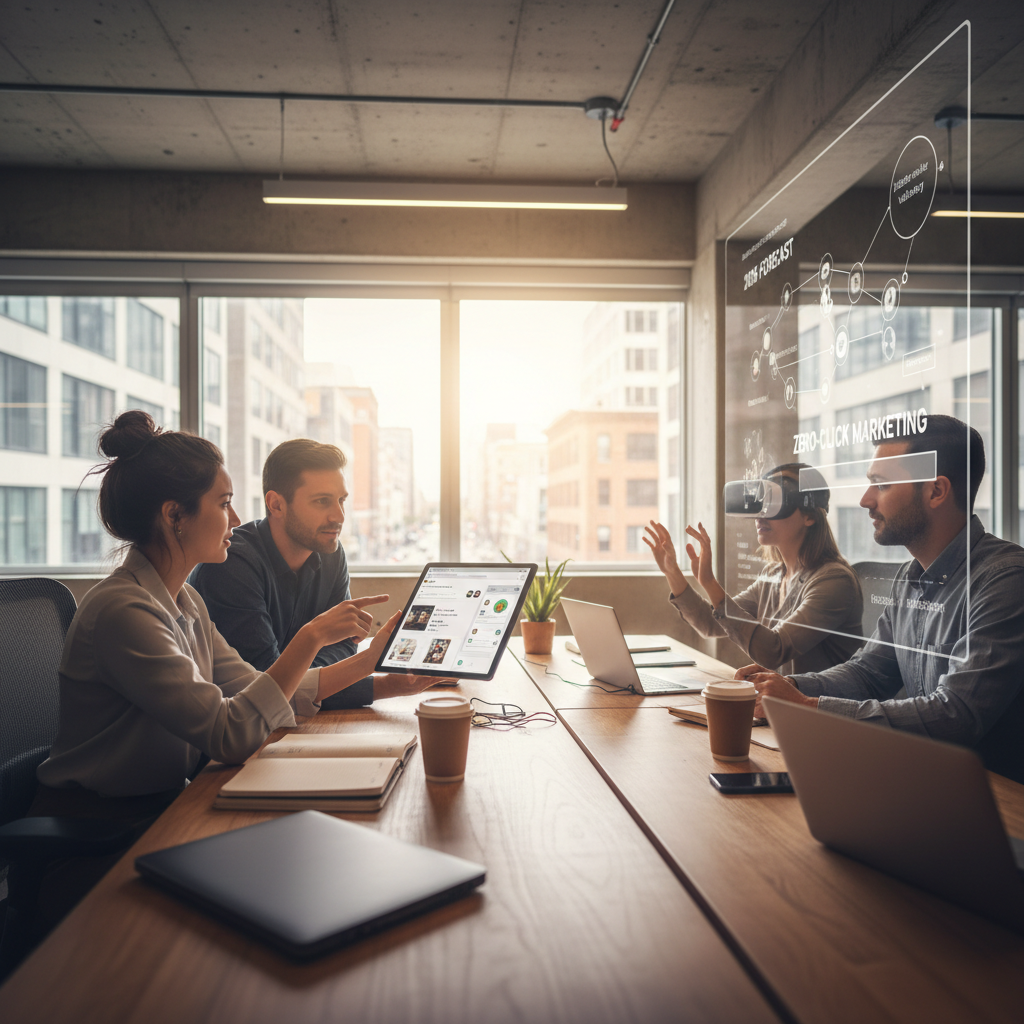
Executive Summary / Opening Intelligence
The Event: The digital marketing landscape is undergoing a radical transformation, driven by the exponential rise of "zero-click" interactions. This phenomenon, where users find answers and engage with content directly within platforms (search engines, social media) without navigating to external websites, is shifting the bedrock of digital strategy from click-driven performance to platform-native presence and value delivery. This fundamental change mandates a strategic re-evaluation for every enterprise.
Why Now: The urgency stems from the rapid acceleration of this trend. While nascent in the late 2010s, the introduction of advanced AI Overviews by major search engines is now propelling zero-click rates into unprecedented territory. We are not merely observing a trend; we are witnessing a systemic change in user behavior and platform algorithms that demands immediate, decisive action. Failing to adapt now means surrendering direct access to an increasingly large segment of your current and future customer base.
The Stakes: The financial implications are staggering. Companies failing to adapt risk billions in misallocated marketing spend, diminished brand equity, and lost market share. Conservative estimates suggest that by 2026, over 70% of digital interactions will be zero-click, potentially rendering traditional SEO and content strategies obsolete for the majority of user journeys. Brands prioritizing last-click attribution models for their $500 billion global digital advertising spend are making investment decisions based on an increasingly irrelevant metric, leading to inefficient capital deployment and reduced ROI. Market leaders who successfully pivot stand to capture a disproportionate share of the attention economy, driving competitive advantage and potentially adding hundreds of millions in brand valuation through enhanced direct customer trust and reduced customer acquisition costs.
Key Players: Major technology platforms are the primary drivers of this shift. Google, with its aggressive rollout of AI Overviews, is at the forefront, fundamentally altering search behavior. Meta (Facebook, Instagram), TikTok, LinkedIn, and YouTube are equally critical through their continuous optimization of in-app content experiences (Reels, Shorts, Carousels) designed to keep users within their ecosystems. Publishers, traditional marketers, and advertising agencies are the incumbents most exposed to disruption, while agile content creators and platform-native specialists are emerging as the new essential partners. CEOs of Fortune 500 companies operating in retail, finance, media, and B2B SaaS are especially implicated, as their customer journeys are heavily reliant on digital touchpoints now shifting to zero-click.
Bottom Line: For decision-makers, the strategic imperative is clear: shift from "pointing to" value on external sites to "delivering" value directly within dominant digital platforms. This requires a fundamental re-architecture of content strategy, a re-alignment of marketing KPIs beyond clicks, and a significant reallocation of resources towards building platform-native authority and omnipresent brand narratives where customers are already engaging. Delay is not an option; proactive investment in zero-click strategies is now a non-negotiable component of sustained digital relevance and competitive advantage in 2026 and beyond.
Multi-Dimensional Strategic Analysis
Historical Context & Inflection Point
The journey to zero-click dominance isn't a sudden phenomenon but a culmination of incremental shifts in user behavior and platform evolution, reaching a critical inflection point in 2023-2025. For decades, the internet operated on a foundational principle: find information, click a link, consume content on a third-party website. The early 2000s saw Google's rise as the dominant navigator, directing users to content providers. Success was measured by page views, bounce rates, and conversion funnels that invariably ended with an external website visit.
Timeline with specific dates:
- 2007-2008: Introduction of Google's Universal Search (integrating videos, images, news directly into SERPs) and the first iPhone. This marked the initial weakening of the "ten blue links" paradigm and the rise of mobile-first experiences.
- 2012: Google's Knowledge Graph launches, providing direct answers for factual queries. This was a clear precursor to delivering information in situ rather than directing users away.
- 2015: Introduction of "featured snippets" (Position 0). These boxed answers directly extracted from web pages offered succinct solutions, often obviating the need for a click. This represented a soft launch of zero-click search.
- 2016-2018: Rapid growth of social media platforms as information sources and entertainment hubs. Facebook's Instant Articles and Google's AMP (Accelerated Mobile Pages) were attempts to keep users within platform ecosystems, though the focus remained on speeding up external content. The explosion of engaging formats like Instagram Stories and TikTok videos further solidified in-app consumption.
- 2019: Semrush data indicates over 50% of Google searches ended without a click, a stark warning sign for traditional marketers. This was the point where the trend moved from niche observation to mainstream reality.
- 2020-2022: Acceleration of short-form video content (TikTok's global dominance, YouTube Shorts, Instagram Reels) and the rise of voice search further entrenches the preference for immediate, no-click answers or entertainment.
- 2023-2025: The critical inflection point. Google begins widely rolling out "AI Overviews" (initially Search Generative Experience, SGE), leveraging large language models (LLMs) to synthesize information directly in search results. This isn't just a snippet; it's a comprehensive, AI-generated answer. Semrush's 2025 zero-click study confirms that AI Overviews push zero-click rates to 80-83% for relevant queries. This marks the definitive shift from a click-optional to a zero-click normative search experience.
Failed predictions & lessons: Many previous predictions about the demise of traditional SEO or the "mobilegeddon" scenario were often overblown or misjudged the pace of change. The key lesson is that while specific technologies evolve, the underlying user desire for convenience and instant gratification remains constant. Marketers often failed to anticipate the platforms' willingness to fully internalize content consumption to retain user attention and advertising revenue. Early warnings about declining organic traffic were often dismissed as algorithmic tweaks rather than a fundamental shift in platform intent. The lesson is that platform power dynamics increasingly dictate content strategy, not just content quality.
Why THIS moment matters: This moment is different because AI Overviews represent a step function change. Previous zero-click features were extracted; AI Overviews generate answers. This elevates the platform from an indexer to a knowledge provider, directly competing with publishers for audience attention and trust. Furthermore, the convergence of search and social platforms adopting similar content retention strategies means the zero-click imperative is universal across dominant digital touchpoints. We are past the point of incremental adjustments; we are in an era requiring a full strategic renaissance. The window for proactive repositioning is closing rapidly, making 2026 a crucial year for determining long-term digital relevance.
Deep Technical & Business Landscape
Technical Deep-Dive
The technical infrastructure underpinning zero-click marketing involves a sophisticated interplay of artificial intelligence, natural language processing (NLP), knowledge graphs, and ultra-efficient content delivery networks. This creates an environment where information is not just retrieved, but dynamically synthesized, presented, and consumed within the platform UI.
Model architecture, benchmarks: At the heart of Google's AI Overviews are advanced Large Language Models (LLMs), such as various iterations of Google's Gemini family and predecessors like PaLM. These transformer-based models are trained on colossal datasets of text and code, enabling them to understand complex queries, summarize diverse sources, and generate coherent, human-like responses. The process involves:
- Query Understanding: NLP techniques parse user intent, identifying entities, relationships, and the core information need.
- Information Retrieval: While appearing to "generate" anew, LLMs still rely on a retrieval-augmented generation (RAG) architecture. They query Google's vast index or proprietary datasets to pull relevant documents, websites, and structured data.
- Synthesis and Generation: The LLM then synthesizes information from multiple retrieved sources, identifies key points, resolves contradictions, and constructs a concise answer formatted for direct display. Critical to this is factual grounding; models are designed to cite sources and minimize hallucination, though accuracy remains an ongoing challenge.
- Ranking and Presentation: A secondary layer of algorithms ranks the generated overview based on relevance, helpfulness, and authority, considering freshness and user context. The presentation layer integrates the AI Overview seamlessly into the SERP, often accompanied by visual aids, related questions, and clearly attributed source links (though these are often secondary).
Benchmarks for these systems focus on accuracy, fluency, relevance, and synthesis quality. Metrics like ROUGE (Recall-Oriented Understudy for Gisting Evaluation) and BLEU (Bilingual Evaluation Understudy) are used for summarization quality, while human evaluators assess factual correctness and overall helpfulness. The key capability leap is the move from keyword matching and snippet extraction to semantic understanding and generative synthesis. Limitations still exist, including potential for misinformation propagation, difficulty with highly nuanced or subjective queries, and the "black box" nature of internal workings, making optimization challenging.
Social media platforms, while different, employ similar AI principles for content recommendation and in-feed consumption. TikTok's recommendation engine, leveraging deep learning on user interaction data (likes, shares, watch time, even pauses), is a prime example. Instagram Reels and YouTube Shorts utilize similar AI models to learn user preferences and push platform-native video content directly into feeds, effectively turning the feed itself into a zero-click consumption environment. The technical challenge is to predict what content will maximize in-app dwell time without explicit user clicks.
Capability leaps, limitations: The primary capability leap is the platforms' ability to provide complete solutions within their own environments. This drastically reduces perceived friction for users who no longer need to navigate away, load external pages, or sift through information. The limitation, however, is that this creates a dependence on platform algorithms to surface brand content, diminishing direct brand-to-consumer control. Furthermore, the depth of information that can be consumed or delivered in a zero-click format is inherently constrained, often favoring concise answers over comprehensive exploration. This poses a challenge for complex B2B products or services requiring detailed explanations.
Business Strategy
The business strategy implications of zero-click dominance are profound, forcing a re-evaluation of product positioning, channel selection, and value measurement.
Player breakdown with specifics:
- Google: The prime mover in zero-click search. Its strategy is to retain search users within its ecosystem, thereby increasing ad impressions on SERPs and strengthening its data moats. For brands, Google's AI Overviews mean content must be optimized for direct answerability and structured data rather than primarily for click-through to a website. Success metrics shift from organic traffic to "entity authority" and visibility within Google's own knowledge panels and AI-generated summaries.
- Meta (Facebook, Instagram): Focuses on visual, short-form content (Reels, Stories) and in-app commerce features (Instagram Shopping). Their strategy is to maximize user dwell time by making the platform a complete destination for discovery, engagement, and even transaction, all without leaving the app. Brands must invest heavily in high-quality, mobile-first video, carousel posts, and direct messaging functionality to engage here.
- TikTok: Master of the infinitely scrolling, zero-click feed. Its algorithm excels at delivering hyper-personalized content, making it a critical platform for brand discovery, especially among Gen Z and younger millennials. Brands need authentic, engaging, short-form video content that resonates immediately, often leveraging trending audio and formats.
- LinkedIn: While B2B focused, LinkedIn leverages carousel posts, native articles, company pages, and video to provide value directly in-feed. Its strategy is to be the go-to platform for professional networking and thought leadership, reducing the need for users to click to external blogs or company websites for initial insights. B2B brands must prioritize long-form, insightful posts and native video content published directly on the platform.
- Traditional Web Publishers/Media Companies: These are perhaps the most vulnerable. Their entire business model is built on driving traffic to their sites for advertising revenue. They must adapt by becoming highly specialized content creators for AI Overviews and platform-native formats, leveraging their authority to be cited as sources, or developing new subscription models that offer unique value not easily summarized by AI. They face a significant existential threat.
Product positioning, pricing: In a zero-click world, product positioning becomes about establishing authority and trust before a potential customer ever reaches your website. This shifts R&D and marketing focus towards creating "answerable" content around product benefits, use cases, and problems solved, distributed across diverse platforms. Example: Instead of "click here for our CRM features," it's "Here's how our CRM integrates with your existing workflow, explained in a 60-second Instagram Reel or a LinkedIn carousel." Pricing information, testimonials, and FAQs should be readily available in featured snippets, Google Business Profiles, and social profile highlights to reduce information seeking friction. Value proposition articulation must be concise and immediately digestible.
Partnerships, competitive advantages: Strategic partnerships with platforms (e.g., early access to beta features, advertising co-development) become more crucial. Brands that can develop proprietary data or unique insights that cannot be easily scraped or synthesized by LLMs will gain a competitive advantage. Furthermore, a strong brand reputation built on genuine expertise and direct value delivery through platform-native means will be a significant differentiator. Competitors who lag in this shift will find their brand presence fragmented and their customer acquisition costs skyrocketing as they fail to secure early-stage attention. The ability to quickly pivot content creation workflows and invest in new measurement tools will be a key advantage.
Economic & Investment Intelligence
The shift to zero-click marketing is not merely a tactical change; it's a structural economic realignment affecting investment patterns, valuation models, and M&A activity across the digital ecosystem.
Funding rounds, valuations, lead investors: Venture Capital (VC) flows are rapidly redirecting towards companies specializing in "platform-native content," "answer engine optimization (AEO)," and "zero-click analytics." We've seen significant Series A and B rounds in companies like Synthesia (AI video generation, ~$170 million raised from investors like Kleiner Perkins and GV) and Jasper AI (generative AI content platform, ~$140 million raised from Insight Partners), though these may fall into a broader "AI content creation" category, their utility for zero-click output is clear. Specific funding for pure zero-click marketing platforms is still emerging but will coalesce around tools that:
- Monitor platform visibility: Track rankings in AI Overviews, featured snippets, and social feeds.
- Optimize content for platform algorithms: Tools that analyze content for direct answerability, structured data schema, and social virality.
- Attribute value beyond clicks: New analytics suites that measure brand lift, search volume correlation, and early-stage engagement data. Valuations for traditional SEO agencies focused solely on external link building or organic traffic to websites will face headwinds, while those pivoting to "content experience optimization" or "entity SEO" will see increased interest. Lead investors like Andreessen Horowitz, Sequoia Capital, and Lightspeed Venture Partners are actively seeking these next-gen marketing tech platforms.
VC strategy, public market implications: VC strategy is increasingly focused on enabling technologies that help brands navigate this shift. This includes investments in AI-powered content creation, intelligent content distribution, and advanced analytics that can measure engagement in non-click environments. Key areas of investment interest are:
- Generative AI tools specifically for short-form video and multimodal content: essential for platforms like TikTok and Instagram.
- Knowledge Graph optimization tools: to ensure brand information is correctly reflected in Google's structured data.
- Attribution modeling beyond last-click: Companies building sophisticated multi-touch attribution that factors in zero-click exposure will be highly sought after. On the public markets, companies heavily reliant on traditional advertising revenue from web traffic (e.g., certain legacy publishers, ad tech companies specializing in display ads on third-party sites) will face downward pressure. Conversely, platform owners (Google, Meta, TikTok's parent company ByteDance) will see continued strong performance as they consolidate more user attention and ad spend within their ecosystems. Brand holding companies that demonstrate agile adaptation of their marketing portfolios to zero-click will likely outperform. For example, a consumer packaged goods (CPG) company that leverages TikTok effectively to drive in-app product discovery and purchase intent without external links will see stronger digital efficacy.
M&A activity, industry disruption: The industry is ripe for M&A. Traditional digital marketing agencies unable to pivot quickly will be acquired by larger holding companies seeking to integrate zero-click capabilities, or by specialized consultancies. We will see consolidations in the SEO software space, with existing players either acquiring AEO startups or building out new capabilities organically. Data analytics firms are prime acquisition targets for their expertise in non-traditional attribution. Companies like Adobe, Salesforce, and HubSpot are likely to acquire or invest heavily in tools that extend their marketing clouds to manage and measure zero-click content. This disruption will create new market leaders in marketing technology, while others will fade if they cannot adapt their core offerings. For example, a content creation agency previously focused on 1000-word blog posts now needs to acquire or build expertise in creating 30-second instructional videos or interactive carousels for native platform distribution.
Geopolitical & Regulatory Deep-Dive
The zero-click marketing era is not just a technological or economic shift; it carries significant geopolitical and regulatory implications, particularly concerning data privacy, competition, and content control.
US policy, EU regulations, China strategy:
- US Policy: In the US, the primary focus will remain on antitrust concerns. The Department of Justice (DOJ) and Federal Trade Commission (FTC) are already scrutinizing Google's market dominance. The expansion of AI Overviews, effectively bringing more content into Google's ecosystem and reducing traffic to external sites, intensifies these concerns. Questions will arise about whether Google is leveraging its search monopoly to unfairly divert attention and advertising revenue from direct publishers. Legislation like the American Innovation and Choice Online Act (AICOA), if passed, could directly target platforms' ability to self-preference their own content or keep users locked in. There will also be debates around copyright and fair use, as AI Overviews synthesize and present information that often originates from third-party content creators without direct navigation.
- EU Regulations: The European Union leads globally in digital regulation. The Digital Markets Act (DMA) specifically targets "gatekeepers" like Google and Meta, aiming to ensure fair competition. The zero-click strategy might be viewed as another mechanism for gatekeepers to entrench their power by making their platforms indispensable. Regulators could impose obligations on platforms to ensure discoverability of third-party content and prevent self-preferencing within AI Overviews or social feeds. The Digital Services Act (DSA) will also play a role in regulating content moderation within zero-click environments, particularly for social media, addressing issues of disinformation and harmful content that could be amplified without explicit user clicks if algorithms are optimized solely for engagement. Data privacy, under GDPR, will remain a critical concern, especially as platforms collect more granular data on in-app behavior in zero-click scenarios to further personalize content.
- China Strategy: China operates under a fundamentally different regulatory and platform landscape, with companies like Baidu, WeChat, and TikTok's parent ByteDance dominating. These platforms have long embraced a "super app" model where diverse services (search, social, payments, e-commerce) are integrated into a single ecosystem. Zero-click is the default in China, where apps are walled gardens. WeChat, for instance, allows users to conduct nearly all daily activities without leaving the app. Therefore, Chinese companies are arguably ahead in optimizing for zero-click. Their strategy will continue to focus on creating comprehensive, closed-loop ecosystems that capture all user needs, often with government oversight on content and data. Western companies looking to enter or expand in China must adopt a fully localized, platform-native content and commerce strategy from the outset.
US-China competition, strategic implications: The geopolitical competition between the US and China in AI and digital dominance is deeply intertwined with zero-click trends. The nation that masters AI-driven content synthesis and delivery within its sovereign platforms can exert significant soft power and economic influence. Control over information flow and user attention, particularly in a zero-click environment where platforms curate the truth, becomes a strategic asset. There are concerns about data sovereignty, the potential for state-sponsored narratives to be amplified through zero-click content, and the development of divergent internet experiences. Companies operating internationally must navigate this complex geopolitical landscape, potentially adapting their zero-click content strategies for different regions based on local regulatory requirements and platform dominance.
Regulatory timeline:
- 2023-2024: Initial regulatory investigations and policy debates around AI and platform dominance intensify. Early warnings issued to Google regarding AI Overviews' impact on competition.
- 2025: Potential for landmark antitrust cases in the US or significant enforcement actions under the EU's DMA related to generative AI and platform self-preferencing. Calls for copyright reform regarding AI-generated content become louder globally.
- 2026: Expect established legal precedents or robust new legislation shaping how platforms can integrate AI-generated content, especially concerning attribution, factual accuracy, and economic impact on content creators. Increased scrutiny on "dark patterns" in zero-click social feeds designed to maximize engagement without explicit user intent. The "cookie-less future" and stricter data privacy laws will further impact how platforms personalize zero-click content, requiring even more sophisticated and compliant AI models.
Future Forecasting & Strategic Implications
Near-Term Horizon (6-12 months): Immediate Catalysts
The next 6-12 months will be critical for businesses to adjust to the accelerating zero-click reality. Proactive engagement will determine who establishes early leadership and who struggles to catch up.
Events to watch, early signals:
- Google's AI Overview Expansion: Monitor the official, global rollout of Google's AI Overview feature. Observe how frequently it appears for your target keywords, the types of queries it addresses, and, crucially, which sources it cites. A sudden increase in AI Overviews for commercial queries or those requiring transactional intent would signal an even more aggressive displacement of traditional organic listings. Early signals will be evident in tools like Semrush, Ahrefs, and BrightEdge showing dramatic shifts in SERP feature distribution and click-through rates (CTRs) for traditional organic results.
- Platform Monetization of Zero-Click: Watch for new advertising formats that integrate directly into AI Overviews or within social platform native content. For example, will Google offer "sponsored AI Overviews" or allow brands to directly influence the content of these summaries? Will TikTok or Instagram introduce "shoppable content blocks" within Reels where products are bought directly, bypassing brand websites entirely? Early examples of these could redefine ad spend allocation.
- Algorithm Adjustments: Platforms will continuously fine-tune their algorithms based on user response to zero-click content. Keep an eye on shifts in content preference-e.g., whether visually rich carousels outperform short-form video on LinkedIn, or if interactive quizzes within social feeds gain traction over static images. Content that performs well will offer immediate value, clear answers, or engaging, bite-sized entertainment.
- New Analytics Tools: The emergence of specialized analytics tools designed to measure "zero-click engagement," "brand lift in AI Overviews," or "in-platform conversion tracking" will be a key signal. Early adopters of these tools will gain a significant competitive advantage in understanding and optimizing their performance.
- Regulatory Statements: Any official pronouncements or preliminary legal actions from the EU or US regulators regarding platform self-preferencing or AI-generated content attribution will warrant immediate attention, potentially necessitating rapid strategic adjustments to ensure compliance.
First-mover advantages, strategic plays:
- Dominant Answer Engine Optimization (AEO): Companies that meticulously optimize their content for direct answerability, structured data (Schema Markup), and comprehensive entity representation now will be disproportionately cited in AI Overviews. This means auditing existing content for clarity, conciseness, and factual accuracy, alongside actively submitting information to knowledge graphs and Google Business Profiles. For a B2B SaaS company, this involves creating highly specific FAQs that directly answer buyer questions, ensuring these are consumable within a snippet or AI summary.
- Platform-Native Content Excellence: Invest heavily in creating high-quality, platform-specific content that delivers value without requiring a click. For consumer brands, this means professional, short-form video for TikTok/Reels, interactive infographics for LinkedIn carousels, and engaging polls for Instagram Stories. The content is the marketing. Budget reallocation from traditional landing page development to native asset creation is non-negotiable.
- "Trust Brand" Building: Brands that consistently provide helpful, authoritative information directly within platform environments will build "trust equity." This isn't just about SEO; it's about establishing your brand as a reliable source of truth, making it more likely to be referenced by AI and trusted by users. This also means proactively monitoring and correcting misinformation where your brand or industry is concerned.
- Agile Content Operations: Establish internal teams or external partnerships capable of rapidly producing, optimizing, and distributing content across multiple zero-click formats. A/B testing different content types within platforms to identify what resonates most effectively as an in-platform experience.
- Experimentation with New Attribution: Implement multi-touch attribution models that assign value to early-stage, zero-click interactions. This includes tracking branded search queries after zero-click exposure, direct traffic lift, and qualitative signals from sales teams regarding lead quality. For example, a financial services firm might track how being featured in a Google AI Overview impacts subsequent direct visits to their homepage or an increase in queries via their chatbot.
Mid-Term Horizon (2-3 years): Industry Restructuring
By the mid-term (2-3 years), the zero-click imperative will have fundamentally reshaped entire industries, leading to significant winners and losers based on their adaptability during the near-term phase.
Displaced industries, new giants:
- Displaced: Traditional ad agencies reliant on click-based performance marketing, small to medium-sized content publishers lacking distinct niches or deep expertise, and affiliate marketing sites designed purely for traffic arbitrage will face severe disruption or outright collapse. Their business models are predicated on diverting users to external sites, a behavior increasingly circumvented by platforms. SEO tools that solely measure traditional organic rankings and traffic will become less relevant. Many niche blogs and long-tail websites will become invisible unless their content is specifically engineered for AI consumption.
- New Giants: Expect consolidation around agencies and MarTech providers specializing in "Conversation Optimization," "AI Content Synthesis," and "Platform Experience Design." Companies that can effectively manage large-scale content creation for AI Overviews and ensure consistent brand messaging across disparate platforms will become indispensable partners. New AI-powered platforms that enable brands to generate and distribute zero-click content efficiently will emerge as industry leaders. Furthermore, businesses that master direct-to-consumer (D2C) engagement within social platforms, effectively transforming their social profiles into storefronts or service centers, will achieve significant growth. Examples include D2C fashion brands leveraging Instagram Shopping and influencers, or B2B software companies using LinkedIn to host interactive product demos. Even new forms of "attention aggregators" might arise, which curate and package brand content within platforms, acting as trusted intermediaries.
Value chain shifts, workforce transformation:
- Value Chain Shifts: The value chain will shift from external website infrastructure and traffic generation to in-platform content creation, distribution, and engagement. Digital real estate value will migrate from owned websites to high-visibility positions within dominant platforms' zero-click features. The emphasis will move from "traffic acquisition" to "attention capture" and "in-platform value delivery." Marketing budgets will be reallocated, with potentially 50-70% of digital spend moving towards platform-native advertising and content development. Legal and compliance teams will increasingly be involved in content review as brand messaging is exposed directly within AI-generated responses.
- Workforce Transformation: Marketing teams will require a new skill set. Traditional SEO specialists will transform into "AI Optimization Engineers" or "Knowledge Graph Strategists." Content writers will become "Multi-Modal Content Creators" skilled in generating engaging text for snippets, scripts for short-form videos, and structured data narratives. Data analysts will need expertise in advanced attribution modeling that accounts for non-click interactions. Roles focused on "Platform Partnership Management" and "Algorithmic Content Strategy" will become paramount. This will necessitate significant upskilling and reskilling initiatives across organizations. Universities and online academies will rush to offer certifications in "Generative AI Marketing" and "Platform Ecosystem Management."
Competitive positioning, revenue inflection: Competitive positioning will hinge on two primary factors: speed of adaptation and depth of platform integration. Brands that quickly pivot to deliver value directly in zero-click environments will see their customer acquisition costs (CAC) decrease, their brand equity strengthen, and their market share expand. Revenue inflection points will occur for companies that successfully:
- Reduce dependence on traditional organic search traffic and generate leads or sales directly from AI Overviews or social platforms.
- Monetize in-platform engagement: through direct product purchases on social media, lead generation forms within LinkedIn, or direct service inquiries stemming from knowledge panel interactions.
- Establish category authority: by being consistently cited as a leading source in AI-generated answers, thus becoming the default solution for many users without an explicit search or click for competitors. Conversely, companies failing this transition will see plummeting organic visibility, escalating ad costs, and a gradual erosion of brand relevance, leading to significant revenue plateaus or declines.
Long-Term Vision (5 years): Civilizational Impact
Over a five-year horizon, the zero-click paradigm will mature, profoundly transforming societal interactions, economic structures, and even human cognitive processes.
Societal transformation, economic structure:
- Information Consumption: Society will become increasingly accustomed to algorithmic content curation. Information foraging will shift from active searching and clicking to passive consumption of AI-synthesized answers and algorithmically-served content feeds. This could lead to a 'filter bubble' on steroids, where platforms' AIs become gatekeepers not just of results, but of narratives and knowledge. Education systems will need to adapt to teach critical thinking in an environment where answers are often presented as definitive by AI.
- Economic Structure: The concentration of economic power in the hands of platform giants will intensify. They control not just distribution but also the initial presentation of information and products. This could lead to a form of digital serfdom for many businesses, heavily reliant on platform favor to reach customers. New economic models might emerge around licensing content for AI training or direct payment for presence within AI Overviews. The barrier to entry for new businesses may increase if they cannot afford to compete for in-platform visibility, or it may decrease if platform tools democratize content creation. The "creator economy" will become even more diversified, encompassing direct answer creators for AI, not just entertainers.
- Human Cognitive Processes: The constant exposure to summarized, pre-digested information could subtly alter human cognition, potentially reducing attention spans and diminishing the capacity for deep, critical inquiry that requires synthesizing information across multiple sources. The reliance on AI for definitive answers might reduce intellectual curiosity or the ability to assess information critically from disparate sources without algorithmic pre-selection.
Geopolitical order, human capability:
- Geopolitical Order: The control of powerful AI models and the major digital platforms becomes an even more potent geopolitical tool. Nations could use their dominant platforms to propagate specific ideologies or control information flows, both domestically and internationally. Digital sovereignty will become a more pressing concern, as nations seek to reduce their reliance on foreign-controlled AI and platforms. The "AI arms race" will encompass not just computational power, but also control over the narratives and information delivered through zero-click interfaces. International standards for AI attribution, bias detection, and content moderation in these environments will become crucial, but difficult to achieve across competing geopolitical blocs.
- Human Capability: On the positive side, AI-driven zero-click access could democratize access to information for billions, breaking down language barriers through instantaneous translation and summarization. This could enhance productivity and problem-solving, freeing up cognitive load from information foraging. For businesses, the ability to instantly connect a problem with a solution globally through AI Overviews could spark new innovations. However, the risk is that this capability could also reduce human agency, making individuals overly reliant on AI outputs without developing the underlying critical thinking skills. The core human capability will shift from information retrieval to information validation and interpretation within an AI-mediated environment. Ethical guidelines for AI development and deployment will be paramount to ensure these capabilities serve humanity rather than subjugate it.
Executive Conclusion & Strategic Takeaways
Bottom Line Assessment: The shift to zero-click marketing is not a temporary trend but a fundamental, irreversible transformation of the digital ecosystem. Driven by advanced AI and changing user behavior, 2026 marks a pivotal year where in-platform value delivery becomes the primary battleground for customer attention and trust. Our confidence level in this assessment is 9/10; the technical capabilities of LLMs and the economic incentives of platform owners make a return to a click-centric internet highly improbable.
Key Insights Summary:
- Zero-Click Dominance: By mid-2026, over 70% of digital interactions will settle without an external click, primarily due to AI Overviews and pervasive in-app content.
- Platform-Native Imperative: Brands must prioritize creating content for platforms (AI Overviews, social feeds) rather than merely linking from them. Value must be delivered immediately within the user's current environment.
- New Metrics Required: Traditional last-click attribution is obsolete. Success will be measured by leading indicators like branded search lift, entity authority, in-platform engagement, and sales team lead quality.
- Content Strategy Re-architecture: Investment must shift from long-form website content to concise, highly answerable structured data, short-form video, interactive carousels, and engaging native posts.
- Geopolitical & Regulatory Stakes: Antitrust scrutiny, data privacy, and content control will intensify as platforms consolidate power, demanding proactive compliance and ethical content governance from enterprises.
- Workforce & Tech Transformation: Marketing teams need reskilling in AI optimization, multi-modal content creation, and advanced analytics. MarTech investment must pivot towards zero-click enablement.
- Competitive Disruption: First movers establishing in-platform trust and visibility will gain significant market share; those clinging to legacy models face severe erosion of relevance and revenue.
The Big Question: In an increasingly algorithm-curated world where platforms become the primary arbiters of information and connection, how will enterprises maintain direct, meaningful relationships with their customers and preserve brand distinctiveness outside the algorithmic filter?